
The Fed's T-Bill Purchases: A New QE Disguise and the Risks of Inflation and Asset Bubbles
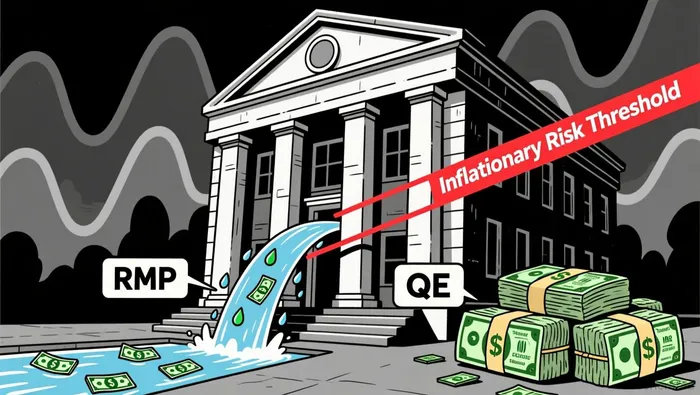
The Federal Reserve's recent foray into purchasing Treasury bills under its Reserve Management Purchases (RMP) program has reignited debates about the boundaries of monetary policy. While the Fed insists these purchases are distinct from quantitative easing (QE), the broader economic context-marked by high fiscal deficits, loose monetary conditions, and persistent inflation-suggestς otherwise. The RMP program, aimed at maintaining "ample" bank reserves and avoiding liquidity crises, risks blurring the line between technical liquidity management and inflationary stimulus. This article argues that the Fed's actions, though technically different from past QE, operate within a framework that amplifies inflationary pressures and asset price distortions, threatening to inflate dangerous bubbles.
The Mechanics of RMP vs. QE: A Delicate Distinction
The Fed's RMP program involves monthly purchases of Treasury bills, potentially up to $45 billion, to offset liquidity imbalances caused by the Treasury's short-term debt issuance and seasonal funding needs. Unlike QE, which historically targeted longer-term assets like mortgage-backed securities (MBS) and Treasuries to lower long-term yields and stimulate investment, RMP is explicitly a liquidity management tool. The Fed's 2025 Monetary Policy Report underscores that RMP is consistent with inflation-moderating goals, as it allows for a slower balance sheet runoff while keeping the federal funds rate steady.
However, the distinction between RMP and QE is increasingly tenuous. Critics argue that the Fed's actions, while technically confined to short-term assets, operate within a broader context of loose monetary and fiscal policy. For instance, the post-COVID-19 QE programs, which included large-scale MBS purchases, directly fueled housing market inflation-a sector still contributing to elevated overall inflation. Similarly, the RMP program, combined with ongoing fiscal deficits, and a $3 trillion projected 2025 deficit, risks creating a "wealth illusion" where asset prices rise despite weak real economy fundamentals.
Inflationary Pressures: A Legacy of QE and Fiscal Profligacy
The inflationary effects of QE are well-documented. Studies indicate that QE generates two to four times more inflation than conventional monetary policy, with statistically significant impacts in both the UK and the US. The post-2020 surge in inflation, for example, was driven by a combination of fiscal stimulus and QE, which compressed capitalization rates and inflated asset prices. While the Fed's RMP program does not directly target long-term yields, its existence within a landscape of high deficits and accommodative policy creates a similar dynamic.
A critical concern is the interplay between monetary and fiscal policy. With the federal government's fiscal deficit projected to reach $3 trillion in 2025, the Fed faces political pressure to sustain asset prices and lower treasury yields. If treasury yields rise sharply, it could trigger a sell-off in asset markets and exacerbate inflation, as higher borrowing costs ripple through the economy. This scenario mirrors the 2020-2022 period, when the Fed's QE programs were used to stabilize markets and support fiscal spending, inadvertently fueling inflation.
Asset Bubbles: The Hidden Cost of Policy Coordination
The most insidious risk lies in the creation of asset bubbles. The Fed's RMP program, while technically a liquidity intervention, contributes to a broader environment where asset prices are decoupled from fundamentals. For example, the valuation of major tech companies has soared to levels that defy traditional economic metrics, creating a wealth illusion that masks underlying economic fragility. This trend is exacerbated by the Fed's dual mandate, which prioritizes maximum employment and price stability but often overlooks the distortions in capital markets caused by prolonged accommodative policy.
The housing market provides a cautionary tale. During the post-COVID-19 period, the Fed's MBS purchases directly inflated home prices, which became a major driver of inflation. Even as other sectors cooled, shelter inflation remained stubbornly high, complicating the Fed's inflation-targeting efforts. A similar dynamic could emerge with the RMP program, as short-term liquidity injections indirectly support asset prices and delay necessary corrections in overvalued sectors.
Policy Implications and the Path Forward
The Fed's current approach reflects a precarious balancing act. On one hand, it seeks to avoid the liquidity crises of 2019 by maintaining ample reserves. On the other, it risks normalizing inflationary expectations and asset price distortions. The political stakes are high: higher treasury yields threaten both asset prices and government spending, creating a self-reinforcing cycle of monetary and fiscal accommodation.
Looking ahead, the Fed may face a difficult choice. If inflation remains stubbornly high and treasury yields rise, it could be forced to resume full-scale QE-a move that would further inflate asset bubbles and deepen economic fragility. Alternatively, a more aggressive tightening of monetary policy could trigger a market correction, particularly in sectors reliant on low interest rates. Either path underscores the need for a reevaluation of the Fed's policy framework, which has been criticized for its delayed response to inflation and its reliance on asset price inflation to mask real economy weaknesses according to experts.
Conclusion
The Fed's RMP program, while technically distinct from QE, operates within a broader context that amplifies inflationary and asset bubble risks. The interplay of loose monetary policy, expansive fiscal deficits, and a political imperative to sustain asset prices creates a fragile economic mirage. As the Fed navigates this landscape, it must confront the uncomfortable truth that its interventions, however well-intentioned, may be sowing the seeds of future instability. The challenge lies not only in managing liquidity but in rethinking the very framework that has allowed monetary and fiscal policy to become tools of speculative finance rather than economic stability.







Comentarios
Aún no hay comentarios