
European Principal Traders Seize U.S. Prime Brokerage Market: Navigating Regulatory Shifts and Tech-Driven Advantages
The U.S. prime brokerage market, a cornerstone of global financial services, is undergoing a seismic shift. With assets under management exceeding $1.5 trillion, European principal traders are positioning themselves to capture market share through strategic advantages rooted in regulatory reforms, advanced risk management, and technological innovation. Amid the U.S. T+1 settlement transition, the EU's Anti-Money Laundering Act (AMLA), and surging demand for derivatives like CME's E-Micro futures, European firms are uniquely poised to challenge U.S. dominance. Investors should prioritize those with robust cross-border compliance frameworks, tech-driven execution capabilities, and agile risk management systems to capitalize on this structural realignment.
The T+1 Revolution: A Catalyst for European Operational Excellence
The U.S. shift to T+1 settlement in May .24 compressed deadlines for trade affirmation and settlement, requiring European firms to modernize systems and processes. While this initially posed operational challenges—such as meeting U.S. time zone requirements and reducing manual interventions—the reforms have become a proving ground for European firms. Those that invested in automation tools like DTCC's CTM and M2i, and optimized straight-through processing (STP), now hold a distinct edge.
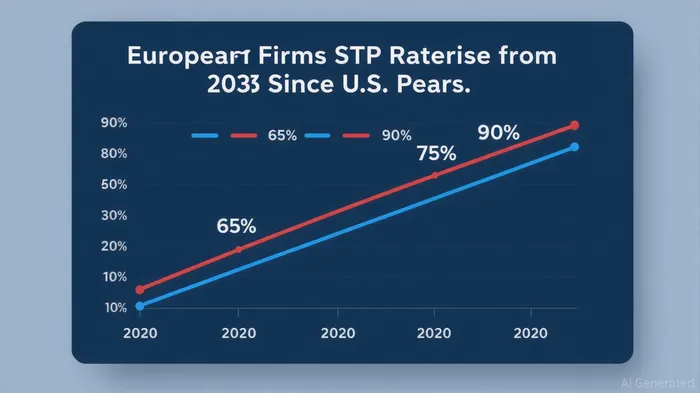
The EU's planned T+1 adoption by 2027 will further solidify this advantage. Firms like Deutsche BankDB-- and Société Générale, which have already reengineered post-trade workflows, can replicate their systems across borders. For investors, this operational rigor translates into lower execution costs and reduced settlement risk—a critical selling point in a market where prime brokers compete on speed and reliability.
AMLA Compliance: A Double-Edged Sword Turned into a Competitive Weapon
The EU's AMLA, effective July 2021, has harmonized anti-money laundering (AML) standards across member states, creating a single rulebook for financial institutionsFISI--. While compliance demands are stringent—requiring real-time monitoring of beneficial ownership data and suspicious transaction reporting—European firms have turned this into a competitive moat.
- Cross-Border Synergy: AMLA's centralized database of beneficial owners and unified reporting standards reduce the complexity of managing U.S. prime brokerage clients. This aligns with evolving U.S. regulations, such as FinCEN's 2026 rule extending AML obligations to investment advisers.
- Risk Mitigation: Over 60% of European firms have deployed AI-driven analytics to monitor transactions in real time, enabling proactive detection of illicit flows. For CMECME-- E-Micro futures—a popular tool for retail and institutional investors—this means lower reputational risk and smoother integration into U.S. markets.
Investors should favor firms like HSBCHSBC-- and UBSUBS--, which have invested in AI platforms to streamline AML checks. Their ability to offer low-risk, high-compliance services to U.S. clients positions them to win mandates in a post-AMLA world, where fines for non-compliance can exceed $1 billion.
The Rise of E-Micro Futures: A Market European Firms Are Designed to Dominate
CME's E-Micro futures—smaller, more accessible derivatives—have surged in popularity, with volumes up 40% since 2023. European firms, accustomed to fragmented regulatory environments and multi-currency operations, are well-suited to serve this niche.
- Tech-Driven Execution: European traders leverage advanced algorithms and low-latency systems to manage high-volume E-Micro trades, a capability honed through cross-border settlement expertise.
- Derivatives Know-How: With experience in navigating EU MiFID II and AMLA requirements, European firms can offer E-Micro products with embedded compliance features, appealing to U.S. clients wary of regulatory overreach.
Investment Thesis: Allocate to Firms with Cross-Border DNA
The convergence of T+1, AMLA, and derivatives demand creates a clear investment roadmap:
- Operational Agility: Prioritize firms with STP rates above 85% and post-settlement failure rates below 5%.
- Compliance Strength: Look for firms with AI-driven AML systems and participation in EU-U.S. regulatory dialogue (e.g., the EU T+1 Industry Committee).
- Derivatives Expertise: Target firms with market share in E-Micro futures and other structured products, such as Credit Suisse or BNP Paribas.
Conclusion: The New Financial Order Favors the Prepared
The U.S. prime brokerage market is no longer a closed arena for domestic players. European firms, armed with regulatory harmonization expertise, advanced technology, and a global mindset, are primed to capture a larger slice of the $1.5 trillion pie. Investors ignoring these structural shifts risk missing out on a decade-defining opportunity. The winners will be those who blend compliance rigor with execution excellence—a combination Europe's top traders have mastered.





Comentarios
Aún no hay comentarios