
EU's Strategic Shift on VW EV Tariffs: Implications for China-EU Trade and EV Market Access
The European Union's evolving approach to electric vehicle (EV) tariffs targeting Chinese automakers has become a focal point of geopolitical and economic tension, with Volkswagen (VW) at the center of a complex web of trade dynamics. As the EU seeks to balance climate ambitions, industrial resilience, and strategic autonomy, its policies are reshaping the global EV landscape-and testing the limits of its economic diplomacy with China.
The Limits of Tariffs: A Mixed EU Strategy
The EU's imposition of tariffs on Chinese EVs-ranging from 17% to 45%-was designed to counter perceived price distortions from Chinese subsidies according to a Merics brief. However, these measures have proven only partially effective. Chinese EV brands such as BYD and XPENGXPEV-- have circumvented tariffs by exporting plug-in hybrids and expanding their market share in the EU to 7.6% by the first eight months of 2025. This resilience reflects China's broader strategy to manage overcapacity in its automotive industry while adapting to European consumer preferences, including a shift toward premium segments according to Bruegel analysis.
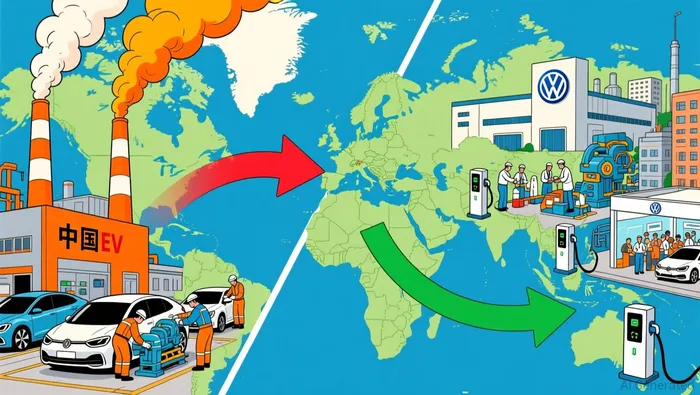 The EU's response has grown more sophisticated. Policymakers are now considering price floors, local content requirements, and security-based restrictions to protect domestic automakers according to Merics research. Yet, as one expert notes, "these tariffs may only moderately reduce the price competitiveness of Chinese EVs in the West," with China likely to retaliate through its own trade barriers according to a ScienceDirect study. Such a scenario could escalate tensions, particularly as Chinese automakers announce plans to localize production in Europe by 2028 according to Reuters commentary.
Volkswagen's Strategic Rebalancing
Volkswagen, a key player in the EU's EV transition, faces a dual challenge: navigating the EU's trade policies while competing with Chinese rivals. The company has warned of potential losses of up to €5 billion due to tariffs and retaliatory measures from China. In response, VW has launched a €10-billion cost-cutting program by 2026, focusing on streamlining production and accelerating software development according to business reporting.
Simultaneously, VW is leveraging its "in China for China" strategy to reduce EV development costs by up to 50% through local supply chains and faster innovation cycles. This approach has enabled the company to export Chinese-developed EVs to Southeast and Central Asia, though it has ruled out European markets due to regulatory differences. Such moves highlight VW's attempt to hedge against trade uncertainties while maintaining its competitive edge in the global EV race.
Geopolitical Implications and EU Economic Security
The EU's strategic shift extends beyond tariffs. A new economic security doctrine, unveiled in December 2025, aims to address dependencies on critical raw materials and technologies, including those controlled by China according to EuroNews reporting. This doctrine emphasizes de-risking supply chains, tightening foreign investment scrutiny, and promoting domestic capabilities in semiconductors and EV batteries according to Politico analysis. Germany, once a champion of free trade, now advocates for "protection for strategic industries," reflecting a broader EU pivot toward economic resilience according to Reuters reporting.
However, this approach carries risks. Chinese investments in EU EV and battery sectors-while offering opportunities for scaling production and decarbonization-raise concerns about market distortions and data security according to SCMP analysis. The EU's conditional state aid and procurement criteria aim to align foreign investments with its climate and security goals, but the effectiveness of these measures remains untested according to Bruegel policy brief.
Investment Opportunities in a Fragmented Market
For investors, the EU's EV sector presents both opportunities and uncertainties. European automakers like VW, Renault, and Stellantis are leveraging brand heritage and consumer loyalty to defend market share according to Bruegel analysis. Meanwhile, the EU's push for local content requirements and green hydrogen initiatives could create fertile ground for domestic EV supply chains according to Merics research.
Yet, the sector's success hinges on coordinated policy action. As one analysis warns, "European policymakers and manufacturers have a window of opportunity to adapt, but only if they act in a coordinated and strategic manner" according to Bloomberg reporting. This includes addressing bottlenecks in battery production, accelerating charging infrastructure, and fostering cross-border collaboration.
Conclusion: A Delicate Balance
The EU's strategic shift on EV tariffs underscores the tension between open markets and strategic autonomy. While tariffs and economic security doctrines aim to protect domestic industries, they also risk deepening trade frictions with China. For Volkswagen and other European automakers, the path forward requires agility in navigating these dynamics while investing in innovation and localization.
As the global EV race intensifies, the EU's ability to balance trade, climate, and geopolitical goals will determine not only its industrial competitiveness but also the stability of its economic relationship with China. Investors must remain attuned to these evolving dynamics, recognizing that the future of the EV market will be shaped as much by policy as by technology.







Comentarios
Aún no hay comentarios