
The Erosion of Retirement Security: Assessing the 2026 Medicare Premium Hikes and COLA Limitations
The financial resilience of retirees in the United States is increasingly under threat from a widening gap between rising healthcare costs and modest adjustments to Social Security benefits. As 2026 approaches, the interplay between Medicare premium increases and the Cost-of-Living Adjustment (COLA) reveals a troubling trend: healthcare inflation is outpacing income growth for older Americans, eroding their purchasing power and forcing a reevaluation of retirement planning strategies.
According to the Centers for Medicare & Medicaid Services, the standard monthly premium for Medicare Part B will rise to $202.90 in 2026, a 9.7% increase from $185.00 in 2025. This hike is starkly at odds with the 2.8% COLA for Social Security benefits, which will add approximately $56 per month to retirees' incomes. For most beneficiaries, this means that nearly one-third of their COLA increase will be offset by higher Medicare premiums. The situation is even more dire for high-income individuals, as those earning above $109,000 (for singles) or $218,000 (for couples) will face income-related monthly adjustment amounts (IRMAA), pushing their Part B premiums as high as $689.90.
This imbalance is not merely a statistical anomaly but a systemic challenge. Data from the Social Security Administration indicates that the average retiree's Social Security check will rise by $56 monthly, while their healthcare costs will surge by $17.90 for Part B alone. When combined with a 10% increase in the Part B annual deductible (from $257 to $283), the financial strain becomes evident. For retirees on fixed incomes, these costs represent a growing share of their budgets, leaving less room for other essentials such as housing, food, and leisure.
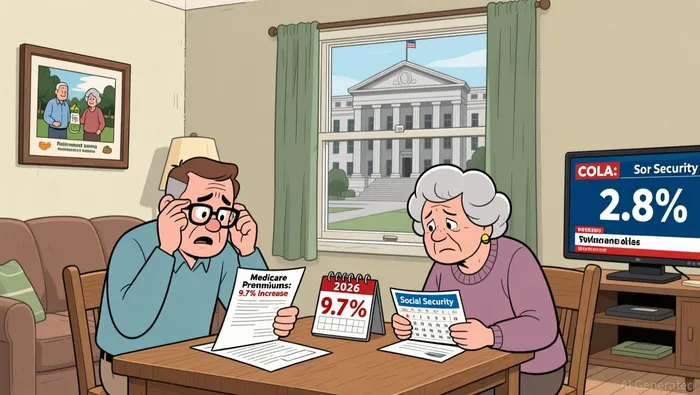 . The disparity is further exacerbated by the uneven nature of healthcare cost inflation. While Medicare Advantage and Part D premiums are projected to decline slightly in 2026-averaging $14.00 and $34.50 per month, respectively-these reductions do little to counteract the sharp rise in Part B premiums. The result is a fragmented landscape where retirees must navigate complex trade-offs between coverage options, deductibles, and out-of-pocket expenses.
For high-income beneficiaries, the challenges are compounded. The IRMAA surcharges, which adjust premiums based on modified adjusted gross income (MAGI) from two years prior, create a feedback loop: higher income leads to higher premiums, which in turn reduces net savings and retirement flexibility. This dynamic underscores the importance of strategic income timing and tax planning, as retirees seek to minimize exposure to these surcharges while preserving capital.
The Medicare Open Enrollment period (October 15–December 7, 2025) offers a critical window for beneficiaries to reassess their coverage. However, the complexity of plan choices and the rapid pace of premium changes demand proactive engagement. Retirees must weigh not only current costs but also long-term healthcare inflation trends, which have historically outpaced general inflation.
The implications for retirement portfolios are profound. Traditional models of retirement savings, which assume a stable or gradually increasing ratio of healthcare costs to income, are no longer reliable. Instead, retirees must adopt a more dynamic approach, incorporating healthcare inflation modeling into their asset allocation and withdrawal strategies. This includes prioritizing tax-efficient accounts, leveraging health savings accounts (HSAs) where possible, and diversifying income streams to buffer against premium volatility.
In conclusion, the 2026 Medicare premium hikes and limited COLA adjustments highlight a systemic vulnerability in the U.S. retirement system. As healthcare costs continue to rise faster than Social Security benefits, retirees face a stark reality: financial resilience requires not only prudent savings but also a sophisticated understanding of policy-driven cost dynamics. For policymakers and financial advisors alike, the challenge is clear-to design solutions that align healthcare affordability with the realities of an aging population.







Comentarios
Aún no hay comentarios