
The Erosion of Federal Reserve Independence and the Rebalancing of Global Capital
The Federal Reserve, long revered as the gold standard of central bank independence, now faces an existential threat. The escalating confrontation between President Donald Trump and Chair Jerome Powell-marked by legal intimidation, constitutional challenges, and explicit demands for policy capitulation-has exposed a dangerous fragility in the separation of monetary and political power. This crisis is not merely a domestic political drama; it is a seismic shift with profound implications for global markets, inflation expectations, and the credibility of U.S. economic governance.
The Assault on Central Bank Autonomy
According to a report by , Trump's repeated threats to fire Powell and his ongoing Supreme Court challenge to the Fed's independence signal a deliberate campaign to subordinate monetary policy to short-term political goals. The Justice Department's alleged investigation into Powell's congressional testimony and the Fed's headquarters renovation further compounds the risk of politicization. Such actions, if successful, would erode the Fed's ability to act as a countercyclical force, prioritizing instead the whims of an executive branch seeking to manipulate interest rates for electoral advantage.
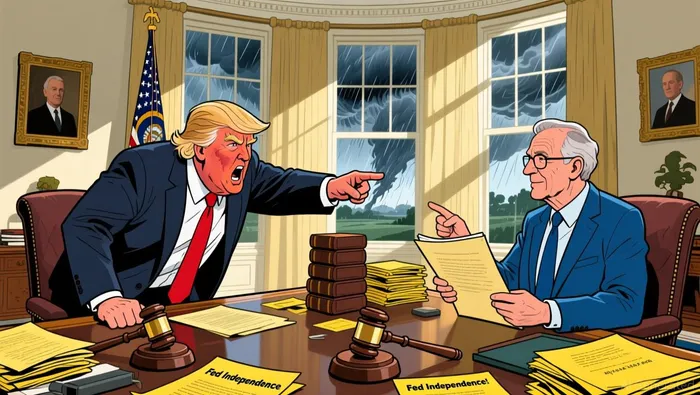 The stakes are high. A central bank constrained by political pressure is unlikely to resist inflationary impulses, particularly in an environment where fiscal policy remains expansionary. As stated by , the global economy has long relied on the Fed's independence to anchor confidence in U.S. financial assets. If this trust is undermined, the consequences could include a self-fulfilling rise in inflation expectations, higher long-term borrowing costs, and a reordering of capital flows away from the dollar.
Market Responses: Hedges Against Uncertainty
Investors are already pricing in these risks. Gold, traditionally a barometer of systemic uncertainty, has surged to record highs, reaching $4,621.38 an ounce in January 2026 as fears of Fed politicization intensified. This trend reflects a broader reallocation toward inflation-linked assets, including Treasury Inflation-Protected Securities (TIPS) and hard currencies.
Emerging markets hard currency debt (EMD HC), for instance, has gained traction as a diversification tool. As noted by , EMD HC offers structural resilience and attractive yields amid U.S. fiscal fragility and a weakening dollar. Meanwhile, the appeal of non-U.S. assets-particularly in China and other emerging economies- has grown as investors seek to hedge against the volatility of a Fed potentially swayed by political agendas.
The Long-Term Risks to U.S. Credibility
The most insidious threat lies in the erosion of the Fed's credibility. If the market perceives the central bank as a political pawn, its ability to manage inflation expectations will falter. Historical precedents, such as the Latin American debt crises of the 1980s, demonstrate how loss of central bank independence can trigger hyperinflation and capital flight. While the U.S. economy is not in immediate danger of such extremes, the long-term damage to its financial primacy could be irreversible.
Moreover, the Fed's independence has been a cornerstone of global monetary cooperation. A U.S. central bank beholden to political expediency would destabilize the delicate balance of international capital flows, potentially triggering a fragmentation of global markets. observed, Trump's defiance of Fed autonomy has already caught policymakers off guard, highlighting the uncharted territory into which we are drifting.
Investment Recommendations
For investors, the imperative is clear: rebalance portfolios to mitigate exposure to a U.S. dollar and bond market increasingly vulnerable to political interference. Gold remains a compelling hedge, with its recent rally underscoring its role as a store of value in times of institutional uncertainty. Inflation-linked bonds, particularly those issued by emerging markets with stronger fiscal discipline, offer another layer of protection.
Hard currencies, especially those tied to economies with stable monetary frameworks (e.g., the Swiss franc, the Canadian dollar), should also feature prominently. Diversification into EMD HC is prudent, given its resilience and yield advantages. At the same time, investors should remain cautious about overexposure to U.S. Treasuries, whose perceived safety may be increasingly illusory.
Conclusion
The battle for the Federal Reserve's independence is not just a test of American democracy; it is a pivotal moment for global capital. The Fed's autonomy has long been a pillar of economic stability, and its erosion would reverberate far beyond U.S. borders. Investors must act now to safeguard against a future where monetary policy is no longer guided by data and expertise but by political convenience. The markets are already voting with their wallets-will you follow?







Comentarios
Aún no hay comentarios