
U.S. Equity Market Resilience Amid Protectionist Policy Shifts: Sector-Specific Opportunities in Industrials and Defense
The United States has long been a paradox in global economic history: a champion of free trade while periodically embracing protectionism to safeguard its industrial and defense might. In 2025, this duality has sharpened. The Trump administration's renewed emphasis on tariffs—ranging from steel and aluminum to pharmaceuticals and heavy trucks—has reshaped the landscape of U.S. equity markets. While critics decry these policies as a return to the self-defeating logic of the 1930s, the industrials and defense sectors are emerging as unexpected beneficiaries. This analysis explores how protectionist measures are creating both opportunities and vulnerabilities, with a focus on the interplay between policy, market dynamics, and long-term resilience.
The Industrial Sector: A Tale of Two Forces
The U.S. industrials sector has been thrust into a dual narrative. On one hand, tariffs on imported materials—such as the 25% levy on heavy trucks and the 100% tariff on patented pharmaceuticals—have imposed cost pressures on foreign competitors, creating a tailwind for domestic manufacturers. For instance, the furniture and automotive sectors have seen domestic producers gain market share as import-reliant rivals face margin erosion [2]. According to a report by Bloomberg, net absorption in the U.S. industrial real estate market hit a post-2023 peak in Q1 2025, driven by companies expanding facilities to meet surging demand for domestically produced goods [5].
Yet these gains are not without caveats. The same tariffs that protect domestic industries also disrupt supply chains. The Department of Defense's recent struggles to secure affordable steel for naval shipbuilding underscore this tension. A 2025 study by Forecast International notes that U.S. shipyards are grappling with price volatility and supply shortages, complicating the Navy's goal of expanding its fleet to meet AUKUS commitments [1]. This paradox—protectionism as both a shield and a sword—highlights the fragility of a strategy that prioritizes short-term gains over systemic resilience.
Defense: A Strategic Rebalancing
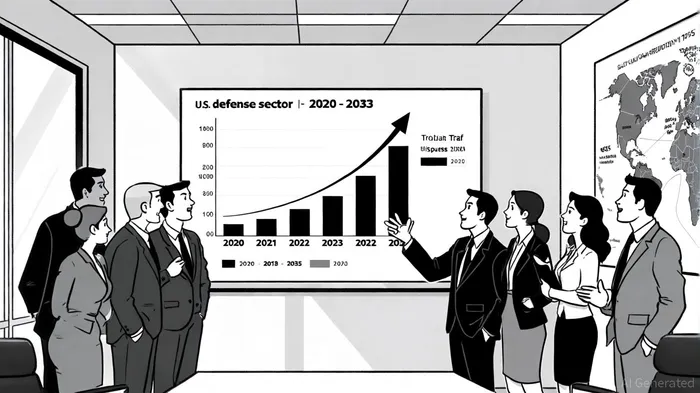
The defense sector, however, appears to be the most direct beneficiary of the protectionist turn. With the Pentagon's National Defense Industrial Strategy emphasizing the need to revitalize domestic production, companies like Lockheed MartinLMT-- (LMT), Raytheon Technologies (RTX), and Northrop GrummanNOC-- (NOC) are poised to capture a larger share of government contracts. A 2025 defense industry report from Yahoo Finance projects a 7% annual growth rate for the U.S. defense market through 2033, driven by modernization efforts in artificial intelligence, cybersecurity, and drone technology [2].
The rationale for this growth is twofold. First, the U.S. government is increasingly insourcing critical capabilities. For example, the Army's new “right to repair” policy, which allows it to maintain its own equipment without relying on intellectual property constraints, is expected to reduce costs and accelerate deployment timelines [1]. Second, tariffs on foreign imports—such as the Section 232 investigations into commercial aircraft and jet engines—have created a more level playing field for domestic aerospace firms. BoeingBA-- (BA), for instance, could see a surge in both government and commercial orders if tariffs on foreign aircraft components are sustained [3].
However, the defense sector's reliance on global supply chains remains a vulnerability. The U.S. imports over 80% of its rare earth elements from China, a dependency that protectionist policies alone cannot resolve [1]. As the CSIS warns, rigid domestic content requirements risk stifling innovation by limiting access to cutting-edge commercial supply chains [6]. This tension between strategic autonomy and economic efficiency will define the sector's trajectory in the coming years.
The Risks of a Protectionist Path
While the industrials and defense sectors are thriving under current policies, the broader economic implications are troubling. Data from Harvard's Center for International Development reveals that U.S. tariffs have already triggered retaliatory measures from trade partners, including France's proposed “Buy European” initiatives [6]. Such tit-for-tat policies risk fragmenting global trade, echoing the catastrophic precedents of the Smoot-Hawley era [4].
Moreover, the long-term sustainability of protectionism is questionable. As Dr. Kalim Siddiqui argues in World Financial Review, the U.S. is using its economic hegemony to reshape global trade norms, but this approach may backfire by accelerating the rise of alternative trade blocs [3]. For investors, this means that while short-term gains in industrials and defense are tangible, the broader market faces heightened volatility from geopolitical and regulatory shifts.
Conclusion: Navigating the New Normal
The U.S. equity market's resilience in 2025 is a testament to the adaptability of its industrial and defense sectors. Yet this resilience is contingent on a narrow set of conditions: continued government spending, manageable supply chain disruptions, and a lack of widespread retaliatory tariffs. For investors, the key lies in balancing exposure to near-term beneficiaries—such as aerospace and shipbuilding firms—with hedging against the systemic risks of a fractured global trading system.
As the world grapples with the consequences of protectionism, one truth remains clear: markets thrive on stability, not conflict. The challenge for policymakers and investors alike is to harness the momentum of industrial revitalization without repeating the mistakes of the past.





Comentarios
Aún no hay comentarios