
Enovix: A High-Risk, High-Reward Bet in the AI-Powered Battery Revolution?
The rise of artificial intelligence (AI) is reshaping global energy demands, particularly in consumer electronics and electric vehicles (EVs), where power density and efficiency have become critical differentiators. At the forefront of this transformation is EnovixENVX--, a Silicon Valley-based battery innovator leveraging silicon-anode technology to address these challenges. Yet, for investors, the question remains: Is Enovix a viable long-term bet, or does its commercialization path remain fraught with unmet promises?
A Technological Leap, But Can It Scale?
Enovix's AI-1™ battery platform, launched in Q2 2025, claims to achieve a volumetric energy density of 919 Wh/L-the highest ever recorded for a smartphone battery-while enabling 3C fast-charging rates (20% charge in 3.8 minutes, full charge in 39.5 minutes). Independent validation by Polaris Battery Labs adds credibility to these claims, suggesting Enovix has overcome longstanding challenges in silicon-anode stability and cycle life. Such performance metrics are critical for AI-driven devices, where prolonged usage and rapid recharging are non-negotiable.
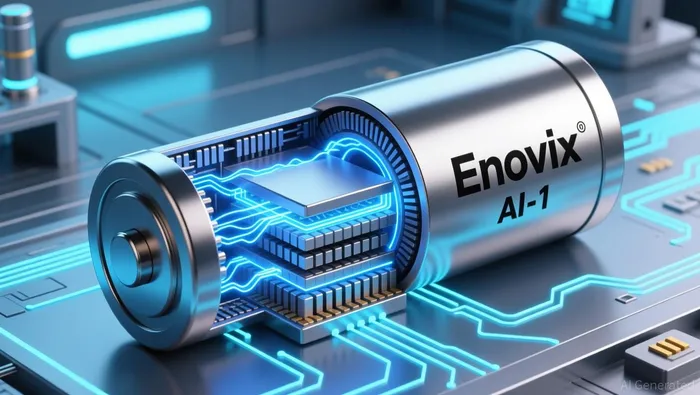
However, translating lab breakthroughs into mass production is another matter. Enovix's Penang, Malaysia, facility is ramping up to meet anticipated demand, with shipments to a third major smartphone OEM already underway and sample deliveries to seven of the top eight OEMs. These partnerships, representing approximately $9 billion of the total addressable market, signal growing industry confidence. Yet, the company's ability to maintain quality at scale remains unproven.
Financial Realities and Competitive Pressures
Despite its technological edge, Enovix operates at a loss, with significant cash burn and recent stock offerings diluting shareholder value. This financial strain contrasts sharply with its ambitious roadmap, including planned Q4 2025 smartphone battery launches and forays into the EV market. In the latter, Enovix's batteries demonstrate 10X better internal temperature gradients and 88% capacity retention after 1,500 cycles-metrics that directly challenge QuantumScape's solid-state lithium-metal alternatives. Yet, even with these advantages, the EV segment remains a high-stakes arena, where cost, safety, and regulatory hurdles loom large.
Competitive pressures extend beyond technology. Traditional lithium-ion incumbents, such as Panasonic and CATL, are also innovating, while startups like Factorial and Amprius are vying for market share. Enovix's differentiation lies in its proprietary 3D stacking architecture, which purportedly mitigates silicon's expansion issues during charging. However, without robust cost controls or pricing power, its margins could erode rapidly.
Strategic Realignments and Market Optimism
A revamped management team since 2023 has prioritized execution, focusing on commercialization over R&D. This shift aligns with the company's stated goal of capturing a "significant share" of the multi-billion-dollar smartphone battery market. Yet, optimism must be tempered by caution. While Enovix's Q2 2025 revenue surged by 98%, profitability remains elusive. For investors, the key risk lies in whether the company can bridge the gap between technical promise and sustainable profitability before competitors or market dynamics outpace it.
Conclusion: A Calculated Gamble
Enovix embodies the archetype of a high-risk, high-reward investment. Its silicon-anode technology is undeniably groundbreaking, with the potential to redefine energy storage for AI-era devices. The partnerships with leading OEMs and validated performance metrics suggest a viable path to commercialization. However, the company's financial fragility, coupled with intense competition and the inherent challenges of scaling novel technologies, cannot be ignored.
For those with a long-term horizon and a tolerance for volatility, Enovix could offer outsized returns if it successfully navigates these hurdles. Yet, for risk-averse investors, the current valuation may appear precarious, given the lack of profitability and the uncertain regulatory and competitive landscape. In the AI-powered battery revolution, Enovix is a compelling story-but one that demands rigorous scrutiny and patience.







Comentarios
Aún no hay comentarios