
Energy Sector Volatility and Refining Operations Risk: Chevron's El Segundo Fire and Market Implications
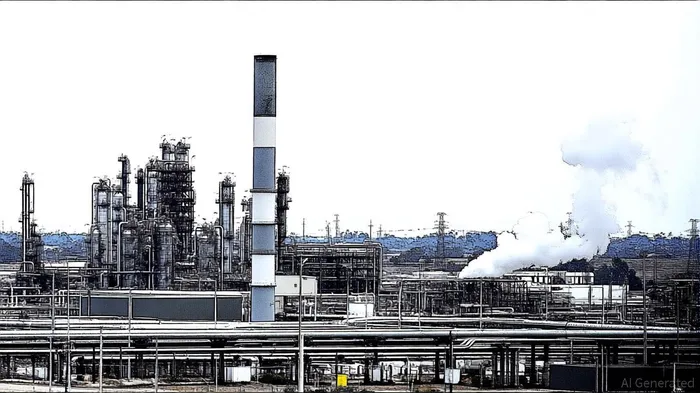
The energy sector has long been a theater of volatility, driven by geopolitical tensions, regulatory shifts, and the fragility of refining operations. Recent events at Chevron CorporationCVX-- (CVX) underscore how operational disruptions at major refiners can amplify market sentiment and create both risks and opportunities for investors. The October 2025 fire at Chevron's El Segundo refinery-a facility processing 290,000 barrels of crude oil daily and supplying 20% of Southern California's gasoline and 40% of its jet fuel-has become a case study in the sector's vulnerabilities. This incident, occurring amid already constrained fuel inventories and seasonal maintenance at other refineries, has triggered immediate price spikes and raised broader questions about the resilience of aging infrastructure.
Operational Disruptions and Market Sentiment
The El Segundo fire, though contained without injuries, disrupted critical refining units, including the Isomax 7 jet-fuel conversion system. Analysts predict a 10–25 cent-per-gallon increase in retail gasoline prices, with some forecasting jumps of up to $1.00 per gallon depending on the duration of the outage, according to a Forbes analysis. California's isolated fuel market-characterized by strict environmental regulations and limited pipeline connectivity-exacerbates such shocks. According to a Forbes report, the state's reliance on CARB-compliant gasoline and its inability to rapidly import substitutes from other regions mean that even short-term disruptions can lead to prolonged price volatility.
Chevron's stock price initially dipped in pre-market trading, but the decline was modest, reflecting investor confidence in the company's financial strength. With a Q2 2025 operating income of $1.7 billion from refining alone, according to a Business News Today report, ChevronCVX-- appears well-positioned to absorb short-term costs. However, repeated incidents-such as the 2012 Richmond refinery fire-have eroded reputational capital and raised concerns about regulatory scrutiny. As stated by Business News Today, the incident highlights the broader fragility of U.S. refining infrastructure, with at least six major refinery fires reported in 2025, according to Reuters.
Comparative Insights: ExxonMobil and Shell
To contextualize Chevron's challenges, consider the contrasting trajectories of ExxonMobil and Shell. In 2024, ExxonMobil reported $185 billion in revenue and $24 billion in net income, outpacing Chevron's $105 billion in revenue and $15.5 billion in net income, according to AnotherPocket. This disparity reflects Exxon's larger scale and integrated operations, which buffer against market volatility. Shell, meanwhile, has faced pressure to balance sustainability goals with profitability, slashing clean energy spending to close valuation gaps with peers, as reported by the Financial Times. These divergent strategies illustrate how operational resilience and capital allocation shape investor sentiment.
ExxonMobil's focus on high-margin projects-such as offshore Guyana and the Permian Basin-has reinforced its appeal to growth-oriented investors, while Chevron's $53 billion acquisition of Hess Corporation has prioritized long-term resource expansion. Yet, Chevron's recent operational hiccups, including the El Segundo fire and integration challenges from the Hess deal, have introduced short-term uncertainties. As noted by AnotherPocket, Chevron's Q4 2024 refining losses and missed earnings estimates contrast with Exxon's consistent outperformance, per a Nasdaq analysis.
Short-Term Investment Opportunities
For investors, the El Segundo incident presents a nuanced landscape. While Chevron's strong balance sheet and $6.9 billion Q2 2025 net income provide a cushion, as Business News Today noted, the fire has intensified scrutiny on its operational safety and capital expenditures. Hedge fund activity reveals mixed signals: entities like Trek Financial increased Chevron holdings by 39.2% in Q4 2025, betting on its long-term resilience, according to TipRanks, while others, including Ray Dalio's firm, exited positions entirely. Analysts remain divided, with a "hold" consensus but a "Buy" price target of $163.95, implying 3.62% upside from October 2025 levels, per Investtech.
Technical indicators also suggest potential for short-term gains. Chevron's stock is in a rising trend channel, with support at $151 and resistance at $163, and price prediction models forecast a steady climb to $199 by December 2025, according to a MarketBeat forecast. However, these projections hinge on Chevron's ability to swiftly resolve the El Segundo outage and reassure regulators and investors.
Historical backtesting of CVX's price behavior around 20-day support and resistance levels from 2022 to 2025 reveals critical insights. For resistance breakouts-when the stock closes above its 20-day high-63 such events occurred, but average cumulative returns turned negative after ~10 trading days, underperforming the benchmark by ~2.1% at 30 days. Win rates fell below 50% after day 8, suggesting trend-following strategies on breakouts have historically failed to sustain momentum. Conversely, support breakdowns-when the stock closes below its 20-day low-showed a surprising mean-reversion pattern: 43 breakdown events were followed by an average +4% excess return by day 30, with win rates rising to 70–80% after 24 trading days. This implies that contrarian strategies, such as buying dips after support failures, historically outperformed holding the benchmark over the following month.
Conclusion
The energy sector's volatility is inextricably linked to the stability of refining operations. Chevron's El Segundo fire exemplifies how localized disruptions can reverberate across markets, influencing fuel prices, investor sentiment, and strategic capital allocation. While Chevron's financial strength offers a buffer, the incident underscores the need for greater infrastructure resilience and operational transparency. For investors, the key lies in balancing short-term risks-such as price spikes and regulatory scrutiny-with long-term opportunities in an industry undergoing profound transformation.





Comentarios
Aún no hay comentarios