
Encore Capital's $400M Senior Secured Notes and Strategic Capital Allocation
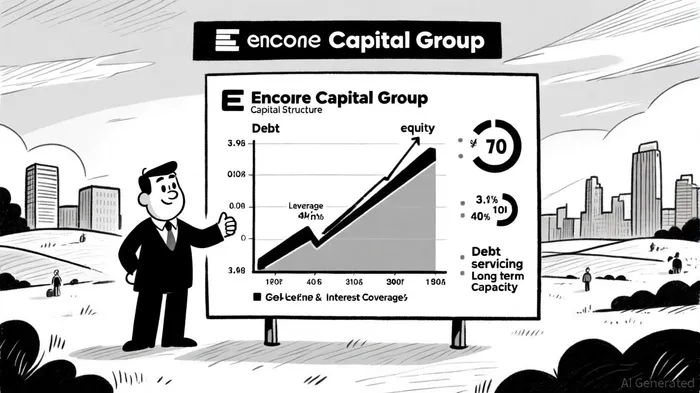
In the intricate dance of corporate finance, the allocation of capital is both an art and a science. Encore Capital Group's recent announcement of a $400 million senior secured notes offering due 2031[1] offers a compelling case study in balancing risk and return. This move, while seemingly straightforward, reveals deeper strategic considerations about capital structure optimization and long-term value creation.
The Capital Structure Puzzle
Encore's decision to issue senior secured notes reflects a deliberate effort to refinance existing debt and reduce leverage. The company's leverage ratios—Total Debt/Equity at 276.83 and Net Debt/EBITDA at 5.25[2]—suggest a capital structure heavily weighted toward debt. By using the proceeds to repay borrowings under its revolving credit facility, Encore aims to lower its floating-rate debt exposure and stabilize interest costs. This is a prudent step in an environment where refinancing risk looms large, particularly for non-investment-grade borrowers.
The notes, secured by substantially all of the company's assets and guaranteed by its subsidiaries[3], add another layer of security for creditors. However, the absence of a disclosed interest rate—a common feature in private placements—introduces uncertainty. Historical data from a 2024 offering of senior secured notes at 9.25%[4] provides a rough benchmark, but market conditions and the company's credit profile may have shifted since then.
Risk-Adjusted Returns: A Delicate Balance
Assessing the risk-adjusted returns of this offering requires a nuanced view. On one hand, Encore's interest coverage ratio—a critical metric for gauging debt servicing capacity—has improved. In Q1 2025, the company reported a 12% profit margin and $46.8 million in net income[5], up sharply from the prior year. This suggests enhanced operational efficiency, which could support higher leverage without immediate distress risk.
On the other hand, Fitch Ratings' assignment of a 'BB+ (EXP)' rating with a negative outlook[6] underscores lingering concerns. A 'BB+' rating, while above junk status, indicates a higher probability of default compared to investment-grade peers. For investors, this means the notes will likely carry a premium yield to compensate for the elevated risk. The challenge lies in determining whether this premium is sufficient to justify the additional risk, especially given the company's already high leverage.
Notably, a backtest of ENCR's performance from 2022 to the present reveals no instances of the company beating earnings expectations during this period, suggesting that the Q1 2025 beat may be an anomaly.
Strategic Implications for Long-Term Value
Encore's capital allocation strategy appears to prioritize short-term liquidity and covenant compliance over aggressive growth. By repaying its revolving credit facility, the company reduces the risk of covenant breaches and extends its debt maturity profile. This is a defensive move, but one that may limit flexibility in pursuing higher-return opportunities.
The redemption of its £300 million senior secured notes due 2026[7] further illustrates this caution. While this action will reduce near-term refinancing risk, it also locks in capital that could otherwise be deployed in growth initiatives. The trade-off here is between stability and innovation—a classic dilemma in capital structure management.
Conclusion: A Calculated Gamble
Encore's $400 million offering is a calculated gamble. It addresses immediate liquidity needs and reduces refinancing risk, but it also raises questions about the company's long-term growth trajectory. For investors, the key will be monitoring how effectively Encore balances debt reduction with strategic reinvestment. The final interest rate on the notes, once determined, will be a critical indicator of market confidence—and a barometer for the company's ability to optimize its capital structure in a high-interest-rate environment.
In the end, Encore's story is a reminder that capital structure is not a static construct but a dynamic process. The true test of its strategy will lie not in the numbers alone, but in the company's ability to adapt to an ever-changing financial landscape.





Comentarios
Aún no hay comentarios