
The Economic and Market Implications of Trump's 10% Credit Card Interest Rate Cap Proposal
The proposal to cap U.S. credit card interest rates at 10% has ignited a fierce debate, pitting consumer advocates against financial institutions. At first glance, the policy appears to promise substantial savings for borrowers, particularly those burdened by high-interest debt. Yet, as history and economic theory suggest, such interventions often entail unintended consequences. This analysis examines the potential impacts of the 10% cap on credit card industry valuation, consumer credit access, and broader market dynamics, drawing on recent data and historical precedents.
The Credit Card Industry's Revenue Structure: A Delicate Balance
The credit card industry's profitability hinges on a tripartite revenue model: interchange fees, interest charges, and ancillary fees. In 2025, interchange fees-paid by merchants to card networks-remain a dominant revenue stream, with VisaV-- and MastercardMA-- charging between 1.30% and 2.90% per transaction, while American ExpressAXP-- commands higher rates of 1.80% to 3.25%. Interest charges, meanwhile, have become increasingly lucrative as average APRs climbed to 20.97% in Q4 2025, up from 19.87% in October 2025. For cardholders who carry balances, these rates generate billions in annual revenue.
A 10% cap would directly erode this income. According to the Vanderbilt Policy Accelerator, such a cap could save consumers $100 billion annually. However, this assumes that banks would absorb the loss without adjusting other aspects of their business models. Critics argue that reduced profitability might lead to cuts in rewards programs, higher fees, or stricter credit underwriting- measures that could disproportionately harm lower-income borrowers.
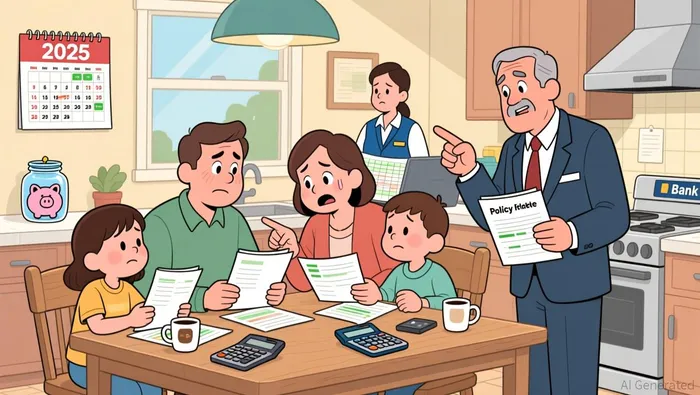
Historical Precedents: Rate Caps and Credit Access
Past experiments with interest rate caps offer cautionary tales. In Illinois, a 36% cap on unsecured installment loans led to an 8% decline in such loans and a 44% reduction in lending to subprime borrowers within six months. Similarly, Oregon's rate caps were associated with deteriorated household financial conditions and reduced credit availability. These outcomes align with broader research indicating that price controls on credit often shrink markets for high-risk borrowers, pushing them toward less regulated, higher-cost alternatives like payday loans.
The same logic applies to credit cards. A 10% cap would likely reduce the willingness of issuers to extend credit to those with imperfect credit histories, as the risk-adjusted returns on such accounts would become unsustainable. Data from the Federal Reserve's Survey of Consumer Finances suggests that up to two-thirds of borrowers who regularly carry balances could face reduced or eliminated credit lines under such a cap.
Industry Valuation and Stock Market Implications
The credit card industry's valuation has long reflected its high-margin business model. A 10% cap would force a reevaluation of these margins. While proponents argue that banks could offset losses by trimming marketing expenses or reducing profit margins- given their current returns on credit card operations are estimated at 2.5% post-tax-critics warn of more severe consequences. For instance, the American Bankers Association notes that interchange fee reductions have begun to erode rewards programs for basic cards. A further shock from interest rate caps could accelerate this trend, reducing the perceived value of credit cards as tools for consumer engagement.
Stock price trends for major players like Visa, Mastercard, and American Express remain difficult to predict without direct historical analogs. However, broader market dynamics suggest volatility. For example, a 2025 study by the Consumer Bankers Association found that rising APRs were driven by macroeconomic factors, not monopolistic behavior. If the 10% cap is perceived as an overreach, it could trigger legal challenges or regulatory rollbacks, creating uncertainty for investors.
Consumer Credit Market Rebalancing: Winners and Losers
The cap's most immediate beneficiaries would be cardholders who carry balances, particularly those with moderate to high credit scores. Lower interest costs could free up disposable income, potentially boosting consumption in other sectors. However, the policy's losers-subprime borrowers-would face a stark trade-off. Reduced credit availability could force them into alternative lending markets, where interest rates often exceed 100% and fees are opaque.
This rebalancing mirrors the outcomes observed in global markets. A World Bank study of 76 countries found that interest rate caps frequently led to financial institutions exiting markets, leaving consumers with fewer options and higher costs. In the U.S., the shift to payday loans or pawnshops could exacerbate financial instability, particularly among households already vulnerable to economic shocks.
Conclusion: A Delicate Equilibrium at Risk
Trump's 10% credit card interest rate cap proposal represents a bold attempt to address systemic inequities in consumer finance. Yet, as history and economic theory demonstrate, such interventions risk disrupting the delicate equilibrium that sustains credit markets. While the policy could deliver significant savings for some, it may also reduce access to credit for the most vulnerable, shifting the burden to alternative, riskier financial products. For investors, the key challenge lies in assessing whether the industry can adapt without compromising its profitability or consumer trust.
The path forward demands a nuanced approach-one that balances consumer protection with the need for credit availability. A phased implementation, coupled with safeguards for high-risk borrowers, might mitigate the worst outcomes. Until then, the credit card industry and its stakeholders must brace for a period of recalibration, where the true costs of price controls will become increasingly evident.





Comentarios
Aún no hay comentarios