
Duxton Water (ASX:D2O): Is the Analyst Upgrade Justified Amid Declining Revenues and Competitive Pressures?
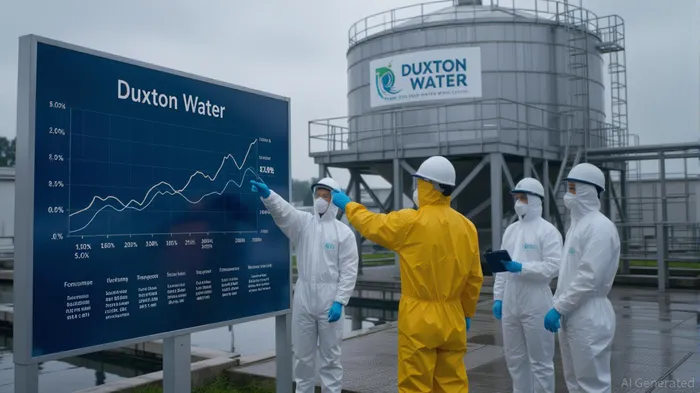
The recent upgrade of Duxton Water Limited's (ASX:D2O) 2025 earnings forecasts by its covering analyst has sparked debate about whether the company's strategic adjustments and industry dynamics justify renewed optimism. While the revised revenue projection of AU$46 million—a 3.7% decline from the prior year—represents an improvement over historical trends of a 6.8% annual revenue drop[1], it still lags behind the 5.0% growth expected from industry peers[1]. Similarly, the upward revision of statutory earnings per share (EPS) to AU$0.15 from AU$0.12 suggests improved operational efficiency, yet the consensus price target of AU$1.73 remains unchanged[1]. This analysis evaluates the validity of the analyst upgrade by examining Duxton's strategic positioning, the structural forces shaping the Australian water market, and the competitive pressures it faces.
Strategic Rationale: Leverage on Expertise and Portfolio Diversification
A key factor underpinning the upgraded forecasts is the company's reliance on strategic expertise, particularly the legacy of Alex Lepori, whose experience in managing cross-border water and real estate portfolios may inform Duxton's approach to asset diversification[2]. Lepori's track record in executing transactions across geographies such as Australia, Uruguay, and Tanzania underscores a capacity to identify undervalued assets and optimize returns—a skill set that could mitigate the risks of declining revenues. Duxton's current strategy of maintaining 70-80% of its water entitlements in long-term leases with irrigators ensures a stable cash flow, while the unleased portion is actively traded to capitalize on spot market volatility[3]. This dual approach aligns with the company's goal of balancing predictability and growth in a sector characterized by climatic and regulatory uncertainty.
Industry Dynamics: Structural Shifts and Supply Constraints
The Australian water industry is undergoing profound structural changes, driven by a combination of government policies, climate pressures, and agricultural demand. In the southern Murray-Darling Basin—a critical region for Duxton's operations—water allocations in 2024–25 hit a five-year low of 6,058 gigaliters (GL), or 78% of total entitlements[4]. This scarcity, exacerbated by dry conditions, pushed volume-weighted average prices (VWAP) to AU$153 per megaliter (ML), a five-year high[4]. Meanwhile, permanent plantings of water-intensive crops like almonds and citrus are driving inelastic demand, with usage against entitlements reaching decade-high levels in regions such as NSW's Murrumbidgee and Victoria's Murray[4].
These trends suggest that while Duxton's revenue may continue to decline in the short term, the long-term appreciation of water entitlements could offset this weakness. The company's ability to carry forward unused allocations and engage in forward contracting provides a buffer against annual variability[3]. Furthermore, government buybacks and regulatory reforms—such as the Water Amendment (Restoring Our Rivers) Act 2023—aim to enhance market transparency and fairness, potentially stabilizing price expectations[5].
Competitive Pressures: Navigating a Fragmented Market
Duxton operates in a fragmented market where competitors range from state governments and irrigation infrastructure operators (IIOs) to private equity-backed entities. State governments, such as New South Wales and Victoria, manage water allocations and trade rules, while IIOs like Murray Irrigation enforce operational consistency within their networks[6]. The Australian Competition and Consumer Commission (ACCC) further shapes the competitive landscape by monitoring pricing and infrastructure charges, with recent inquiries into tradeable water rights in the Murray-Darling Basin aimed at reducing barriers to trade[6].
Despite these pressures, Duxton's focus on irrigation water—distinct from the bottled water or water treatment chemical markets—positions it to capitalize on the sector's unique dynamics. For instance, while the bottled water market is projected to grow at a CAGR of 6.96% from 2025–2030[7], Duxton's core business benefits from the inelastic demand for agricultural water, which remains less susceptible to consumer trends. However, the company must contend with rivals like LGI (ASX:LGI) and PBAPBA-- Holdings Bhd (KLSE:PBA), which also operate in water entitlement trading[8].
Valuation and Long-Term Prospects
The analyst upgrade appears partially justified, but the lack of a price target revision raises questions about the market's skepticism. Duxton's net asset value (NAV) per share of AU$1.66 as of July 2025[3] suggests a discount to the AU$1.73 consensus price target, implying potential upside if the company can stabilize its revenue trajectory. However, the projected 8.8% decline in EPS to AU$0.15 highlights the fragility of earnings in a sector where margins are sensitive to allocation volumes and pricing volatility[1].
Long-term growth hinges on the company's ability to navigate two critical challenges:
1. Capital Expenditure Constraints: The Australian water supply industry faces rising fixed costs due to aging infrastructure and climate adaptation needs[7]. Duxton's reliance on existing entitlements rather than capital-intensive projects may insulate it from some of these pressures.
2. Regulatory Uncertainty: The impending implementation of insider trading prohibitions under the Water Amendment Act could reduce speculative trading activity, potentially dampening returns from the unleased portion of Duxton's portfolio[5].
Conclusion: A Cautious Case for Optimism
The analyst upgrade reflects a nuanced view of Duxton Water's prospects. While the company's strategic diversification and industry tailwinds—such as rising entitlement prices and structural demand—provide a foundation for resilience, the persistent revenue decline and competitive pressures temper the case for aggressive optimism. Investors should monitor the company's ability to execute its leasing strategy, capitalize on spot market opportunities, and adapt to regulatory shifts. For now, the upgrade appears justified as a recognition of Duxton's operational improvements, but the path to outperformance remains contingent on broader market dynamics.







Comentarios
Aún no hay comentarios