
DraftKings: NFL Betting Trends and Bettor-Friendly Innovation Fuel Market Leadership
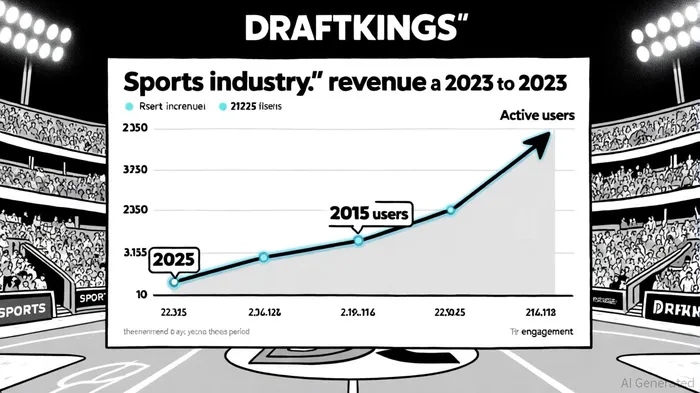
The sports betting industry has undergone a seismic transformation in recent years, driven by the legalization of wagering in U.S. states and the rise of digital platforms. At the forefront of this revolution is DraftKingsDKNG-- (DKNG), whose strategic alignment with NFL betting trends and innovative bettor-centric features has redefined user engagement and revenue growth. By 2025, the company's financial trajectory—from a $507 million net loss in 2024 to a projected $214 million net income—demonstrates a remarkable turnaround, underpinned by its ability to harness the NFL's cultural dominance and technological agility[4].
NFL Betting: A Catalyst for Growth
The NFL season, with its 17-week regular schedule and high-stakes playoff drama, has become a cornerstone of DraftKings' business model. According to a report by Business of Apps, sportsbook revenue accounted for the majority of DraftKings' $4.7 billion in 2024, with a 42% year-on-year increase projected to push this segment to $4.1 billion in 2025[4]. This growth is not merely a function of market expansion but a reflection of DraftKings' ability to monetize NFL betting through a higher “hold percentage”—a metric that rose from 9.4% in 2024 to 10.8% in 2025, indicating improved risk management and pricing strategies[4].
User engagement has mirrored this financial ascent. Active users surged from 3.5 million in 2023 to 4.8 million in 2024, with average monthly unique payers reaching 4.3 million in 2025[1]. The NFL's broad appeal, combined with DraftKings' targeted promotions (e.g., same-game parlay boosts for primetime games), has created a flywheel effect: more users, longer session times, and higher average bets[1].
Bettor-Friendly Features: The Secret Sauce
DraftKings' success lies in its relentless focus on enhancing the user experience. A case study by Latterly highlights the company's integration of gamification and personalization, which tailors promotions and content to user behavior[1]. For instance, in-play betting technology—launched in partnership with live streaming—has driven a 50% increase in in-play revenue, while session times have grown by 40%[2]. These innovations are not merely incremental; they represent a fundamental shift in how bettors interact with sports wagering, transforming it from a transactional activity into an immersive experience.
Cross-selling between DraftKings' product lines (sports betting, daily fantasy sports, and iGaming) has further amplified customer lifetime value by 30% and reduced acquisition costs by 20%[2]. Strategic partnerships with brands like Tums and Samuel Adams during major sporting events have also added a layer of entertainment, fostering brand loyalty and differentiating DraftKings from competitors[5]. Meanwhile, AI-driven personalization has boosted customer satisfaction by 30% and session time by 35%, underscoring the power of data analytics in modern betting platforms[2].
Financial Resilience and Future Prospects
DraftKings' financial resilience is equally compelling. By 2025, the company is on track to achieve its first profitable year, with net income projected at $214 million[4]. This turnaround reflects disciplined cost management and a shift toward high-margin services. For example, the company's geographic expansion to 24 U.S. states has been paired with aggressive digital marketing campaigns on platforms like Facebook and Instagram, ensuring scalability without proportionate cost increases[2].
Looking ahead, DraftKings' focus on customer retention—evidenced by an 85% retention rate—positions it to capitalize on the NFL's enduring popularity[3]. The company's CEO has emphasized that maximizing customer lifetime value remains a priority, a strategy that aligns with broader industry trends toward long-term user relationships[6]. With the U.S. sports betting market expected to grow further, DraftKings' first-mover advantage and technological edge suggest a sustainable growth trajectory.
Conclusion
DraftKings' market leadership is a testament to its ability to blend NFL betting trends with bettor-friendly innovation. By leveraging data-driven personalization, cross-selling, and strategic partnerships, the company has not only captured a significant share of the sports betting market but also redefined user expectations. As the NFL remains a cultural touchstone, DraftKings' financial and operational performance—marked by profitability and user growth—signals a compelling investment opportunity for those seeking exposure to the digital betting revolution.







Comentarios
Aún no hay comentarios