
Dow Inc.'s Share Price Rebound: Sustainable Value Creation or Short-Term Optimism?
The Fungicides Market: A Tailwind for Long-Term Growth
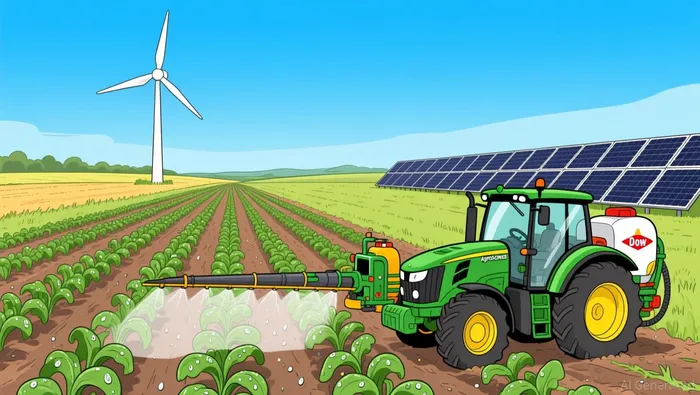
The global fungicides market, a cornerstone of the agrochemical industry, is expanding rapidly. According to a report by Towards Chemical and Materials Consulting, the market was valued at USD 25.34 billion in 2025 and is projected to grow at a compound annual growth rate (CAGR) of 6.25% through 2034, reaching USD 43.73 billion. This growth is fueled by rising food demand, the adoption of precision agriculture technologies, and a shift toward sustainable crop protection solutions. For a company like Dow, which operates under the Dow AgroSciences brand, this represents a significant opportunity. The fungicides market's trajectory suggests that investor optimism about Dow's agrochemical segment is not entirely misplaced, as long-term demand fundamentals remain robust.
Financial Performance: Mixed Signals in Q1 2025
Dow's Q1 2025 results, however, tell a more nuanced story. The agrochemical segment, classified under the Industrial Intermediates & Infrastructure business unit, reported net sales of $2.9 billion-a 5% decline year-over-year, driven by lower local prices and currency impacts. Operating EBIT for the segment turned negative at -$128 million, reflecting margin compression from higher energy costs and reduced equity earnings. While volume gains in Industrial Solutions partially offset these pressures, the segment's performance underscores the challenges of navigating a volatile commodity environment.
Dow's strategic response has been to prioritize cost discipline and capacity rationalization. The company delayed its Fort Saskatchewan Path2Zero project-a net-zero emissions ethylene cracker-by $1 billion in 2025 capital expenditures. Simultaneously, it expanded its European asset review, targeting high-cost upstream facilities for idling or shutdown. These moves, while necessary to align with market conditions, raise questions about the sustainability of near-term profitability.
Sustainability Initiatives: A Double-Edged Sword
Dow's long-term sustainability strategy, extending through 2030, emphasizes decarbonization, circular economy innovations, and partnerships to reduce emissions. A notable example is its $500 million collaboration with the U.S. Department of Agriculture to develop ammonia-based fertilizers using green hydrogen technology, which could cut carbon emissions by 90%. Such initiatives align with global decarbonization trends and position Dow as a leader in climate-smart agriculture. However, the immediate financial burden of these projects-such as the delayed Path2Zero project-highlights the tension between long-term environmental goals and short-term cash flow constraints.
The agrochemical sector's broader sustainability push, including the adoption of IoT-enabled logistics and green shipping corridors, further underscores the importance of environmental stewardship. Yet, Dow's Q1 results suggest that translating these initiatives into consistent profitability remains a work in progress.
Analyst Insights: A Cautionary Outlook
Recent analyst reports offer a mixed assessment. Dow's Q3 2025 earnings, for instance, exceeded EPS expectations but fell short on revenue, with EBITDA at $868 million. The stock's 14.33% pre-market surge was followed by a pullback, reflecting investor uncertainty. While the company anticipates $725 million in Q4 EBITDA, it warns of margin compression due to rising feedstock costs. Analysts remain divided: some view the fungicides market's growth potential as a catalyst for recovery, while others caution that Dow's operational challenges-such as its exposure to energy-intensive assets-could undermine long-term value creation.
Conclusion: A Delicate Balance
Dow's share price rebound appears to rest on a fragile equilibrium. The fungicides market's expansion and the company's sustainability initiatives provide a compelling narrative for long-term investors. However, the Q1 2025 financial results and ongoing operational adjustments reveal vulnerabilities that could test investor patience. For the rebound to be sustainable, Dow must demonstrate that its cost-cutting measures and green investments can coexist with consistent profitability. Until then, the current momentum may reflect a blend of justified optimism and speculative hope.







Comentarios
Aún no hay comentarios