
Douglas Emmett’s Strategic Refinance and Portfolio Flexibility
In the current economic climate, where interest rate volatility and shifting demand for commercial real estate persist, real estate investment trusts (REITs) must adapt to maintain resilience. Douglas EmmettDEI--, a prominent player in the Los Angeles office and multifamily markets, has demonstrated a strategic approach to refinancing and portfolio management that offers valuable lessons for investors. By extending debt maturities and leveraging unencumbered assets, the company has positioned itself to navigate uncertainty while optimizing capital allocation.
Strategic Refinancing: Mitigating Risk Through Extended Maturities
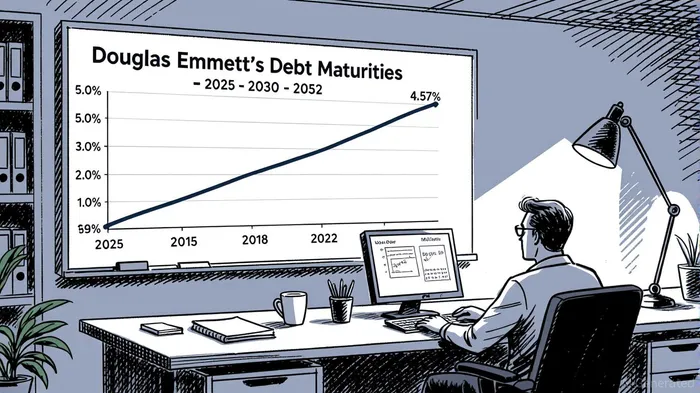
Douglas Emmett’s refinancing activities in early 2025 underscore its commitment to long-term stability. In Q1 2025, the company secured two landmark loans: a $127.2 million fixed-rate loan maturing in April 2030 at 4.99%, and a $335 million loan maturing in March 2032 at 4.57% [2]. These transactions extend the average maturity of its debt, reducing exposure to short-term interest rate fluctuations. As noted by Peter Abramowitz of JefferiesJEF--, such refinancing aligns with broader industry trends of de-risking balance sheets in a high-rate environment [2].
The benefits of these extended maturities are twofold. First, they provide a buffer against refinancing pressures, which have historically strained REITs during liquidity crunches. Second, the fixed rates lock in favorable terms amid expectations of rate normalization, preserving cash flow predictability. According to Q2 2025 earnings reports, Douglas Emmett maintains a manageable total debt-to-total capital ratio of 0.55, reflecting its conservative approach to leverage [1]. This discipline ensures the company remains well-positioned to fund its 2025 plans without overextending its balance sheet.
Unencumbered Assets: A Catalyst for Flexibility
Another cornerstone of Douglas Emmett’s strategyMSTR-- is its emphasis on unencumbered assets. Nearly half of its office portfolio remains unencumbered, offering significant flexibility in capital deployment [2]. This liquidity is critical in a market where rapid repositioning—such as converting underutilized office spaces to residential units—can unlock value. For instance, the company’s decision to redevelop 10900 Wilshire into a residential property was driven by synergies with adjacent projects and favorable demand dynamics [2].
Unencumbered assets also enhance the company’s ability to respond to unexpected challenges. In Q2 2025, leadership acknowledged that rising interest rates could complicate refinancing but emphasized that the unencumbered portfolio provides a “strategic runway” to absorb such shocks [1]. This flexibility is particularly valuable in Los Angeles, where demand for multifamily housing remains robust, allowing Douglas Emmett to pivot quickly between asset classes.
Resilience and Capital Allocation: A Symbiotic Relationship
The interplay between extended maturities and unencumbered assets strengthens Douglas Emmett’s resilience while expanding capital allocation opportunities. By reducing refinancing risk, the company can focus on high-conviction projects, such as the ongoing remodel of Studio Plaza, which has already exceeded leasing expectations [2]. Meanwhile, the unencumbered portfolio acts as a reserve for debt financing, joint ventures, or acquisitions, enabling the REIT to capitalize on market dislocations.
This dual strategy also supports the company’s EBITDA growth. As highlighted in Q3 2024 earnings calls, Douglas Emmett’s net debt-to-EBITDA ratio remains near its 6x target, a testament to its prudent capital management [1]. Such discipline not only satisfies investor expectations but also reinforces credit ratings, which are critical for accessing favorable financing terms.
Conclusion
Douglas Emmett’s approach to refinancing and portfolio management exemplifies how REITs can thrive in an era of economic uncertainty. By extending debt maturities and maintaining a substantial unencumbered asset base, the company has created a resilient framework that balances risk mitigation with growth potential. For investors, this strategy underscores the importance of proactive capital structuring and adaptive asset management in the evolving real estate landscape.
Source:
[1] Douglas Emmett Q2 2025 Earnings Call Transcript [https://www.investing.com/news/transcripts/earnings-call-transcript-douglas-emmett-q2-2025-earnings-beat-estimates-93CH-4174292]
[2] Peter Abramowitz, Jefferies Market Insights Report [https://fintool.com/app/research/analyst/peter-abramowitz]





Comentarios
Aún no hay comentarios