
Is Old Dominion Freight Line (ODFL) a Buy After Missing Q2 Estimates? Assessing Long-Term Resilience in a Turbulent Sector
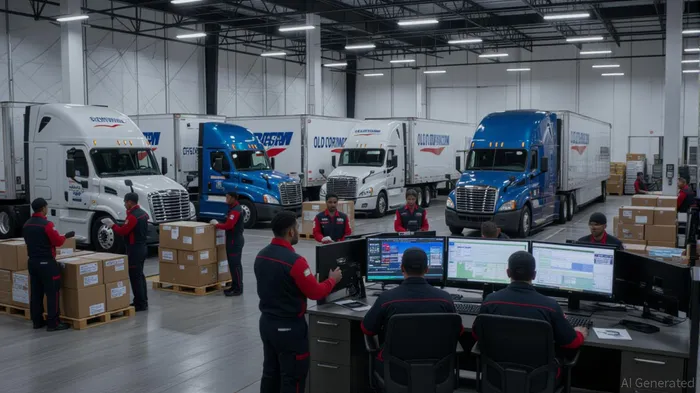
The logistics sector in 2025 is navigating a treacherous landscape. Geopolitical tensions, economic stagnation, and regulatory shifts have created a perfect storm for freight companies. Old Dominion Freight LineODFL-- (ODFL), a dominant player in the less-than-truckload (LTL) market, recently reported Q2 earnings that fell short of expectations, sending its stock down 5.4%. Yet, amid the near-term pain, its long-term business model remains a compelling case for resilience. The question is whether this resilience justifies a long-term investment.
A Challenging Q2, But Not a Crisis
ODFL's Q2 revenue declined 6.1% year-on-year to $1.407 billion, driven by a 9.3% drop in LTL tons per day. While this reflects weak demand, the company mitigated the blow by raising LTL revenue per hundredweight by 5.3%. Operating income fell 15.1% to $357.9 million, with a deleveraging operating ratio of 74.6%. These numbers, while disappointing, are not catastrophic. They reflect broader industry headwinds: a 1.69% global export slowdown, U.S. inflation at 3.2%, and a 145% tariff spike on Chinese imports.
The key takeaway is that ODFL's struggles are macro-driven, not operational. Its service metrics—99% on-time performance and a 0.1% cargo claims ratio—remain industry-leading. These are not mere numbers; they are barriers to entry in an industry where reliability is paramountPARA--. Even as volumes contracted, ODFL's pricing discipline preserved margins. LTL revenue per hundredweight (excluding fuel) grew 5.6% year-to-date, outpacing competitors.
Sector-Wide Challenges: A Harsh but Fair Test
The logistics sector is in a prolonged correction. Air freight demand grew 3% in Q1 2025, far below the 11% of 2024, while ocean freight faces a 15-17% rate decline due to oversupply. Trucking demand is muted by high interest rates and inventory destocking. For ODFL, the LTL segment is particularly sensitive to these trends. Yet, its union-free model and disciplined yield management have historically insulated it from downturns.
The U.S. trucking sector is in a “slow rebalancing” phase, with Class 8 build rates near historic lows and spot rates flat. ODFL's response? A focus on profitable freight over volume. While some carriers chase denser loads to offset lower volumes, ODFL prioritizes higher-rated shipments. This strategy, though counterintuitive in a down market, aligns with its long-term value proposition: service excellence and pricing power.
Financial Strength: A Fortress Balance Sheet
ODFL's balance sheet is a testament to its prudence. With $4.235 billion in shareholders' equity and a debt-to-equity ratio of 1.4%, the company is a poster child for conservative capital management. Its free cash flow of $1.65 billion in 2024 (despite $646 million in capex) underscores its ability to fund growth while returning capital to shareholders.
The company's 2025 capital expenditures of $450 million—$210 million for real estate, $190 million for tractors/trailers, and $50 million for IT—are not just maintenance but strategic investments. These will enhance network efficiency, reduce claim ratios, and improve customer visibility. In an industry where technology can be a differentiator, ODFL's forward-looking approach is a strength.
Strategic Resilience: Beyond the Numbers
ODFL's long-term resilience lies in its strategic pillars:
1. Service Excellence: Its 99% on-time performance is a competitive moat. In an economy where supply chain reliability is a premium, this is a critical differentiator.
2. Yield Management: The company's ability to raise prices on a per-pound basis, even in a weak demand environment, suggests strong customer loyalty and pricing power.
3. Capital Discipline: Share repurchases ($424.6 million YTD 2025) and dividends ($118.5 million YTD) signal confidence in its cash flow sustainability.
4. Regulatory Adaptation: Proactive compliance with FMCSA and EPA regulations ensures operational continuity in a highly regulated sector.
The Investment Case: A Buy for the Long-Term
The Q2 miss is a short-term setback, not a structural problem. ODFL's business model is designed for resilience: it thrives in upturns and endures downturns. Its low debt, strong cash flow, and strategic investments position it to outperform peers when demand recovers.
For investors, the key question is whether the current 5.4% stock price drop reflects the company's long-term potential or overreacts to near-term noise. Given ODFL's track record of navigating cycles—its 2020 pandemic recovery and 2023 rate hike resilience—the latter is more likely. The stock's forward P/E ratio of 12.3x (as of July 2025) is also attractive compared to its historical average of 15x.
Conclusion: Patience Rewarded
ODFL is not a “buy and hold” stock for the faint-hearted, but for those with a long-term horizon, it offers a compelling mix of defensive strength and growth potential. The Q2 miss is a temporary blip in a sector-wide slowdown. By maintaining its focus on service, pricing, and efficiency, ODFL is poised to emerge stronger. In an era of supply chain fragility, companies that can deliver reliability and resilience will be the beneficiaries. Old Dominion Freight Line is one such company.
"""





Comentarios
Aún no hay comentarios