
Dividend Sustainability Risks in Global Equities: A Proactive Approach for Income Investors
AXA SA: A Cautionary Tale of Fragile Dividend Security
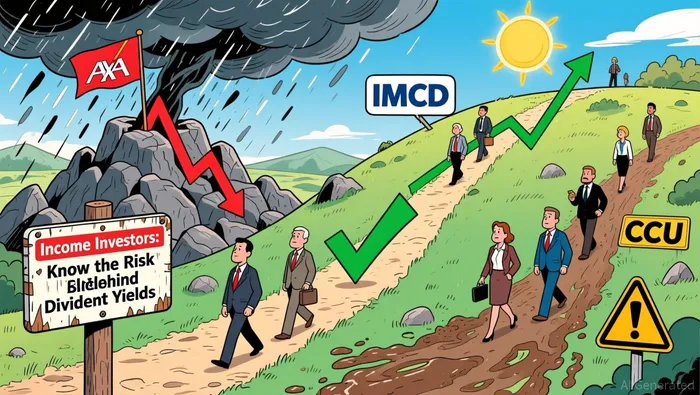
AXA Group (AXAHY) presents a stark warning for investors prioritizing dividend stability. According to a report by Seeking Alpha, the insurer carries a Dividend Safety Score of F, placing it at a 64.4% probability of cutting dividends in the future. This rating reflects broader concerns about AXA's financial flexibility, particularly in a sector prone to large-scale liabilities. While the company has maintained annual dividend payments, its payout history reveals significant volatility. For instance, the dividend was slashed to $0.83 per share in 2020 amid pandemic-related losses, and though it has since rebounded to $2.44 per share in 2025, the 59.08% payout ratio remains a double-edged sword. A high payout ratio, while suggesting generous returns, also leaves little room for error in the face of economic shocks.
IMCD N.V.: A Model of Resilient Dividend Growth
In contrast, IMCD N.V. (IMCDY) exemplifies the benefits of disciplined capital allocation. Data from Investing.com indicates that the chemical distributor has achieved a 5-year dividend growth rate of +19.03%, with no recorded cuts in the past five years. This consistency underscores the company's ability to balance reinvestment and shareholder returns, a trait particularly valuable in cyclical industries. For income investors, IMCDY's track record suggests a lower risk of sudden disruptions, even as macroeconomic conditions evolve.
CCU: The Perils of Eroding Dividend Performance
Cervecerías Unidas (CCU), the Mexican beverage giant, offers a sobering counterpoint. Its 5-year dividend growth rate of -15.73% highlights a troubling trend of declining payouts. While the company has not entirely suspended dividends, the negative trajectory signals operational or strategic challenges that could undermine future income streams. For investors, this serves as a reminder that even companies with a history of paying dividends are not immune to deterioration in their ability to sustain them.
Proactive Risk Management: Beyond the Yield
The contrasting cases of AXA, IMCD, and CCU underscore a fundamental truth: dividend sustainability is not guaranteed by current yields alone. Proactive risk management requires investors to:
1. Assess Dividend Safety Scores as a forward-looking indicator of vulnerability.
2. Analyze historical patterns of cuts or increases, particularly during periods of stress.
3. Evaluate payout ratios in the context of industry norms and financial flexibility.
For example, AXA's F rating and CCU's negative growth rate should trigger deeper scrutiny, even if their current dividends appear attractive. Conversely, IMCDY's consistent growth and absence of cuts justify a more confident allocation.
Conclusion
Dividend sustainability is a cornerstone of income investing, yet it demands more than passive reliance on current yields. By integrating tools like Dividend Safety Scores and historical performance analysis, investors can better navigate the risks of dividend cuts. In a world where corporate resilience is increasingly tested, such proactive strategies are not merely prudent-they are indispensable.







Comentarios
Aún no hay comentarios