
Dine Brands Global's Leadership Transition: Strategic Alignment and Shareholder Value in a Turbulent Market
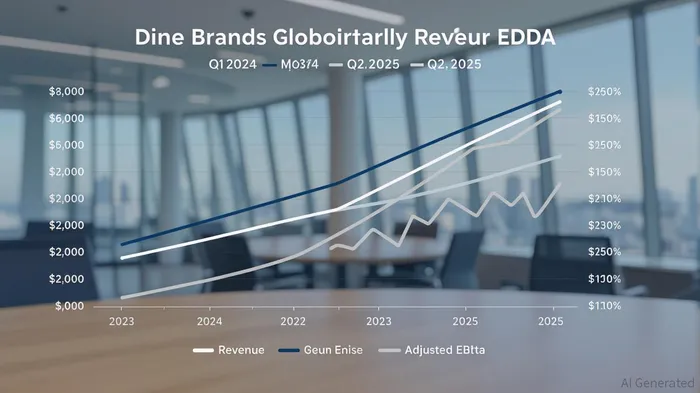
Dine Brands Global's recent leadership transition has sparked both optimism and skepticism among investors. The departure of Tony Moralejo as President of Applebee's in March 2025, coupled with John Peyton's interim leadership, marks a pivotal moment for the casual dining giant. While the company has outlined ambitious strategic initiatives, the path to restoring shareholder value remains fraught with challenges. This analysis evaluates the alignment between Dine Brands' leadership changes and its financial performance, offering insights into whether these moves can catalyze long-term growth.
Strategic Alignment: From Leadership to Execution
The transition at Dine Brands underscores a shift toward stabilizing operations and reinvigorating brand growth. Tony Moralejo's exit, though abrupt, was softened by his advisory role until June 2025, ensuring continuity during the search for a permanent Applebee's leader [1]. John Peyton, the CEO, has stepped into the interim role, leveraging his experience in franchise operations and brand development to prioritize digital transformation, menu innovation, and domestic expansion [2].
According to a report by Bloomberg, Peyton's focus on digital engagement aligns with the company's broader strategy to boost off-premise sales. For instance, Applebee's reported a 3.7% increase in off-premise sales in Q1 2025, driven by AI-driven personalization and ghost kitchen concepts [4]. These initiatives reflect a modernization push critical for competing in a market where younger demographics increasingly favor convenience and tech-enabled experiences.
However, strategic alignment extends beyond digital efforts. Dine Brands has also launched a $25 million franchisee financial assistance program to mitigate inflationary pressures, a move praised by analysts as a step toward restoring franchisee trust [2]. The addition of Tom Lewison and Chris Marshall to the board, as proposed by The Edge Group, further signals a commitment to financial oversight and operational expertise [1]. These changes aim to reverse a 70% stock decline under previous leadership, though their efficacy remains unproven.
Shareholder Value: Mixed Financial Signals
Despite strategic optimism, Dine Brands' financial performance post-transition has been mixed. For Q2 2025, the company reported revenues of $230.8 million, a 11.9% year-over-year increase, yet GAAP net income fell to $13.2 million, or $0.89 per diluted share, compared to $22.5 million, or $1.50 per share, in Q2 2024 [1]. Adjusted EBITDA also declined to $56.2 million from $67.0 million in the same period.
Data from MarketBeat indicates that Dine Brands' stock has underperformed, with a 52-week decline of -19.34% and a beta of 1.07, mirroring market volatility [3]. While the company's asset-light model and $263.2 million in cash reserves provide liquidity, its 8.38% dividend yield—a double-edged sword—may attract income-focused investors but raises concerns about sustainability amid shrinking profits.
The company's 2025 guidance, projecting consolidated adjusted EBITDA between $235 million and $245 million, suggests cautious optimism. However, this range implies a potential 10% decline from 2024's $267 million (Q1-Q2 2024: $110.9 million) [1]. Such projections highlight the fragility of Dine Brands' recovery narrative.
Risks and Opportunities
The leadership transition's success hinges on executing strategic priorities without exacerbating existing challenges. For example, while international expansion—such as entering three new markets and launching a dual-brand restaurant in Costa Rica—is promising, it risks diverting resources from domestic revitalization [4]. Similarly, the reliance on interim leadership may delay long-term vision implementation, as Peyton's dual role as CEO and interim Applebee's President could stretch his capacity.
A critical risk lies in franchisee sentiment. Despite the financial assistance program, Dine Brands must address historical tensions with franchisees, who have criticized corporate decisions as misaligned with their interests. The Edge Group's board additions aim to bridge this gap, but trust is a slow-building asset.
Conclusion: A Calculated Bet for Investors
Dine Brands Global's leadership transition represents a calculated attempt to realign strategy with shareholder value. The emphasis on digital innovation and franchisee support addresses key pain points in the casual dining sector. However, the company's financial metrics—declining EBITDA, a volatile stock price, and a high dividend yield—underscore the urgency of delivering tangible results.
For investors, the decision to engage with Dine Brands hinges on risk tolerance. The company's $26.57 average price target and “Hold” consensus rating suggest limited short-term upside, but its strategic initiatives and liquidity position offer a foundation for long-term recovery. As the search for a permanent Applebee's leader progresses, the market will likely scrutinize whether these moves translate into operational and financial resilience.





Comentarios
Aún no hay comentarios