
Denmark's $9 Billion Air Defence Investment: Strategic Implications for European Defense Contractors
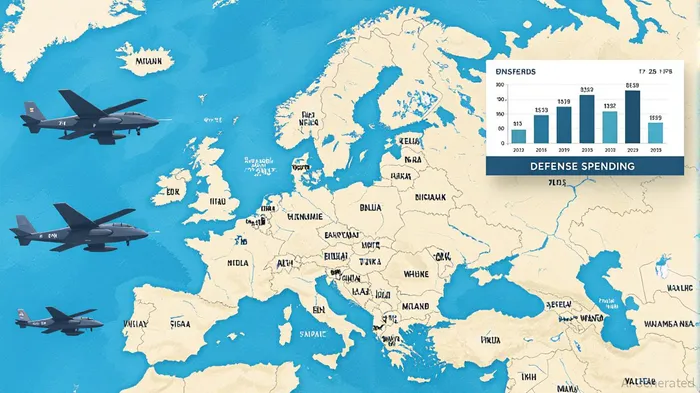
In an era of escalating geopolitical tensions and shifting defense priorities, Denmark's recent commitment to a historic $9.11 billion (58 billion DKK) air defense investment[1] marks a pivotal moment for European defense markets. This surge in spending, coupled with a parallel $2.05 billion (14.6 billion DKK) Arctic defense initiative[2], reflects a broader recalibration of national security strategies across the continent. For equity investors, the implications are clear: European defense contractors are poised to benefit from a sustained uptick in demand for advanced military systems, particularly in air and missile defense.
A Strategic Shift in Danish Defense Policy
Denmark's decision to allocate over 3% of its GDP to defense in 2025 and 2026[3] represents a dramatic departure from its historically low defense spending—1.37% of GDP in 2022[3]. This shift is driven by a combination of regional security concerns, including the volatility of the Arctic and the Baltic regions, and a commitment to NATO's 2024 call for member states to reach 2% of GDP in defense spending. The air defense component of the investment is particularly noteworthy, with the Danish government set to finalize the acquisition of long-range systems such as the U.S. Patriot and the French-Italian SAMP/T by year-end[1]. These systems, alongside short- to medium-range solutions like the IRIS-T SLM and VL MICA[1], will form the backbone of Denmark's modernized air defense architecture.
Growth Opportunities for Defense Contractors
The procurement process has already triggered a surge in activity for key contractors. Raytheon, the U.S. manufacturer of the Patriot system, and the European consortium of Leonardo (Italy) and MBDA (France/UK), which produces the SAMP/T, are among the primary beneficiaries. Similarly, German firm Diehl Defence, supplying the IRIS-T SLM, and Thales (France), providing the VL MICA, stand to gain from Denmark's immediate modernization efforts[1]. For investors, this represents a near-term tailwind for equity valuations in these firms, particularly as Denmark's procurement timeline aligns with broader European defense modernization programs.
The Arctic-focused investments further diversify the opportunities. The acquisition of naval vessels, drones, and satellite systems[2] will likely involve contractors such as BAE Systems (UK), Saab (Sweden), and Kongsberg Gruppen (Norway), all of which have established Arctic capabilities. This regional specialization underscores a trend toward niche, high-margin defense technologies—a sector where European firms have traditionally held competitive advantages.
Broader Market Implications
Denmark's spending spree is not an isolated event. The country's defense market, valued at $5.1 billion in 2023, is projected to grow at a compound annual rate of over 4% through 2028[3], driven by both domestic and NATO-aligned initiatives. This trajectory mirrors trends across Europe, where defense budgets are expanding in response to hybrid threats, cyber warfare, and the proliferation of advanced drone and missile technologies. For equity markets, the result is a structural shift toward defense as a core growth sector, with European firms increasingly positioned to outperform their U.S. counterparts in niche areas such as integrated air and missile defense (IAMD).
Risks and Considerations
While the outlook is optimistic, investors must remain cognizantCTSH-- of potential headwinds. Currency fluctuations, as seen in the divergent exchange rates for Denmark's air defense ($1 to 6.3672 DKK) and Arctic spending ($1 to 7.1158 DKK)[1][2], could impact contractor margins. Additionally, geopolitical shifts—such as a reduction in Russian aggression or a slowdown in Arctic tensions—might temper long-term demand. However, given the current trajectory, these risks appear secondary to the immediate growth drivers.
Conclusion
Denmark's $9.11 billion air defense investment is a harbinger of a new era in European defense spending. For equity investors, the strategic implications are twofold: first, a near-term boost for contractors supplying advanced air and missile defense systems; and second, a long-term reorientation of European defense markets toward high-tech, regionally tailored solutions. As NATO members continue to align with the 2% GDP benchmark, the Danish model may well serve as a blueprint for others, cementing defense as a cornerstone of European economic and strategic resilience.







Comentarios
Aún no hay comentarios