
The Democratic Republic of Congo: A New Frontier for Strategic Mineral Investments
The Democratic Republic of the Congo (DRC) holds roughly 60% of the world's cobalt reserves, 34% of its coltan, and emerging lithium deposits critical to electric vehicle (EV) batteries. Yet its mineral wealth has long been overshadowed by conflict, corruption, and geopolitical rivalry. Now, a U.S.-brokered peace agreement with Rwanda, signed in June 2025, offers a transformative opportunity to reduce risks and position the DRC as a cornerstone of America's counter-China mineral diplomacy. For investors, this deal marks a turning point to capitalize on secure supply chains for strategic minerals while navigating persistent risks.
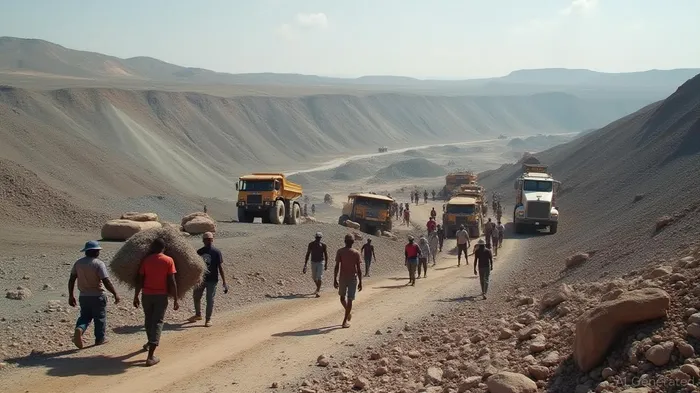
The Peace Deal: Mitigating Conflict Risks
The June 2025 agreement between the DRC and Rwanda, mediated by U.S. envoy Massad Boulos, aims to end decades of cross-border violence fueled by the M23 rebel group and its alleged Rwandan backers. Key terms include:
- Rwanda's troop withdrawal: Kigali agreed to remove its forces from DRC territory within 90 days, reducing direct military pressure on mining regions.
- Economic integration framework: The deal mandates a 90-day timeline to formalize U.S. and Western access to critical minerals like cobalt, lithium, and tantalum.
- Joint security coordination: A monitoring mechanism to verify compliance and neutralize militias like the M23, though their exclusion from talks remains a risk.
While the M23's continued control over key cities like Goma poses a threat, U.S. pressure and economic incentives—including access to DRC's Banana deep-sea port—could compel Rwanda to fully comply. The U.S. has also suspended military ties with Rwanda until withdrawal is verified, signaling resolve to enforce terms.
Strategic Minerals: A Geopolitical Battleground
The DRC's mineral reserves are vital to global supply chains:
- Cobalt: 60% of global reserves, essential for EV batteries. China currently dominates processing, but U.S. firms like TeslaTSLA-- are seeking direct access.
- Coltan: A source of tantalum, critical for electronics. DRC supplies 34% of global reserves.
- Lithium: Emerging deposits could rival Australia and South America, supporting EV demand.
The U.S. aims to counter China's dominance by securing long-term supply agreements. For example, Apple's recent lawsuits against Congolese cobalt suppliers over labor abuses highlight the need for transparent, conflict-free sourcing—something the peace deal could enable.
The U.S. Geopolitical Playbook
The DRC's pivot aligns with U.S. strategies to:
1. Diversify supply chains: Reduce reliance on Chinese-controlled cobalt and lithium.
2. Undermine Chinese influence: Beijing's $3.5 billion stake in DRC infrastructure projects, including cobalt mines, faces U.S. competition.
3. Strengthen regional alliances: The deal positions the DRC as a U.S. partner in Africa, countering Russian and Chinese inroads.
Risks and Mitigations
- M23 non-compliance: If the militia resists disarmament, localized violence could disrupt mining. The U.S. must enforce sanctions against Rwanda if it covertly supports M23.
- Governance failures: The DRC ranks 154/164 in rule-of-law metrics. Investors should prioritize firms with transparent contracts and local partnerships.
- Environmental and labor issues: Child labor and deforestation plague mining. Look for companies adhering to ESG standards.
Investment Opportunities
- Cobalt mining: Firms like First Quantum Minerals (TSX:FM) and Cobalt 27 (TSX:KBLT), which hold DRC assets, could benefit from stabilized supply.
- Lithium exploration: Early-stage miners in the DRC's Central African Copperbelt, such as Savant Capital (OTC:SVCW), may see demand surge.
- Infrastructure plays: Port operators like DRC's Banana deep-sea port could attract investment for mineral exports.
- ETFs: The Global X Lithium & Battery Tech ETF (LIT) and iShares MSCI Africa ETF (AFK) offer diversified exposure.
Conclusion
The DRC's peace deal reduces the existential risk of conflict-driven supply chain disruptions. While governance and militia risks linger, the U.S. is incentivizing stability through mineral diplomacy—a compelling long-term thesis. Investors should prioritize firms with:
- Direct DRC mineral exposure
- ESG compliance
- Government partnerships
The DRC's strategic minerals could soon transition from a symbol of conflict to a pillar of global decarbonization—if the U.S. and its allies deliver on governance reforms and economic integration. For patient investors, this is a frontier worth exploring.
Disclosure: This analysis is for informational purposes only and does not constitute investment advice.





Comentarios
Aún no hay comentarios