
Dell Technologies' AI Infrastructure Leadership and Long-Term Growth Potential
The global enterprise computing landscape is undergoing a seismic shift, driven by the rapid adoption of artificial intelligence (AI) and the urgent need for scalable, secure infrastructure to support it. At the forefront of this transformation is Dell TechnologiesDELL--, a company that has redefined its strategic positioning to capitalize on the AI-driven computing boom. With record-breaking orders, innovative product launches, and a holistic approach to AI infrastructure, DellDELL-- is not only securing its market leadership but also laying the groundwork for sustained growth in the coming years.
Strategic Positioning: A Holistic AI Ecosystem
Dell's dominance in the AI infrastructure sector is underpinned by its Dell AI Factory, a comprehensive end-to-end solution that integrates servers, storage, networking, and professional services. This approach addresses a critical pain point for enterprises: the complexity of deploying AI at scale. By offering validated, pre-configured systems like the Dell PowerEdge XE9785 and XE9785L, Dell enables organizations to deploy high-density GPU workloads with minimal friction according to financial reports. These systems, paired with advanced cooling solutions such as the Powercool Rack-mount Coolant Distribution Unit (RCDU), ensure that enterprises can manage the thermal and power demands of next-generation AI and high-performance computing (HPC) workloads as detailed in Dell's latest blog.
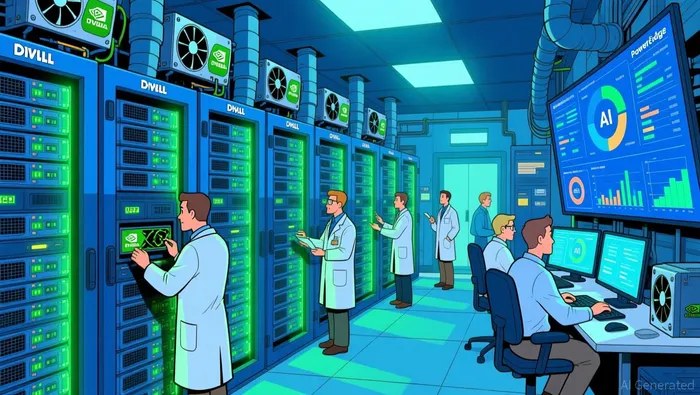 Dell's ecosystem is further strengthened by its partnerships with industry leaders like NVIDIA and Red Hat, which provide access to cutting-edge AI chips and enterprise-grade software platforms. For instance, the PowerEdge XE8712 supports up to 144 NVIDIA Blackwell GPUs per rack, a configuration that directly aligns with the surging demand for large-scale AI model training. This integration of hardware and software not only accelerates deployment but also reduces the risk of compatibility issues, a key concern for enterprises navigating uncharted AI territory.
Financial Performance: A Test of Resilience
Dell's strategic bets are translating into robust financial results. In Q3 FY2026, the company reported $12.3 billion in AI server orders and a record backlog of $18.4 billion, reflecting the strength of its value proposition. Infrastructure Solutions Group (ISG) revenue surged 24% year-over-year to $14.1 billion, with Servers and Networking revenue rising 37% to $10.1 billion according to Dell's Q3 financial report. These figures underscore Dell's ability to convert market demand into tangible revenue growth.
Financially, Dell is also navigating challenges such as rising memory costs and margin compression with resilience. Non-GAAP operating income reached $2.5 billion, and non-GAAP net income stood at $1.8 billion in Q3 FY2026 as reported in financial disclosures. Analysts remain optimistic about Dell's ability to maintain profitability, particularly as its AI Factory model reduces customer acquisition costs and enhances cross-selling opportunities according to financial analysis.
Competitive Edge: Innovation and Sovereignty
Dell's competitive positioning is further solidified by its leadership in file and object storage for AI, a category where it was named the 2025 IT Brand Pulse Market and Innovation Leader according to Dell's official announcement. Solutions like Dell PowerScale and Dell ObjectScale provide enterprises with scalable storage and AI-optimized search capabilities, accelerating data-intensive workflows. This is particularly critical in an era where data sovereignty and secure data paths are non-negotiable for global enterprises.
Moreover, Dell's Dell Automation Platform streamlines the deployment of AI infrastructure, enabling organizations to achieve faster time-to-market. This platform, combined with Dell Professional Services, which offers interactive AI use case pilots, ensures that enterprises can validate business value before scaling investments. Such services mitigate the risk of underutilized AI infrastructure, a common challenge in early-stage adoption.
Long-Term Growth: Navigating Risks and Opportunities
While Dell's trajectory is promising, it is not without risks. Rising costs for components like AI accelerators and memory could pressure margins in the short term. However, Dell's focus on rack-scale innovations and end-to-end automation positions it to offset these challenges through operational efficiency and customer retention as detailed in Dell's strategic outlook.
The company's long-term growth is also bolstered by its alignment with macro trends such as sovereign cloud initiatives and hybrid AI deployments. By offering solutions that prioritize data localization and interoperability with public cloud providers, Dell is addressing the regulatory and operational needs of enterprises in markets like the EU and China. This strategic foresight ensures that Dell remains relevant as AI adoption evolves beyond the hyperscale cloud.
Conclusion: A Strategic Bet on the Future
Dell Technologies' leadership in AI infrastructure is not a fleeting success but a calculated, long-term strategy. By combining cutting-edge hardware, integrated software, and a customer-centric approach, Dell is addressing the multifaceted challenges of AI deployment. With a raised FY2026 revenue outlook of $111.7 billion and a backlog that signals sustained demand, the company is well-positioned to outpace competitors in the AI-driven enterprise computing era. For investors, Dell represents a compelling case study in how strategic innovation and operational agility can unlock value in a rapidly evolving market.







Comentarios
Aún no hay comentarios