
The December Jobs Report: Recession Signals Amid Structural Shifts in the Labor Market
The December 2025 U.S. jobs report, released by the Bureau of Labor Statistics, has sparked renewed debate about the health of the labor market and the broader economy. While headline metrics such as the unemployment rate falling to 4.4% and the addition of 50,000 nonfarm payrolls may appear reassuring, a closer examination of leading indicators and structural trends reveals a more nuanced-and troubling-picture. The labor market is not merely slowing; it is undergoing a profound transformation driven by technological disruption, policy uncertainty, and shifting demand dynamics. For investors, this divergence between headline optimism and underlying fragility presents both risks and opportunities, particularly in resilient service-sector equities and AI-driven sectors.
Headline Metrics vs. Leading Indicators: A Tale of Two Narratives
The December jobs report's headline numbers mask a labor market that is increasingly decoupling from its pre-2025 momentum. Annual job creation in 2025 totaled 584,000, the weakest since 2003, with average monthly gains of 49,000-a stark contrast to the 168,000 monthly additions in 2024. This slowdown is not merely cyclical but structural. The Job Openings and Labor Turnover Survey (JOLTS) data for November 2025 underscores this: job openings fell to a 14-month low of 7.146 million, and hiring weakened by 253,000 to 5.115 million. The job-to-unemployment ratio dropped to 0.91, reflecting a labor market where businesses are increasingly cautious about expanding their workforce.
These trends are amplified by the rise of artificial intelligence. While AI adoption is reducing demand for certain roles-particularly in administrative and technical sectors-it is also creating new opportunities in fields like cybersecurity, data infrastructure, and machine learning engineering. The paradox is clear: wage growth remains above inflation (3.8% year-over-year in December 2025), yet real wage gains are eroded by rising living costs. This divergence between nominal wage increases and purchasing power highlights the fragility of consumer demand, a critical driver of economic activity.
The Fed's Policy Dilemma: Stabilization or Stagnation?
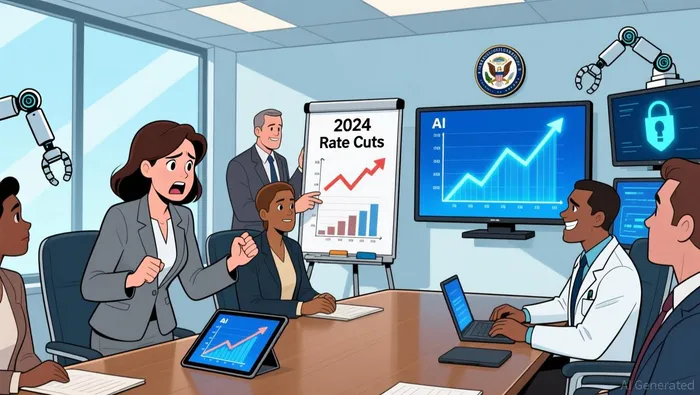
The Federal Reserve's December rate cut, the first of 2025, signals a pivot toward accommodative policy in response to these labor market dynamics. However, the central bank's cautious approach-hinting at potential pauses in rate cuts-reflects a delicate balancing act. On one hand, further easing could stimulate hiring and counteract the drag from import tariffs and AI-driven productivity gains. On the other, it risks inflating asset bubbles in sectors already overhyped by speculative capital, such as AI infrastructure.
This policy ambiguity creates a fertile ground for contrarian investors. While the Fed's actions may stabilize the broader economy, they also amplify the risks of overvaluation in certain tech-driven sectors. For instance, the surge in AI-related capital expenditures-accounting for 30% of U.S. corporate investment in 2025-has raised concerns about a potential bubble, with mentions of AI in CEO earnings calls rising sharply and parallels drawn to the dot-com era.
Contrarian Opportunities: Resilient Services and AI-Driven Sectors
Amid these headwinds, two categories of equities stand out for their resilience and growth potential: essential service-sector companies and AI-integrated businesses.
Healthcare and Social Assistance: Despite the broader labor market slowdown, healthcare added 31,000 jobs in August 2025, reflecting its role as a defensive sector. With demand projected to grow by 2.3 million net jobs through 2033, healthcare remains a cornerstone of employment. For investors, this sector offers stability, particularly in companies leveraging AI for diagnostics, personalized medicine, and administrative efficiency.
AI-Driven Productivity Gains: While AI adoption is displacing certain roles, it is also creating high-value opportunities in fields like cybersecurity, data analytics, and automation. Deloitte's 2025 tech value survey reveals that 74% of organizations are prioritizing AI and generative AI investments, with agentic AI and robotics gaining traction. Sectors such as IT, healthcare, and telecommunications are leading this transition, offering long-term growth for companies that can scale AI applications effectively.
3. Defensive Sectors in a Downturn: As consumer confidence wanes- reflected in the Conference Board's index declining amid inflationary pressures-defensive sectors like utilities, consumer staples, and education services are likely to outperform. These industries provide essential goods and services, insulating investors from the volatility of cyclical markets.
Conclusion: Navigating the Crossroads of Policy and Technology
The December 2025 jobs report is a harbinger of a labor market at a crossroads. While headline metrics suggest stability, leading indicators and structural shifts point to a more complex reality. For investors, the key lies in identifying sectors that can withstand-or even thrive-in an environment of policy uncertainty and technological disruption. Resilient service-sector equities and AI-integrated businesses offer a dual advantage: they align with long-term demographic and technological trends while providing a buffer against the risks of a potential recession.
As the Federal Reserve navigates its next steps, the market's focus should shift from short-term volatility to structural opportunities. In a world where AI reshapes industries and consumer demand evolves, contrarian positioning in essential services and high-growth tech sectors may prove to be the most prudent strategy.






Comentarios
Aún no hay comentarios