
Dave & Buster's (PLAY): A Cautionary Tale in a Competitive Leisure Sector
The leisure sector, long a barometer of consumer confidence, is facing a reckoning. Dave & Buster'sPLAY-- (PLAY), a once-bright star in the entertainment and dining space, now epitomizes the fragility of business models reliant on discretionary spending. Its Q3 2025 financial results, coupled with broader macroeconomic headwinds, paint a troubling picture of a company struggling to reconcile aggressive expansion with deteriorating fundamentals.
A Deteriorating Financial Landscape
Dave & Buster's reported Q3 2025 revenue of $448.2 million, a 1.1% decline year-over-year, with comparable store sales falling 4.0%. This marks a sharp reversal from the 3.0% increase in weekday visits reported in 2024 according to Placer AI. The company's net loss of $42.1 million ($1.22 per diluted share) and adjusted EBITDA of $59.4 million-down from $68.3 million in 2024-highlight a widening gap between operational ambition and financial reality. While the firm generated $58.0 million in operating cash flow, its liquidity of $441.9 million must now support a capital budget of $220 million for 2025, including 10–12 new store openings.
The company's debt burden further complicates its trajectory. As of April 2025, Dave & Buster's net debt stood at $3.21 billion, with a net-debt-to-EBITDA ratio of 3.2x. However, conflicting reports suggest a leverage ratio as high as 7x, raising questions about the accuracy of disclosures and the sustainability of its capital structure. Analysts project modest revenue growth of 5.8% over the next 12 months, but this falls short of the sector average and fails to offset declining operating margins, which dropped to 9.5% in Q2 2025.
Sector-Wide Pressures and Strategic Missteps
The leisure sector is grappling with a perfect storm of inflation, higher financing costs, and shifting consumer priorities. According to the Comerica Small Business Pulse Index, 23% of small businesses cite inflation as their top concern, while 42% report negative impacts from tariffs, particularly in retail and manufacturing. Meanwhile, U.S. consumer sentiment surveys reveal a shift toward essential spending, with discretionary activities like dining out and big-ticket leisure experiences losing traction according to McKinsey.
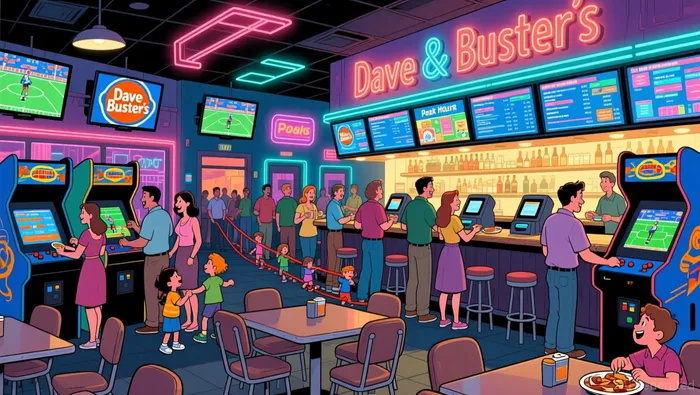
Dave & Buster's "back-to-basics" strategy-focusing on technological upgrades such as self-service beer tap walls and large video displays-aims to attract middle-income families and affluent couples. Yet, these efforts have not translated into robust sales. The company's weekday promotion strategy, which drove a 3.0% increase in visits in 2024, appears insufficient to counter broader trends of reduced discretionary spending.
A Harsh Comparative Reality
Dave & Buster's struggles are not unique, but its debt profile exacerbates its vulnerabilities. Competitors like Gaming and Leisure Properties (GLPI) report a net-debt-to-EBITDA ratio of 4.7x, while Travel + Leisure Co. maintains a 3.4x leverage ratio according to its Q2 2025 results. These figures, though elevated, suggest Dave & Buster's is operating at the upper end of industry norms. However, its interest coverage ratio of 1.6x-far below the 3.0x threshold typically considered safe-signals acute leverage risk.
The company's expansion strategy, including three new Main Event locations and international forays in the Philippines, is ambitious but poorly timed. With operating margins contracting and same-store sales declining, the financial rationale for such investments is tenuous. As one analyst notes, "Dave & Buster's is betting on growth in a market where demand is softening, and its balance sheet may not withstand further shocks" according to financial reports.
Conclusion: A Model in Peril
Dave & Buster's (PLAY) business model, once celebrated for its blend of entertainment and dining, now faces existential questions. Its financial performance-marked by declining revenues, eroding margins, and a precarious debt load-contrasts sharply with its expansion ambitions. While the leisure sector's long-term potential remains intact, the company's ability to navigate current headwinds hinges on operational discipline and a credible path to deleveraging. For investors, the cautionary tale of Dave & Buster's underscores the perils of overreaching in a sector where consumer sentiment can shift overnight.





Comentarios
Aún no hay comentarios