
The Data Center Energy Bottleneck and Its Implications for AI Growth and Investment Risk
The Energy Appetite of AI-Driven Data Centers
By 2030, AI applications are projected to consume 71% of global data center capacity, driven by hyperscalers like Alphabet, MicrosoftMSFT--, and AmazonAMZN--, which have already committed $3–4 trillion to AI infrastructure according to market analysis. The energy intensity of training large language models and running inference workloads is staggering. For instance, a single AI model can require as much electricity as a mid-sized town, with cooling systems alone accounting for up to 40% of total energy use according to industry reports.
The U.S. data center sector, which consumed 176 terawatt-hours in 2023 (4.4% of national electricity use), is expected to double this figure by 2030 according to sustainability research. This trajectory is unsustainable without transformative efficiency gains. While Power Usage Effectiveness (PUE) has improved from 2.5 in 2007 to 1.58 in 2023, progress has stalled, underscoring the limits of incremental optimization according to industry analysis.
Sustainability Initiatives and Renewable Energy Adoption
To mitigate energy constraints, data centers are increasingly adopting renewable energy and advanced storage solutions. Lithium iron phosphate (LFP) batteries, with their safety, thermal stability, and longer cycle life, are becoming central to energy storage strategies. The global LFP battery market is projected to grow at 14.2% annually, reaching $160.3 billion by 2030, as data centers seek to integrate intermittent renewables like solar and wind according to market research.
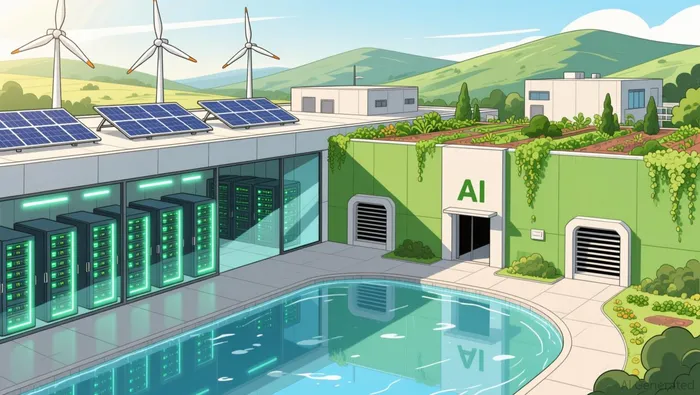 Microgrids and Power Purchase Agreements (PPAs) are also gaining traction. By 2030, 38% of data centers are expected to rely on on-site generation, up from 13% in 2024, while 84% of developers now prioritize electricity availability in site selection according to industry data. These shifts reflect a strategic pivot toward energy resilience, but they also highlight the high capital intensity of sustainable infrastructure.
Financial Risks and Investment Uncertainties
The financial risks of energy-dependent AI infrastructure are becoming acute. Rising energy costs, coupled with grid capacity constraints, are straining capital allocation. For example, the U.S. power grid faces bottlenecks in interconnection timelines and natural gas pipeline capacity, which could delay new data center deployments according to utility reports. Meanwhile, the global Energy Management Systems (EMS) market is expanding rapidly, projected to grow from $56 billion in 2025 to $219.3 billion by 2034, driven by AI-enabled predictive analytics to optimize energy use according to market projections.
Investors, however, face a paradox. While the data center infrastructure market is expected to reach $1 trillion in annual spending by 2030, companies like C3.ai-a key player in enterprise AI-illustrate the fragility of the sector. C3.ai's 45% stock price drop over 12 months, alongside a 19% revenue decline and $117 million net loss, underscores the operational and financial risks of AI infrastructure according to financial analysis. Leadership instability and sales execution failures have eroded investor confidence, raising questions about the scalability of AI platforms and their integration with renewable energy systems.
Geographic Shifts and Strategic Priorities
To circumvent energy bottlenecks, data center operators are relocating to regions with lower water stress and renewable energy access. The Midwest and "windbelt" states like Texas and Nebraska are emerging as hubs, while Nordic countries and Australia are gaining traction due to their natural cooling advantages according to energy research. This geographic realignment is reshaping capital allocation, with 60% of AI infrastructure spending directed toward technology developers and 25% toward power generation and cooling solutions according to industry insights.
However, these strategies are not without trade-offs. The need for continuous baseload power is driving utilities to adopt hybrid renewable-plus-storage systems and even nuclear energy according to infrastructure analysis. Such transitions require long-term regulatory support and grid modernization, which remain uncertain in many regions.
Conclusion: A Race Against the Clock
The AI data center boom is a double-edged sword. While it promises transformative economic gains, its sustainability hinges on resolving energy constraints through innovation, investment, and policy reform. For investors, the risks are manifold: energy cost volatility, grid capacity limitations, and the financial instability of key players like C3.ai. The path forward demands not only technological ingenuity but also a rethinking of how energy and AI infrastructure are financed and governed.
As the global data center infrastructure market races toward a $7 trillion valuation by 2030 according to market analysis, the question is no longer whether AI will reshape the world-but whether the energy systems supporting it can keep pace.





Comentarios
Aún no hay comentarios