
The DAT Bubble Burst: Regulatory, Market, and Strategic Aftermath in 2025
Regulatory Realignments: A New Framework for Stability
The regulatory environment has become a critical determinant of success in crypto infrastructure. Ripple's decision to forgo an IPO despite a $40 billion valuation underscores the sector's aversion to public market pressures. By maintaining private status, Ripple prioritizes long-term flexibility and regulatory agility, a strategy mirrored by other firms seeking to avoid the scrutiny that led to the DAT Bubble's implosion. Meanwhile, the U.S. Senate's restrictive language on hemp-derived products-though delayed by a one-year grace period-highlights the broader challenge of aligning crypto infrastructure with evolving legal standards. Companies like CV Sciences are adapting by diversifying into non-cannabinoid products and leveraging in-house manufacturing to mitigate regulatory risks.
Market Realities: Innovation Amidst Volatility
The post-bust market has seen a surge in innovation, particularly in bridging crypto and traditional finance. Crypto.com's Level Up programme, for instance, offers tiered cashback rewards on its Visa Prepaid Card, integrating digital assets into everyday spending. This model not only simplifies user access but also aligns with UK financial regulations, signaling a maturation of crypto infrastructure. Similarly, Ethereum-based infrastructure saw a 65% price increase in Q3 2025, while Layer 2 activity rose by 18%, reflecting growing demand for scalable solutions. Stablecoins, now managing $275 billion in assets under management, have become a cornerstone of this transition.
Strategic Opportunities: Undervalued Sectors and Companies
Three sectors stand out as undervalued yet strategically critical: blockchain interoperability, DeFi security, and institutional custody.
Blockchain Interoperability: The expansion of Wrapped BitcoinWBTC-- (WBTC) to the HederaHBAR-- network exemplifies this trend. By enabling BTC holders to access low-fee, MEV-resistant DeFi platforms, WBTC's integration with Hedera enhances liquidity and use cases. Similarly, LayerZero's cross-chain communication tools are reducing friction between ecosystems, a critical enabler for global adoption.
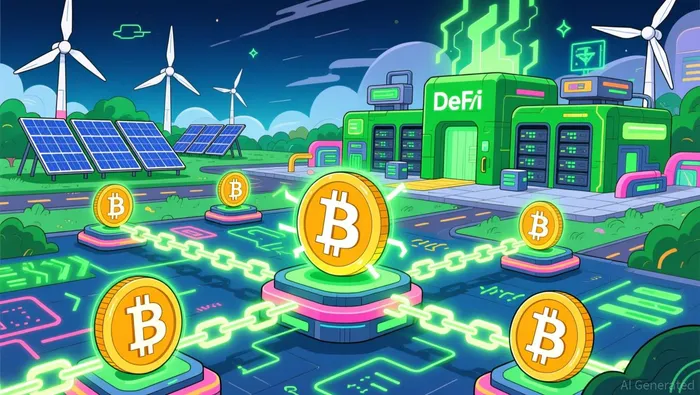
DeFi Security: IOIO-- DeFi has emerged as a leader in this space, offering transparent, automated yield contracts powered by renewable energy. With 3 million users and bank-grade encryption, the platform's stability contrasts sharply with the volatility of the DAT Bubble era. Its focus on green infrastructure further aligns with institutional demands for ESG-compliant investments.
Institutional Custody: Anchorage Digital's role in facilitating Bitcoin-native DeFi through its custody services for BOB's hybrid Bitcoin–Ethereum ecosystem is transformative. By securing $250 million in TVL, Anchorage is positioning BitcoinBTC-- as a gateway to DeFi, not just a store of value. This aligns with JPMorgan's upgraded rating for Circle, citing USDC's growth potential.
Financial Metrics and Risk Factors
While the sector's potential is clear, valuation metrics remain uneven. American Bitcoin, a Trump-linked mining firm, reported a 100% revenue increase in Q3 2025, yet its share price remains volatile amid Bitcoin's $97,000 slump. Similarly, IO DeFi's lack of public financials contrasts with the transparency of stablecoin-linked assets like USDCUSDC--, which now dominate $275 billion in AUM. Investors must weigh these metrics against macro risks, including the Bitcoin derivatives market's slow recovery from a $19 billion flash crash.
Conclusion: A Post-Bust Renaissance
The DAT Bubble's aftermath has forced crypto infrastructure firms to prioritize resilience over hype. Regulatory clarity, institutional adoption, and technological innovation are converging to create a more sustainable ecosystem. For investors, the key lies in identifying companies that align with these trends-those like Anchorage Digital, IO DeFi, and WBTC-while remaining vigilant about sector-specific risks. As the market matures, the undervalued sectors highlighted here may well become the bedrock of the next crypto cycle.





Comentarios
Aún no hay comentarios