
Dassault Aviation: A Powerhouse in the Expanding Defense Sector
The global defense industry is undergoing a transformation driven by geopolitical tensions, technological innovation, and the urgent need for modernization. In this environment, Dassault Aviation has emerged as a standout performer, leveraging its flagship Rafale program to secure a dominant position in the aerospace and defense market. The recent delivery of the 300th Rafale jet, announced on October 7, 2025, marks not just a milestone for the company but a testament to its operational excellence and strategic foresight in a sector poised for sustained growth.
Financial Momentum and Strategic Execution
Dassault Aviation's 2024 financial results underscore its robust momentum. Net sales surged to €6.2 billion, a 29% year-on-year increase, while adjusted operating income hit a record €519 million, translating to an 8.3% margin, according to Dassault's 2024 results. This performance was fueled by the Rafale program, which accounted for 30 export orders in 2024, including 18 for Indonesia and 12 for Serbia, according to a Defence Industry report. The Falcon business jet segment also contributed, with 26 orders in 2024, reflecting resilience in the luxury aviation market.
The company's financial strength is further evidenced by a €43.2 billion backlog as of December 31, 2024, ensuring a steady revenue pipeline. Dassault's 2025 outlook is equally promising, with projected net sales of €6.5 billion and plans to deliver 25 Rafale jets and 40 Falcon aircraft. This trajectory aligns with broader industry trends: the global defense market, valued at $2,563.1 billion in 2024, is expected to grow to $2,688.7 billion in 2025, driven by demand for advanced military technologies, according to the MarketsandMarkets outlook.
Rafale: A Catalyst for Market Leadership
The Rafale program is the cornerstone of Dassault's success. The delivery of the 300th Rafale jet-a milestone achieved ahead of schedule-highlights the program's operational efficiency and commercial appeal. With 533 aircraft ordered to date, including 56 for France and 164 for export, the Rafale has become a preferred alternative to Western and Russian platforms in markets such as the UAE (80 aircraft), Indonesia (42), and Egypt (30), according to a Mordor Intelligence report.
This success is underpinned by the Rafale's versatility, proven in combat operations, and its ability to integrate cutting-edge technologies. Dassault aims to increase production to four aircraft per month by 2025, a rate that reflects growing demand and the program's scalability. The company's industrial ecosystem, involving 400 French suppliers, also reinforces its strategic value to France's military and industrial sovereignty.
Defense Sector Dynamics and Competitive Positioning
Dassault's growth must be viewed against the backdrop of a rapidly evolving defense sector. The U.S. defense market, projected to reach $320.86 billion in 2025, is dominated by firms like Lockheed MartinLMT-- and BoeingBA--, which focus on platforms such as the F-35 and F-15EX. However, Dassault's niche in the European and emerging markets, combined with its emphasis on multirole capabilities, positions it to capture market share beyond its traditional base.
The company's innovation pipeline further strengthens its competitive edge. Dassault is developing a next-generation combat drone to accompany the Rafale F5, expected to enter service by 2030. This aligns with the industry's shift toward unmanned systems and AI-driven technologies, areas where early investment will determine long-term leadership.
Risks and Opportunities
While Dassault's trajectory is impressive, challenges remain. Supply chain disruptions and subcontractor issues could delay production targets. Additionally, geopolitical shifts-such as the U.S. and China's dominance in defense exports-pose risks to smaller players. However, Dassault's focus on high-value, technologically advanced platforms and its strong ties to French defense policy provide a buffer against such headwinds.
Conclusion
Dassault Aviation's 2024 performance and the 300th Rafale delivery signal a company in ascendance. By capitalizing on the defense sector's growth, diversifying its product portfolio, and investing in next-generation technologies, Dassault is well-positioned to sustain its momentum. For investors, the company represents a compelling case study in strategic execution within a sector defined by both geopolitical urgency and technological evolution.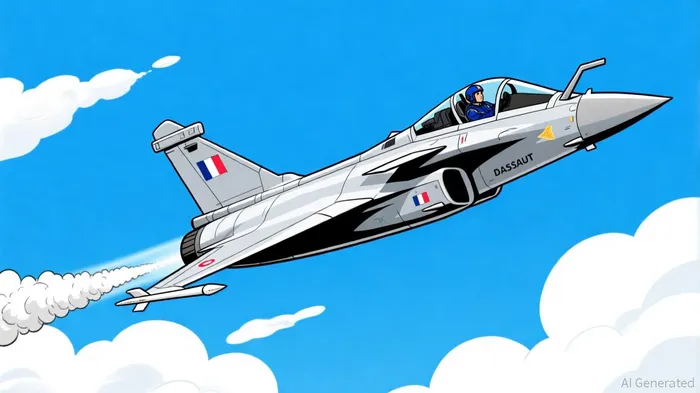





Comentarios
Aún no hay comentarios