
Currency Shifts in a Divergent World: USD-Long, EUR-Neutral, and JPY-Short Strategies Amid Powell's Cautious Fed
The global monetary landscape is undergoing a subtle but significant realignment as central banks navigate the delicate balance between inflation control and economic growth. At the heart of this shift lies the U.S. Federal Reserve's recent decision to cut interest rates by 25 basis points, marking the first reduction since December 2024. This move, framed by Chair Jerome Powell as a “risk management” strategy, reflects a growing concern over a cooling labor market and persistent inflationary pressures[1]. Meanwhile, the European Central Bank (ECB) and the Bank of Japan (BOJ) have adopted more cautious stances, maintaining rates amid divergent economic trajectories. These divergences are reshaping currency positioning, with USD-long, EUR-neutral, and JPY-short strategies gaining traction among investors.
The Fed's Tightrope: Balancing Risk and Rate Cuts
The Federal Reserve's September 2025 rate cut to a target range of 4.00%-4.25% underscores its prioritization of labor market stability over inflation. Powell emphasized that while inflation remains above the 2% target, the immediate threat lies in a weakening job market, where rising unemployment among specific demographics and declining job-finding rates signal fragility[1]. The Fed's Summary of Economic Projections anticipates two further cuts by year-end and one in 2026, though internal divisions—evidenced by Stephen Miran's dissent for a larger 50-basis-point reduction—highlight the uncertainty[1].
This cautious approach has immediate implications for the USD. While rate cuts typically weaken a currency, the Fed's emphasis on “meeting-by-meeting” adjustments and its commitment to maintaining policy independence[3] suggest that the USD may remain resilient in the short term. Investors are pricing in a gradual normalization of rates, which could support the dollar against peers with more accommodative policies.
The ECB's Steady Hand: A Neutral EUR Outlook
In contrast to the Fed's measured rate cuts, the ECB has opted to hold its key rates steady, with the deposit facility rate at 2.00% and the main refinancing rate at 2.15%[1]. The Governing Council's decision reflects confidence in the eurozone's inflation trajectory, which is projected to average 2.1% in 2025 and 1.7% in 2026[1]. This stability, coupled with upward revisions to growth forecasts (1.2% for 2025), positions the euro as a neutral asset.
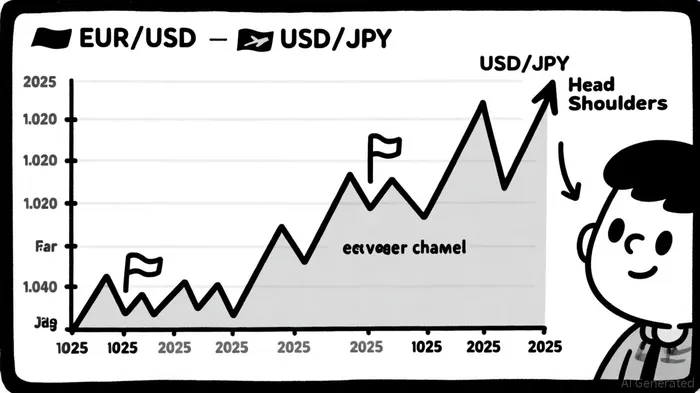
However, the EUR's trajectory is not without risks. The ECB's data-dependent approach means that any surprise inflationary spikes or growth disappointments could trigger rate adjustments. For now, though, the EUR's positioning against the USD hinges on the Fed's pace of easing. With the EUR/USD pair trading within an ascending channel since early 2025[2], investors may find EUR-long positions attractive if the Fed's rate cuts accelerate, but the currency's volatility warrants caution.
The BOJ's Hesitation: A Case for JPY-Short Strategies
The BOJ's decision to maintain its benchmark rate at 0.5% underscores Japan's unique challenges. High U.S. tariffs and global economic uncertainty have forced the central bank to delay further rate hikes, with the next increase now expected by year-end[4]. Meanwhile, Japan's inflation projections have been revised downward to 2.2% for fiscal 2025 and 1.7% for 2026[3], reflecting weaker domestic demand and falling oil prices.
This dovish stance, combined with the BOJ's announcement to sell ETFs and REITs to reduce market dysfunction[4], signals a prolonged period of yen weakness. The USD/JPY pair, which has broken above an inverted Head and Shoulders pattern[2], is likely to remain under upward pressure. A JPY-short strategy, therefore, appears well-justified, particularly as the BOJ's reluctance to accelerate tightening contrasts with the Fed's gradual easing.
Positioning in a Divergent World
The interplay of these policies creates a compelling case for a USD-long, EUR-neutral, and JPY-short portfolio. The Fed's rate cuts, while modest, are expected to ease borrowing costs and support economic activity, potentially stabilizing the USD against the EUR and JPY. The EUR's neutrality stems from the ECB's balanced approach, while the JPY's vulnerability to global trade tensions and slow rate hikes makes it a natural short.
Technically, the EUR/USD's ascending channel and the USD/JPY's bullish engulfing pattern[2] reinforce these strategic tilts. Investors should monitor the Fed's upcoming meetings for signs of faster rate cuts, which could amplify the USD's strength, and the BOJ's response to inflationary pressures, which might limit the yen's decline.
Conclusion
Central banks are navigating a complex web of inflation, labor market dynamics, and geopolitical risks. The Fed's cautious rate cuts, the ECB's steady hand, and the BOJ's hesitancy are reshaping currency valuations in ways that favor a USD-long, EUR-neutral, and JPY-short strategy. As these policies unfold, investors must remain attuned to both macroeconomic fundamentals and technical signals to capitalize on emerging opportunities.







Comentarios
Aún no hay comentarios