
When Courts Close Doors: The Khalil Case and the Erosion of Institutional Trust in U.S. Immigration Policy
The detention of Mahmoud Khalil, a Columbia University graduate student and lawful permanent resident, has become a flashpoint in the U.S. immigration debate. His case, Khalil v. Joyce, raises profound questions about the balance between national security, constitutional rights, and the rule of law. For investors, it signals a deeper risk: the erosion of institutional trust in a legal system increasingly perceived as inconsistent or overreaching. This uncertainty could destabilize sectors reliant on immigration, from agriculture to technology, while amplifying geopolitical tensions that weigh on markets.
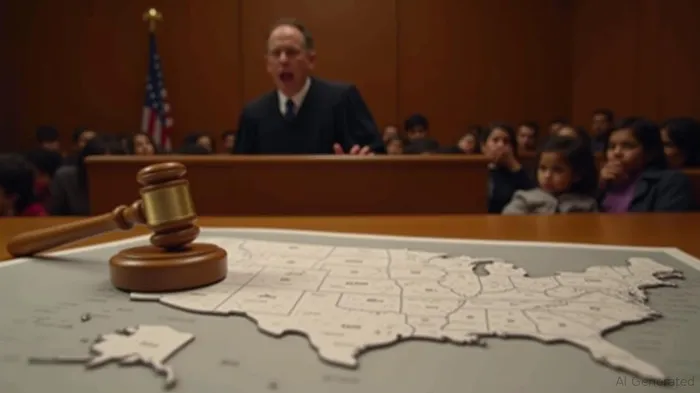
The Khalil Case: A Microcosm of Legal Uncertainty
Khalil, accused of advocating for Palestinian rights—a charge the government claims harms U.S. foreign policy—was detained under Section 1227(a)(4)(C)(i) of the Immigration and Nationality Act. His habeas corpus petition argued that his arrest violated First Amendment rights and due process. However, the case's first hurdle was jurisdictional: the court ruled it lacked authority because Khalil had been transferred to New Jersey by the time his New York-based lawyer filed the petition. This strict adherence to the "district of confinement" rule, despite the gravityGRVY-- of his constitutional claims, underscores a paradox: procedural rigor can overshadow substantive justice.
The court's decision, while legally defensible under Rumsfeld v. Padilla, highlights a systemic issue. As Judge Lewis A. Kaplan noted, jurisdictional rules "apply without exception," even when constitutional rights are at stake. For investors, this signals a broader risk: policies and rulings that prioritize procedure over clarity may erode confidence in the system's ability to protect fundamental rights—or, conversely, its capacity to enforce immigration laws consistently.
Geopolitical Tensions and Institutional Stability
The Khalil case is part of a pattern of executive overreach in immigration enforcement. The Trump administration's 2025 policies—including restrictions on birthright citizenship, expanded expedited removals, and the revival of the "Remain in Mexico" program—have intensified scrutiny of U.S. institutions. Legal challenges to these measures, such as the temporary restraining order against birthright citizenship changes, add to the uncertainty.
The interplay between foreign policy and immigration law is particularly fraught. Khalil's detention was framed as a national security issue, yet his alleged offense—protesting Israel's Gaza policies—invites comparisons to past overreactions against dissent. For investors, the risk is twofold:
1. Economic Disruption: Sectors relying on immigrant labor, such as agriculture (where 23% of workers are foreign-born) and construction (20%), face potential labor shortages if enforcement intensifies.
2. Reputational Damage: Aggressive policies may deter global talent, weakening innovation hubs like Silicon Valley, where immigrants account for 52% of engineers.
The Investment Implications: Navigating Uncertainty
Investors must weigh the Khalil case and broader policy shifts against three critical factors:
1. Sector-Specific Risks
- Labor-Dependent Industries: Agriculture, hospitality, and construction face elevated risks. A 10% reduction in immigrant labor could cut U.S. farm output by $12 billion annually, per the American Farm Bureau. Investors should consider hedging with defensive stocks or sectors less reliant on migrant workers (e.g., healthcare, utilities).
- Technology and Innovation: High-skilled immigrants contribute 36% of patents in tech fields. Policies restricting visas or work permits may slow R&D, favoring firms with domestic talent pipelines or offshore operations.
2. Legal and Political Uncertainty
- Litigation Costs: Companies exposed to immigration enforcement (e.g., employers verifying worker status) may face compliance burdens. The legal challenges to birthright citizenship alone could cost $15 billion in enforcement and court costs.
- Geopolitical Fallout: Strained U.S. relations with countries like Mexico or Canada over asylum policies could disrupt trade. Investors might diversify into regions less tied to U.S. immigration dynamics, such as Southeast Asia.
3. Opportunities in Security and Enforcement
- Border Infrastructure: Firms supplying detention facilities or surveillance technology (e.g., Palantir, Boeing) may benefit from increased spending. However, reputational risks exist, as public backlash grows.
- Legal Services: Demand for immigration attorneys and compliance experts could rise, favoring firms like Greenberg Traurig or niche consultancies.
A Path Forward: Prudent Caution, Strategic Flexibility
Investors should adopt a two-pronged strategy:
- Short-Term: Reduce exposure to sectors vulnerable to labor shortages or regulatory overreach. Consider defensive assets like Treasuries or commodities.
- Long-Term: Monitor judicial outcomes. A ruling in Khalil's favor on his constitutional claims could restore confidence in legal safeguards. Conversely, further executive actions (e.g., banning pro-Palestinian advocacy) might trigger capital flight from U.S. markets.
Conclusion: Trust is the Currency of Capital
The Khalil case reveals a systemic tension: the U.S. legal system's strict adherence to procedural rules may protect institutional integrity but risks alienating those who see it as indifferent to constitutional principles. For investors, this is a warning. Institutions that appear inconsistent—or overly influenced by political agendas—erode trust. In an era of geopolitical volatility, capital will flow to markets where the rule of law is perceived as both robust and equitable. Until clarity emerges, caution—and diversified portfolios—remain the safest bets.
In the words of Justice Kennedy, quoted in Padilla, "The purpose of habeas corpus is to protect against imprisonment that is either unlawful or otherwise violates constitutional rights." If courts increasingly prioritize form over substance, the cost to U.S. competitiveness—and investor confidence—will be profound.







Comentarios
Aún no hay comentarios