
Costco Wholesale Corp: Valuation Implications and Growth Sustainability Amid Inflation and Rate Cuts
The recent decision by Mizuho to cut its price target for Costco WholesaleCOST-- Corp (COST) from $975 to $950-despite the company's robust financial performance-raises critical questions about valuation sustainability in a high-inflation, high-interest-rate environment. This adjustment, announced in September 2025, reflects the firm's caution over slowing growth and a perceived overvaluation of the stock, even as broader analyst sentiment remains cautiously optimistic, according to Costco's fiscal 2025 results. To assess the implications of this move, we must dissect Costco's financial resilience, strategic adaptability, and the macroeconomic forces shaping its trajectory.
Mizuho's Rationale: A Cautionary Stance in a Crowded Market
Mizuho's initial April 2025 coverage of CostcoCOST-- with a Neutral rating and $975 target acknowledged the company's "strong financial fundamentals" and its ability to navigate tariffs through inventory stockpiling and vendor negotiations, per StockAnalysis's ratios. However, the firm's subsequent reduction to $950 underscores concerns about decelerating growth and a stock it deems "overvalued" and a "crowded long." This suggests that while Costco's business model remains durable, the market may be pricing in optimism that exceeds near-term execution risks, according to StockAnalysis. The firm's skepticism contrasts with the broader analyst consensus, which assigns an average one-year target of $1,050 (8.97% upside) and a "Moderate Buy" rating.
Costco's Financial Resilience: Navigating Inflation and Interest Rates
Costco's fiscal 2025 results demonstrate its ability to thrive in a challenging macroeconomic environment. Net sales surged 8.1% year-over-year to $269.9 billion, driven by a 10% increase in membership fees and strategic investments in e-commerce (14.8% growth via partnerships like Instacart) and standalone gas stations, as noted in the company report. Operating margins expanded to 3.65%, and the company generated $6.63 billion in free cash flow, reflecting disciplined cost management, supported by Monexa's analysis. These metrics suggest that Costco's value-driven model-emphasizing bulk sales and high-margin memberships-has insulated it from inflationary pressures better than many peers.
Yet, the company's valuation remains a point of contention. As of July 2025, Costco traded at a P/E ratio of 55.51x, significantly above its historical range (37.50x–61.05x) and industry benchmarks like Walmart's 39x, according to StockAnalysis. This premium reflects investor confidence in Costco's predictable cash flows and international expansion potential but leaves little margin for error in a slowing economy. Mizuho's critique-that strategic initiatives may prioritize customer experience over immediate profit-highlights a risk: if reinvestments fail to translate into earnings growth, the stock's lofty multiple could become a liability.
Macroeconomic Context: Rate Cuts and Inflation Moderation
The U.S. Federal Reserve's September 2025 rate cut-reducing the federal funds rate to 4.00–4.25%-and projections of two further cuts in 2025 provide some tailwind for growth stocks like Costco, as reflected in the Fed's September decision. Lower borrowing costs could ease pressure on consumer spending, a critical driver for retail. However, inflation remains a wildcard: the annual CPI-U stood at 2.9% as of August 2025, above the Fed's 2% target, with core inflation at 3.02%-indicating persistent price pressures in services and housing, per the BLS CPI release. While Costco's gross margin expansion (12.61%) suggests it has mitigated input costs effectively, sustained inflation could erode consumer discretionary spending, particularly for non-essential bulk items, as earlier industry analysis observed.
Strategic Expansion and Valuation Sustainability
Costco's aggressive expansion-28 new warehouses planned for 2025-and digital innovations position it to capitalize on long-term trends. Its 92% U.S. and Canadian membership renewal rate underscores customer loyalty, a key moat in a competitive retail landscape, according to the company report. However, the company's debt-to-equity ratio of 0.21 (as of August 2025) and 30.69% ROE highlight a delicate balance between leveraging growth and maintaining financial flexibility, a point noted in a Mizuho coverage note. In a high-interest-rate environment, maintaining this equilibrium will be crucial.
Conclusion: A Stock at a Crossroads
Mizuho's target price cut signals a measured approach to Costco, emphasizing valuation risks in a market where optimism may outpace fundamentals. While the company's operational strengths and strategic initiatives justify its premium valuation, investors must weigh these against macroeconomic uncertainties. The Fed's rate cuts and Costco's resilience in a 2.9% inflationary environment offer some reassurance, but the stock's 55x P/E ratio demands consistent earnings growth to justify its price. For now, Costco remains a compelling long-term play, but short-term volatility-and divergent analyst views-suggest prudence for new entrants.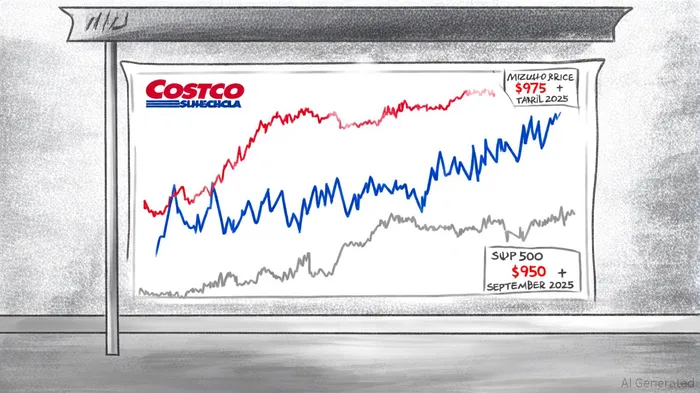





Comentarios
Aún no hay comentarios