
The Cost of Contradiction: How US Tech Deterrence Backfires and Fuels Chinese Resilience
The United States' aggressive approach to curbing China's technological rise—through tariffs, export controls, and supply chain fragmentation—has paradoxically weakened its own semiconductor industry, inflated global costs, and accelerated innovation in China. While Washington aims to “friend-shore” advanced chip production, its inconsistent policies have created fertile ground for Chinese tech firms to thrive. This article explores how the Stargate project's delays, TSMC's strategic pivots, and US inflation dynamics are reshaping the global semiconductor landscape—and why investors should look east for opportunities.
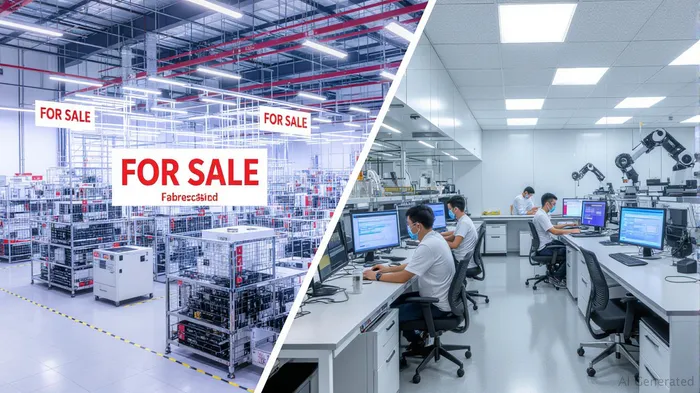
The US Policy Paradox: Tariffs, Delays, and Inflation
The Trump-era tariffs on semiconductors and materials (e.g., aluminum, steel) were designed to protect domestic industries, but their execution has been chaotic. By 2025, Section 232 tariffs on steel and aluminum had doubled to 50%, while IEEPA-based “reciprocal” tariffs faced legal challenges. These measures forced companies like TSMCTSM-- to prioritize U.S. production to avoid penalties, yet labor shortages and logistical bottlenecks have delayed its Arizona “Stargate” project—a $40 billion 3nm fab—by over a year. Meanwhile, Japan's TSMC plant, delayed to 2028, underscores the fragility of U.S. supply chain ambitions.
The economic toll is stark. reveals a 12% U.S. decline versus China's 25% rise. Inflation metrics highlight the cost: shows tariffs contributed 0.8% to annual inflation, stifling competitiveness.
China's Resilience: Innovation Amid Constraints
While the U.S. struggles with fragmentation, Chinese firms are leveraging constraints to build self-reliance. Huawei's HiSilicon, barred from TSMC's advanced nodes, has pivoted to cost-efficient 14nm and 28nm chips for AI edge computing—a market growing at 22% annually. Similarly, DeepSeek's large-scale language models (LLMs) now use China's indigenous chipsets, reducing reliance on U.S. GPU imports.
reveals a 30% cost advantage for DeepSeek's solutions, signaling a shift toward “good enough” innovation that bypasses U.S. tech dominance.
Investment Opportunities: Betting on Resilience
The U.S. semiconductor ecosystem is overvalued and vulnerable to policy whiplash. TSMC (TSM), while a beneficiary of subsidies, faces execution risks in its Stargate project. Meanwhile, Chinese stocks like Semiconductor Manufacturing International Corporation (SMIC) and Vietnam's VinChip (a Southeast Asian foundry) offer asymmetric upside:
- Chinese Tech Titans: SMIC's 28nm foundry capacity is now 85% utilized, with contracts from ByteDance and Xiaomi. shows a 35% outperformance.
- Supply Chain Alternatives: Vietnam's VinChip, backed by Samsung and IntelINTC--, is building a 55nm fab to serve regional demand. Its valuation is 40% below peers, offering exposure to Asia's $150 billion semiconductor market.
Conclusion: The New Semiconductor Playbook
The U.S. may have started the tech deterrence war, but China is writing the playbook for resilience. Investors ignoring this shift risk missing a generational opportunity. As U.S. policies fracture supply chains and inflate costs, capital should flow to firms thriving in constrained environments—whether through efficient AI models, indigenous chipmaking, or regional manufacturing hubs. The future of semiconductors is not about who builds the fastest chips, but who adapts best to a fractured world.
The era of U.S. semiconductor hegemony is ending. The question now is: Who will fill the void?





Comentarios
Aún no hay comentarios