
Copper's Strategic Position Amid Fed Uncertainty and Geopolitical Turbulence
The global copper market in 2025 is at a crossroads, shaped by the interplay of monetary policy uncertainty, geopolitical fragility, and surging industrial demand. As the Federal Reserve navigates rate-cutting expectations amid a U.S. government shutdown, and as supply chains face disruptions from mine accidents and political instability, copper's role as a strategic commodity has never been more pronounced. This analysis examines how these forces converge to position copper as both an inflation hedge and a critical asset in the energy transition.
Fed Policy and Dollar Dynamics: A Double-Edged Sword
The Federal Reserve's projected rate cuts-3.6% in 2025, declining to 3.1% by 2028-signal a dovish tilt, according to the FOMC projections. However, the September 2025 government shutdown has muddied the waters. With key economic data (nonfarm payrolls, CPI) delayed, the Fed risks making decisions based on incomplete information, potentially leading to abrupt policy shifts, as a Reuters report warned. Historically, copper prices have risen 5–8% in the three months following Fed easing cycles, according to Discovery Alert. A weaker dollar, already down 2.3% since its May 2025 peak, further supports copper by making it cheaper for dollar-dependent buyers, the Discovery Alert analysis noted. Yet, the shutdown's uncertainty could amplify volatility, as markets oscillate between hawkish and dovish interpretations of Fed signals.
Supply Constraints: A Perfect Storm
Global copper supply is under severe strain. The Grasberg mine in Indonesia, which accounts for 3% of global output, remains in force majeure after a September 2025 flood, reducing production by 35%, according to an Oilprice report. Meanwhile, Chile's El Teniente mine collapse and Peru's Constancia mill shutdown have removed 2.6% of global supply, as a Benzinga piece explained. These disruptions compound long-standing structural bottlenecks: new mines take up to 25 years to develop, and ore grades are declining, the UNCTAD update noted. China's recent discovery of 20 million tons of copper in the Qinghai-Tibet Plateau offers a glimmer of hope but raises environmental and geopolitical concerns, particularly given the region's ecological sensitivity and proximity to India, an EcoTicias report observed.
Industrial Demand: The Energy Transition's Appetite
Copper demand is surging, driven by electric vehicles (EVs), renewables, and AI infrastructure. A single EV requires four times more copper than a conventional car, while offshore wind farms demand vast quantities for transmission, according to the IEA Global EV Outlook. Global demand is projected to rise 40% by 2040, yet supply is expected to lag, creating a 30% shortfall by 2035, J.P. Morgan projects. The U.S. and Europe's push for decarbonization is accelerating this trend, with EVs alone set to consume 780 TWh of electricity by 2030, the Deloitte outlook finds. However, geopolitical risks in key producing regions-such as Chile's regulatory uncertainty and Peru's anti-mining protests-threaten to disrupt this demand-supply balance, per S&P Global analysis.
Strategic Investment Strategies: Hedging and Diversification
Investors are adopting multi-layered strategies to navigate these challenges. Futures and options on the LME and CME are being used to lock in prices amid volatility, as outlined in a BMREducation guide. Physical inventory buffers are also gaining traction, though they carry the risk of depreciation if demand softens. Geopolitical diversification is another priority: companies like Glencore and BHPBHP-- are shifting capital to Chile and Argentina, where high-grade deposits and stable ESG frameworks attract institutional capital, the Crux Investor analysis notes. Meanwhile, recycling is emerging as a critical solution-UNCTAD reported that secondary sources accounted for 20% of refined copper output in 2023.
Conclusion: Copper as a Strategic Asset
Copper's strategic positioning is underscored by its dual role as an inflation hedge and a linchpin of the energy transition. While Fed policy and geopolitical risks create near-term volatility, the long-term fundamentals-driven by electrification and decarbonization-remain robust. For investors, the key lies in balancing exposure to near-term price swings with long-term supply chain resilience. As the world races toward a low-carbon future, copper will remain a barometer of both economic health and geopolitical stability.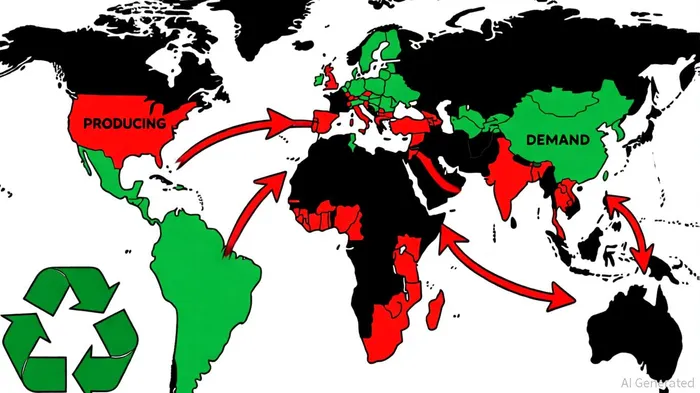





Comentarios
Aún no hay comentarios