
Is Constellation Energy Overvalued Despite Its Strong Growth Narrative?
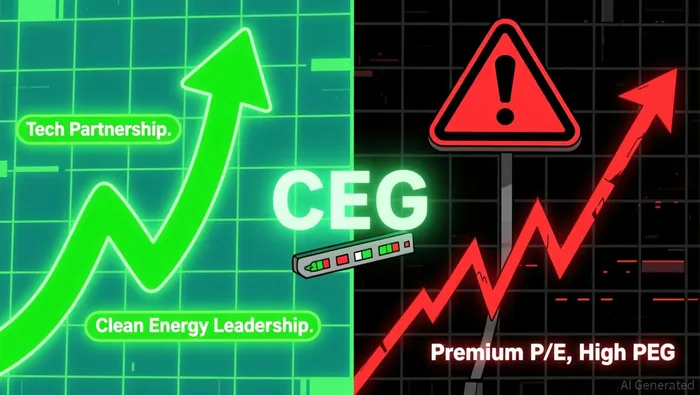
The debate over whether Constellation EnergyCEG-- (CEG) is overvalued hinges on a critical tension between valuation realism and future growth optimism. While the stock's current metrics suggest a premium valuation, its aggressive expansion plans, strategic acquisitions, and long-term revenue visibility from major tech clients could justify the elevated multiples. This analysis dissects the numbers and narratives to determine whether the market is overreaching or simply pricing in a compelling growth story.
Valuation Realism: Metrics Suggest a Premium
Constellation Energy's trailing price-to-earnings (P/E) ratio of 40.89 and forward P/E of 31.75 according to stock analysis place it well above the S&P 500's average P/E of around 25. The PEG ratio of 2.09 according to stock analysis, which compares the P/E ratio to earnings growth expectations, further underscores the stock's premium valuation. A PEG above 1 typically signals overvaluation relative to growth prospects, and CEG's ratio implies investors are paying significantly more for each unit of earnings growth compared to its peers.
The enterprise value-to-EBITDA (EV/EBITDA) ratio also raises questions. As of September 2025, CEG's EV/EBITDA stood at 15.71 according to Gurufocus, exceeding the Utilities - Independent Power Producers sector median of 11.41. A separate report from December 2025 cited in value investing analysis cited a higher EV/EBITDA of 20.4, likely reflecting updated enterprise value assumptions or seasonal fluctuations. Regardless, the metric positions CEGCEG-- as one of the more expensive utilities in its sector, with analysts noting it ranks in the lower 36.55% of the industry in terms of valuation according to Gurufocus.
Growth Optimism: Strategic Catalysts and Revenue Visibility
The counterargument rests on CEG's robust growth narrative. The company has revised its 5-year earnings guidance, projecting a compound annual growth rate (CAGR) of over 10% in adjusted EPS through 2028. This optimism is fueled by two key drivers: long-term power purchase agreements (PPAs) with tech giants and the pending $26.6 billion acquisition of Calpine Corporation.
1. Tech Sector Partnerships
CEG's 20-year PPAs with Microsoft and Meta Platforms according to Nasdaq analysis provide stable, inflation-protected cash flows. These agreements lock in demand for carbon-free energy from its nuclear and renewable assets, insulating the company from market volatility while aligning with global decarbonization trends. Such visibility reduces growth risk, making high valuation multiples more palatable to investors.
2. Calpine Acquisition
The Calpine deal, expected to close in 2026, is a game-changer. Analysts estimate it will add over $2 per share to CEG's earnings and $2 billion annually to free cash flow. This acquisition not only diversifies CEG's energy mix but also accelerates its path to becoming a top-tier clean energy provider. The market appears to price in a significant portion of these synergies, as reflected in the 9.56% average analyst price target premium over the current stock price according to stock analysis.
3. Operational Momentum
CEG's fourth-quarter 2024 results according to company news-GAAP net income of $2.71 per share and adjusted operating earnings of $2.44 per share-highlight operational efficiency and nuclear portfolio strength. These results, coupled with reaffirmed 2025 guidance of $8.90–$9.60 in adjusted EPS according to company news, reinforce confidence in the company's ability to meet growth targets.
Balancing the Equation: Is the Premium Justified?
The crux of the valuation debate lies in whether CEG's growth trajectory can outpace its current multiples. A PEG ratio of 2.09 according to stock analysis implies investors are paying double the earnings growth rate for the stock. However, if the Calpine acquisition and tech PPAs deliver the projected $2-per-share earnings boost, the PEG could normalize to a more attractive range.
Moreover, the industry EV/EBITDA comparison according to Gurufocus must be contextualized. While 15.71 exceeds the sector median, it aligns with high-growth utilities that have secured long-term contracts or are undergoing transformative M&A. CEG's unique position as a carbon-free energy leader with tech-sector partnerships may warrant a premium valuation, especially in a low-interest-rate environment where investors prioritize stable cash flows.
Conclusion: A High-Stakes Bet on the Future
Constellation Energy's valuation appears stretched by traditional metrics but is underpinned by a compelling growth story. The market is pricing in the success of its Calpine acquisition and the execution of its clean energy strategy. For investors, the key risk is whether these ambitious plans materialize as expected. If CEG meets its 10% EPS CAGR target, the current premium could prove justified. However, any delays in the acquisition, regulatory hurdles, or underperformance in its nuclear operations could expose the stock to significant downside.
In the end, CEG embodies the classic tension between valuation realism and growth optimism. For those who believe in its long-term vision, the stock represents a high-conviction bet on the future of energy. For others, the elevated multiples serve as a cautionary tale of market exuberance.







Comentarios
Aún no hay comentarios