
The Coal Industry's Structural Decline and Its Impact on Global Mining Equities: Capital Reallocation and Sector Rotation in the Energy Transition
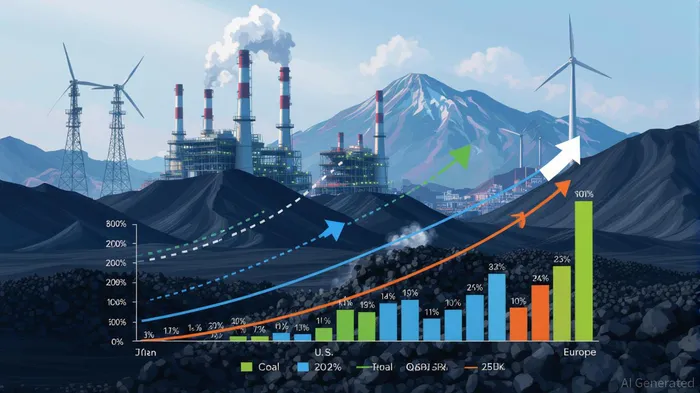
The global coal industry is undergoing a structural decline driven by shifting energy priorities, regulatory pressures, and the accelerating energy transition. While coal demand grew to 8.79 billion tonnes in 2024, this represents a slowing rate of growth compared to earlier years, with China's coal share in power generation dropping to a nine-year low of 51% in June 2025 [1]. Meanwhile, capital reallocation is reshaping mining equities, as investors pivot toward renewables and critical minerals. This analysis examines the interplay of structural decline, capital reallocation, and sector rotation, and its implications for mining equities.
Structural Decline in the Coal Industry
The coal sector's decline is most pronounced in the U.S. and OECD countries. U.S. coal production fell to 512 million short tons in 2024, with forecasts predicting a further drop to 467 million short tons by 2026 due to rising mining costs, environmental regulations, and competition from natural gas and renewables [2]. In Europe, coal retirements accelerated in 2024, with the EU27 retiring 11 GW of coal capacity and the UK completing its coal phaseout [3].
However, the picture is more complex in China and India. Despite global coal phaseout trends, China commissioned 30.5 GW of new coal capacity in 2024—70% of the global total—and plans further additions to support its energy security [3]. India also proposed 38.4 GW of new coal capacity in 2024, underscoring its reliance on coal despite a 500 GW non-fossil target by 2030 [3]. These developments highlight the uneven pace of the energy transition, where coal remains a critical energy source in emerging economies.
Capital Reallocation and Sector Rotation
Capital reallocation is a defining trend in 2025, with global energy transition investments reaching $3.3 trillion, of which two-thirds are directed toward clean energy [4]. Solar energy alone attracted $450 billion in 2025, while European investments in renewables surged by 63% in the first half of the year, contrasting with a 36% drop in U.S. renewables investments [4]. This shift reflects a broader sector rotation, as investors move away from high-flying tech stocks and into energy and industrials, driven by the demand for energy to power AI data centers and infrastructure [5].
Mining equities are also feeling the impact. Companies like Newmont CorporationNEM-- and BHPBHP-- are investing heavily in decarbonization technologies, including battery-electric vehicles (BEVs) and hydrogen-powered haul trucks, to align with net-zero targets [6]. Meanwhile, coal mining firms face mounting pressure to adopt carbon capture and storage (CCUS) or risk obsolescence. For example, Peabody Energy's Q3 2024 revenue rose 12% year-over-year, but U.S. coal production declined by 6.6% in the same period, reflecting the sector's fragility [7].
Equity Performance and Investor Sentiment
Coal and renewable energy equities have shown divergent performance in Q3 2025. Hallador EnergyHNRG-- (HNRG) and Warrior Met CoalHCC-- (HCC) outperformed, with HNRG's stock surging 78.54% over the past year [7]. In contrast, renewable energy stocks faced mixed results: Bloom EnergyBE-- (BE) saw a 164% stock price jump after raising revenue guidance, while Plug PowerPLUG-- (PLUG) and Array (ARRY) underperformed due to weak guidance [7].
Investor sentiment is increasingly influenced by policy and macroeconomic factors. The U.S. Inflation Reduction Act (IRA) has bolstered cleantech manufacturing, but its enforcement freeze under the Trump administration in 2024 caused a downturn in renewable energy investor confidence [8]. Meanwhile, coal stocks benefit from short-term demand for energy security, particularly as LNG exports expand to meet industrial and data center needs [8].
Future Outlook and Strategic Implications
The energy transition is creating a dual-track scenario: coal's decline in OECD countries is offset by its persistence in China and India, while capital flows into renewables and critical minerals. Mining companies must navigate this duality by balancing short-term coal operations with long-term decarbonization strategies. For instance, Rio Tinto's ELYSIS™ joint venture for low-carbon aluminum production and Vale's green briquettes for steelmaking exemplify adaptive strategies [6].
However, challenges remain. Grid constraints, permitting delays, and underinvestment in infrastructure threaten the rapid deployment of renewables [4]. For coal equities, the risk of stranded assets grows as OECD countries accelerate phaseouts. Conversely, companies that pivot to critical minerals—such as lithium and copper—position themselves to benefit from the energy transition's demand surge [9].
Conclusion
The coal industry's structural decline is reshaping global mining equities through capital reallocation and sector rotation. While coal remains a lifeline for energy security in key markets, its long-term viability is increasingly contingent on decarbonization technologies. Investors must weigh the risks of stranded assets against the opportunities in renewables and critical minerals, as the energy transition continues to redefine the mining sector's landscape.





Comentarios
Aún no hay comentarios