
CleanSpark: Is the AI Transition a Sustainable Play or a Bitcoin Rebound Story?
The strategic evolution of CleanSparkCLSK--, a company once synonymous with BitcoinBTC-- mining, has sparked a critical debate among investors: is its pivot to artificial intelligence (AI) and high-performance computing (HPC) a sustainable long-term play, or is it merely a stopgap measure to ride the next Bitcoin bull cycle? The answer lies in dissecting the company's financial allocations, infrastructure bets, and the broader industry dynamics shaping its trajectory.
The Bitcoin Foundation: A Double-Edged Sword
CleanSpark's 2025 financial results underscore the enduring dominance of Bitcoin in its revenue model. The company reported $766.3 million in revenue for the year, a 102% year-over-year increase, driven largely by Bitcoin mining operations. This growth, however, masks a persistent vulnerability: the sector's susceptibility to volatile crypto markets and declining profit margins post-halving. CleanSpark's 2023 results, for instance, revealed a $136.6 million net loss, partly attributed to non-cash expenses tied to Bitcoin valuation changes. Such volatility raises questions about the sustainability of relying on Bitcoin alone.
Yet, Bitcoin remains a critical asset. The company's $1.15 billion zero-coupon convertible notes offering in 2025 explicitly earmarked funds for expanding Bitcoin mining infrastructure, including power and land acquisitions. This reflects a pragmatic approach: leveraging its existing expertise in energy procurement and data center management to maintain a competitive edge in mining while hedging against crypto market fluctuations.
The AI and HPC Gambit: A Strategic Diversification
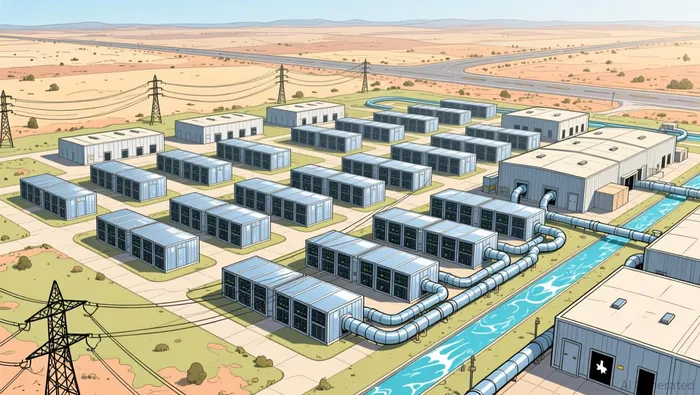
CleanSpark's foray into AI and HPC represents a calculated attempt to future-proof its business. By 2025, the company had secured 271 acres in Texas and 285 MW of power agreements to build an AI-focused data center campus, with 200 MW expected to be operational by 2027. These investments are underpinned by a $1.15 billion capital raise, with $670 million allocated to infrastructure development, including HPC capabilities. The firm has also partnered with Submer to deploy liquid-cooled modular data centers, a move that aligns with the surging global demand for compute resources.
However, the AI segment remains a work in progress. As of 2025, AI/HPC initiatives are non-revenue-generating, with management projecting revenue to materialize only in 2027 following tenant onboarding and infrastructure commissioning. This timeline introduces a critical risk: the time lag between capital outlays and returns. For investors, the question becomes whether CleanSpark can sustain its Bitcoin operations long enough to see the AI bets pay off.
Capital Allocation and Industry Trends
 CleanSpark's capital strategy reveals a nuanced balance between short-term survival and long-term transformation. The $1.15 billion convertible notes offering included $460 million for share repurchases, signaling confidence in its equity value while reducing dilution. The remaining funds were directed toward repaying Bitcoin-backed credit lines, expanding power infrastructure, and developing AI/HPC capabilities. This approach mirrors a broader industry trend: Bitcoin miners repurposing their energy and hardware assets for AI workloads to offset shrinking margins.
Yet, the zero-coupon structure of the notes-offering equity optionality instead of cash interest-hints at investor skepticism about CleanSpark's ability to generate consistent cash flows in the near term. This contrasts with the company's optimistic projections of $3.8 billion in shareholder value from its Texas campus by 2027, a figure that hinges on the successful execution of its AI strategy.
The Sustainability Question
The sustainability of CleanSpark's AI transition depends on two factors: the scalability of its infrastructure and the alignment of its strategy with macroeconomic trends. The company's access to 1.3 gigawatts of power capacity and its focus on energy-efficient, modular data centers position it to capitalize on the AI boom. However, the sector is highly competitive, with tech giants and specialized firms already dominating the market. CleanSpark's ability to differentiate itself through cost efficiency and geographic proximity to major urban centers will be pivotal.
Conversely, the Bitcoin rebound story is inherently speculative. While the post-halving environment often triggers price recoveries, CleanSpark's financials suggest that Bitcoin mining alone may not sustain its ambitions. The 2025 net loss of $136.6 million in 2023, despite a revenue surge, underscores the sector's fragility.
Conclusion: A Hybrid Play with High Stakes
CleanSpark's strategic shift is neither purely a Bitcoin rebound story nor a fully realized AI play. It is a hybrid approach, leveraging Bitcoin's current profitability to fund a transition into HPC and AI. This dual-track strategy is logical in a volatile market but carries significant risks. The AI segment's delayed revenue generation and the capital intensity of infrastructure development mean that CleanSpark must navigate a narrow path: maintaining Bitcoin's cash flow while accelerating its AI pivot.
For investors, the key will be monitoring the company's ability to execute its 2027 timeline and secure meaningful AI contracts. If successful, CleanSpark could emerge as a diversified compute platform. If not, it risks being caught between a fading Bitcoin model and an unproven AI venture. In the end, the sustainability of this transition will depend not just on CleanSpark's operational agility, but on the broader market's appetite for compute-driven innovation.







Comentarios
Aún no hay comentarios