
China's Strategic Use of Rare Earths as a Geopolitical and Economic Weapon: Assessing the Impact on Tech and Crypto Sectors and Identifying Resilient Investment Opportunities
China's rare earth export controls, announced in October 2025, represent a calculated escalation in its geopolitical and economic strategy. By tightening control over critical materials-such as holmium, erbium, and ytterbium-Beijing is not merely restricting trade but reshaping the architecture of global supply chains. These elements are indispensable for advanced technologies, from semiconductors and AI systems to defense electronics and renewable energy infrastructure, according to a Diplomat analysis. The timing of these measures, coinciding with U.S.-China trade tensions and a planned Trump-Xi summit, underscores their strategic intent: to leverage resource dominance as a tool of economic coercion and technological leverage, according to a CoinDesk report.
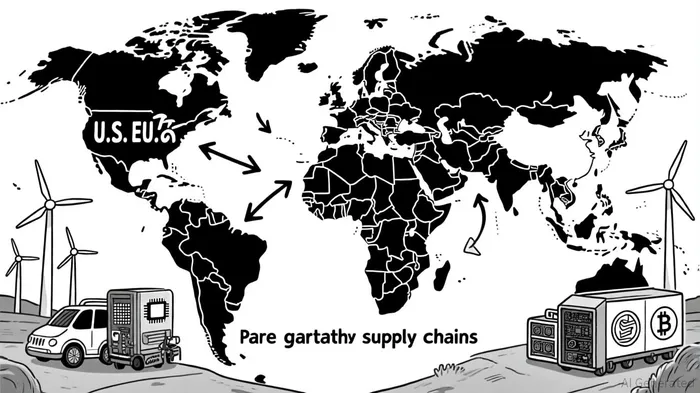
The Tech Sector: A Perfect Storm of Scarcity and Volatility
The semiconductor industry, already reeling from supply chain disruptions, now faces a dual crisis. Rare earth elements are vital for producing high-performance magnets, vacuum systems, and ultra-pure materials used in chip manufacturing. For instance, neodymium and dysprosium are critical for the permanent magnets in electric vehicle motors and wind turbines, while europium and yttrium are essential for semiconductor lithography, according to a Business News Today analysis. China's export restrictions, which extend to downstream technologies and equipment, threaten to exacerbate bottlenecks in production.
The U.S. and EU are scrambling to diversify supply chains, but progress is slow. Domestic refining capacity remains underdeveloped, and alternative sources-such as Greenland's carbonatite deposits or Australia's Nolans project-face environmental and technical hurdles, according to an ACS review. Meanwhile, companies like TSMCTSM-- and NvidiaNVDA--, which rely on Chinese-origin rare earths for their advanced manufacturing processes, are exposed to price volatility and geopolitical risks, according to a CNBC analysis.
Crypto's Indirect Exposure: Energy, Efficiency, and Regulation
While rare earths do not directly power cryptocurrency mining, their indirect impact is profound. The materials are integral to renewable energy infrastructure-wind turbines and lithium-ion batteries-which underpin the energy grids supporting mining operations. As China restricts access to these components, energy costs for miners could rise, squeezing profit margins. Additionally, the global shift toward green energy, which depends on rare earths, may accelerate regulatory scrutiny of crypto's energy consumption, according to an Atlantic Council blog.
However, the crypto sector is adapting. Regulated alternatives, such as stablecoins and institutional-grade ETFs, are gaining traction. The U.S.'s CLARITY Act of 2025 and the EU's MiCA framework are creating clearer regulatory pathways, fostering institutional adoption and reducing market volatility, according to a Finance Monthly article. For example, BlackRock's BitcoinBTC-- ETF, launched in late 2025, attracted $2 billion in inflows within its first month, signaling a shift toward legitimacy, as reported in a Gate article.
Resilient Investment Opportunities: Substitutes, Resilience, and Regulation
The crisis in rare earths has spurred innovation in substitutes and recycling. Japanese researchers have reduced dysprosium content in magnets by 40% without compromising performance, while U.S. firms like Metallium are advancing recycling technologies to recover rare earths from e-waste, according to a Patsnap report. Investors should consider companies like MP MaterialsMP-- (NYSE: MP) and Lynas Rare Earths (ASX: LYC), which are scaling domestic refining and processing capabilities, per a Rare Earth Exchanges roundup.
Semiconductor resilience is another frontier. The U.S. government's $1 billion investment in critical minerals projects, including a $135 million Rare Earth Elements Demonstration Facility, aims to reduce reliance on Chinese processing, according to a Rare Earth Exchanges report. Startups developing graphene-based alternatives to rare earth-dependent components are also attracting capital, offering long-term diversification, as highlighted in a Rare Earth Exchanges guide.
In crypto, regulated stablecoins and institutional-grade products present opportunities. The GENIUS Act's 1:1 reserve requirements have bolstered confidence in stablecoins like USDCUSDC-- and USDTUSDT--, while the SEC-CFTC joint statement on spot crypto products has opened the door for broader institutional participation, according to a BolderGroup snapshot.
Conclusion: Navigating the New Resource Order
China's rare earth strategy is a masterclass in resource-based power projection. For investors, the key lies in hedging against scarcity through substitutes, diversifying supply chains, and capitalizing on regulatory clarity in crypto. The tech sector must accelerate innovation in material efficiency, while the crypto industry should embrace regulated alternatives to mitigate energy and geopolitical risks. In this new era of resource nationalism, resilience-not speculation-will define long-term success.





Comentarios
Aún no hay comentarios