
China's Strategic Economic Deals and Their Global Investment Implications: Geopolitical Repositioning and Supply Chain Realignment
China's economic strategy in the 2023–2025 period has been defined by a dual focus: reinforcing its dominance in global supply chains while recalibrating its geopolitical influence through strategic partnerships and infrastructure investments. Despite persistent U.S.-China trade tensions, Beijing has leveraged its economic scale, technological ambition, and diplomatic outreach to deepen its integration into global markets, particularly in the Global South and Southeast Asia. This recalibration has profound implications for investors, reshaping trade flows, industrial competitiveness, and regional power dynamics.
The Belt and Road Initiative: A Geopolitical and Economic Engine
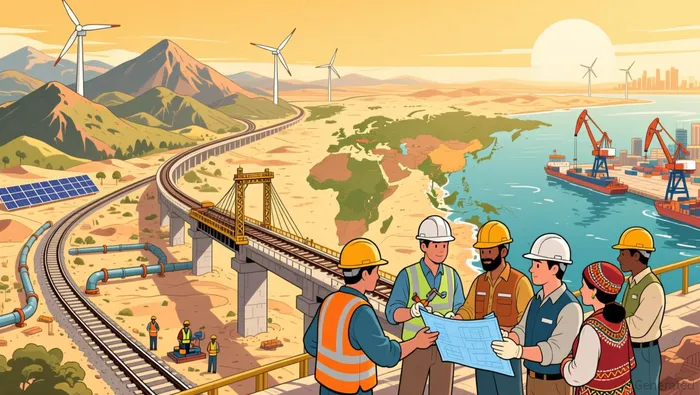
The Belt and Road Initiative (BRI) remains the cornerstone of China's geopolitical repositioning. In the first half of 2025, BRI engagement reached record levels, with USD 66.2 billion in construction contracts and USD 57.1 billion in investments. Energy projects dominated this activity, accounting for USD 42 billion, including USD 30 billion in oil and gas infrastructure in Nigeria and USD 9.7 billion in green energy projects. These investments are not merely economic but strategic, embedding Chinese firms into critical global supply chains while securing long-term access to energy and raw materials.
For instance, Nigeria's Ajaokuta-Kaduna-Kano gas pipeline, supported by Chinese financing, exemplifies how BRI projects align with host nations' energy needs while enhancing China's geopolitical leverage. Similarly, the China-Pakistan Economic Corridor (CPEC), a flagship BRI project, integrates energy, transportation, and port infrastructure to connect China with the Arabian Sea via Gwadar Port. Such projects underscore China's ability to transform infrastructure gaps into strategic assets, reinforcing its influence in regions like Central Asia and the Gulf.
Supply Chain Realignment and Southeast Asia's Rise
The U.S.-China trade war has accelerated supply chain realignment, with Southeast Asia emerging as a critical hub. Vietnam, Malaysia, and Thailand have become preferred destinations for nearshoring, driven by lower labor costs, improved infrastructure, and proximity to China. In 2024, China's trade with ASEAN reached USD 778.6 billion, making ASEAN its largest trading partner. This shift is not accidental but part of a deliberate strategy to diversify trade dependencies and mitigate U.S. pressure.
However, this realignment has created bottlenecks. Ports such as Vietnam's Cat Lai and Thailand's Laem Chabang face congestion due to surging cargo volumes, highlighting the need for further infrastructure investment. Chinese firms are capitalizing on this demand, with private companies like Longi Green Energy and Xinfa Group expanding into renewable energy and mining projects in the region. For investors, Southeast Asia's integration into China's supply chain ecosystem presents opportunities in logistics, manufacturing, and green technology, though risks such as regulatory fragmentation and infrastructure strain persist.
Technological Ambitions and Industrial Policy
China's "Made in China 2025" initiative underscores its ambition to dominate high-tech industries, including semiconductors, electric vehicles (EVs), and advanced robotics according to CFR analysis. By 2024, China accounted for 70% of global rare earth production and 90% of processing capacity, giving it significant leverage in critical sectors. These efforts are not just about self-sufficiency but about reshaping global trade dynamics. For example, China's dominance in EV battery production and solar panel manufacturing has enabled it to export green technologies at scale, even as it faces U.S. tariffs on imports.
The geopolitical implications are clear. As the U.S. and its allies impose export controls on semiconductors and advanced machinery, China is accelerating domestic innovation. By 2025, its 33% average tariff on U.S. imports-up from 3% in 2017-reflects a strategic shift toward economic self-reliance. For investors, this means opportunities in China's tech-driven sectors but also risks of fragmentation in global supply chains, as firms navigate competing regulatory environments.
Geopolitical Implications and the Multipolar Order
China's economic strategies are reshaping the global order, reducing its reliance on the U.S. while expanding its influence in the Global South. The U.S. now accounts for just 10.8% of China's trade, down from 14.2% in 2017, while BRI partners and ASEAN nations fill the void. This shift has accelerated a multipolar order in East Asia, with South Korea and Japan increasingly aligning with China's economic gravity due to its geographic proximity and market size.
For investors, the key takeaway is the need to balance exposure to China's growth with an understanding of its geopolitical ambitions. The BRI's focus on fossil fuels and extractive projects, despite green rhetoric, suggests that China's near-term priorities remain resource security and industrial expansion. Meanwhile, its push into high-tech manufacturing and green energy signals a long-term bet on technological leadership.
Conclusion: Navigating the New Economic Landscape
China's strategic economic deals and industrial policies are redefining global trade and investment. For investors, the opportunities are vast: from BRI-driven infrastructure projects in Africa and Southeast Asia to China's green technology exports and high-tech manufacturing. However, the risks are equally significant, including geopolitical tensions, supply chain fragmentation, and regulatory shifts.
As China continues to realign its supply chains and expand its geopolitical footprint, the challenge for investors lies in aligning with its strategic priorities while mitigating exposure to its growing assertiveness. The coming years will test whether the world can accommodate a China-centric order-or whether a new equilibrium will emerge in a fractured global economy.







Comentarios
Aún no hay comentarios