
China's Sinopec Overtakes U.S. Rivals in Global Chemical Leadership: Strategic Implications for Commodity Chemicals Exposure
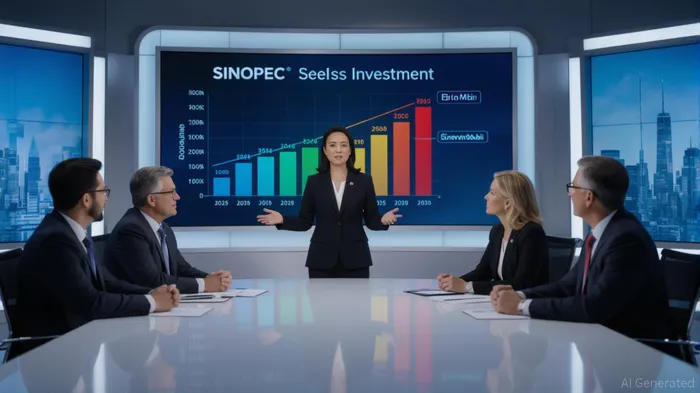
The global chemical industry is undergoing a seismic shift, driven by energy transition imperatives and cyclical demand fluctuations. China's Sinopec has emerged as a formidable leader, surpassing U.S. peers like ExxonMobil and ChevronCVX-- in both scale and strategic agility. According to the ICIS Top 100 Chemical Companies ranking, Sinopec's chemical sales reached $71.3 billion in 2023, securing its position as the world's second-largest chemical producer, ahead of U.S. giants such as Dow and ExxonMobil[4]. This ascent is not merely a function of scale but a reflection of Sinopec's disciplined approach to navigating global destocking cycles and aligning with decarbonization trends.
Strategic Resilience Amid Destocking Cycles
The 2023 downturn, marked by weak demand and extended customer destocking, exposed vulnerabilities in traditional chemical producers. Yet Sinopec's dual focus on domestic infrastructure and international partnerships insulated it from the worst effects. Its joint venture with Saudi Aramco to build a petrochemical complex in Yanbu, for instance, diversifies supply chains and taps into high-growth markets[1]. This contrasts with U.S. rivals, which, while investing in low-carbon technologies, remain heavily exposed to cyclical commodity swings.
ExxonMobil and Chevron, for example, have committed to $30 billion and $10+ billion respectively for hydrogen, carbon capture, and biofuels by 2030[1][3]. However, these timelines lag behind Sinopec's 2025 targets, which include a $4.64 billion hydrogen strategy aimed at reducing 10 million metric tons of CO2 annually[5]. Such urgency is critical in an industry where first-movers gain pricing power and regulatory favor.
Energy Transition: A New Battleground
Sinopec's energy transition strategy is both ambitious and pragmatic. By 2025, it aims to install solar panels at 7,000 retail stations (400 MW capacity) and develop offshore wind projects at coastal refineries[5]. These initiatives align with its 2025 carbon peaking and 2050 neutrality goals, supported by 470 energy efficiency projects completed in 2024 alone, which cut emissions by 2.05 million metric tons[2].
U.S. peers, while investing heavily, face structural challenges. ExxonMobil's $30 billion pledge (65% directed at industry-wide decarbonization) relies on partnerships and policy frameworks that remain uncertain[1]. Chevron's dual strategy—balancing oil growth with renewables—risks diluting focus, as evidenced by its incremental projects like a 10-acre Iowa solar array[3]. Sinopec's state-backed scale and integrated approach, including a ¥5 billion hydrogen-focused venture fund, offer a stark contrast[5].
Strategic Implications for Investors
For investors, Sinopec's positioning signals resilience in two key areas:
1. Destocking Cycles: Its domestic-centric projects and international collaborations reduce exposure to global demand volatility.
2. Regulatory Tailwinds: Aggressive decarbonization aligns with China's 14th Five-Year Plan and global net-zero targets, enhancing long-term asset value.
U.S. rivals, meanwhile, face a trade-off between short-term profitability and long-term sustainability. While their emphasis on affordability and gradual transition is politically expedient, it may cede ground to faster-moving competitors like Sinopec.
Conclusion
Sinopec's leadership in the chemical industry is a product of strategic foresight and operational discipline. By outpacing U.S. peers in energy transition investments and leveraging its domestic market, it has positioned itself as a bellwether for the industry's future. For investors, the lesson is clear: in an era of decarbonization and cyclical uncertainty, agility and scale will define winners.





Comentarios
Aún no hay comentarios