
China's Policy Dilemma in a Post-Fed Rate Cut Era
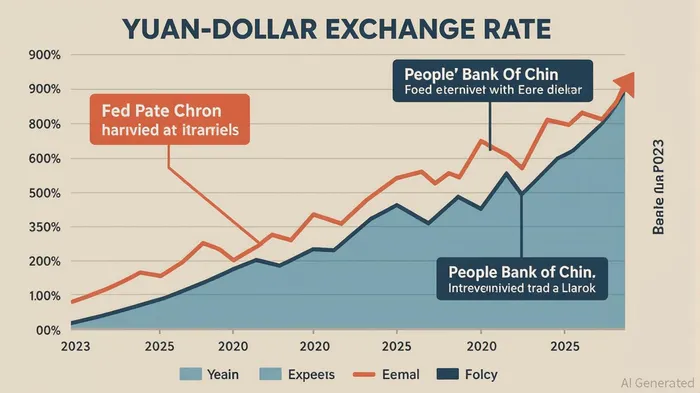
The U.S. Federal Reserve's rate cuts between 2023 and 2025 have reshaped global capital flows and foreign exchange dynamics, creating a complex policy environment for China. As the Fed's accommodative stance lowered global borrowing costs, it also intensified capital outflows from emerging markets, including China, exacerbating currency depreciation pressures and inflationary risks[2]. This divergence in monetary policy—where the U.S. prioritizes domestic inflation control while China grapples with structural growth challenges—has placed the People's Bank of China (PBOC) in a precarious position.
The PBOC's Dual Challenge: FX Stability and Domestic Growth
The PBOC has responded to external pressures with a mix of conventional and unconventional tools. In 2024, the IMF's Article IV consultation explicitly urged the PBOC to deepen monetary easing, including interest rate cuts, to stimulate growth[1]. However, such measures risk amplifying capital outflows and undermining the yuan's stability. To counter this, the PBOC has resorted to direct intervention, effectively pegging the yuan to the U.S. dollar within a narrow band—a departure from its earlier rhetoric of a “managed float”[2]. This de facto peg, while stabilizing the currency, has raised questions about China's commitment to market-driven exchange rate mechanisms and its ability to absorb external shocks.
The PBOC's interventions have also extended to innovative tools, such as Central Bank Digital Currency (CBDC) experiments. By leveraging CBDCs to target liquidity to specific sectors, the PBOC aims to mitigate capital misallocation and boost returns in underperforming industries[3]. Yet, these measures remain experimental and have yet to offset broader structural weaknesses, such as a slowdown in GDP growth. Official estimates suggest China's growth in 2024 fell to 2.4–2.8%, far below the 5% targets, prompting aggressive liquidity injections and mid-year fiscal adjustments[2].
Equity Market Volatility and Policy Uncertainty
The interplay of divergent monetary policies has also created turbulence in China's equity markets. While the PBOC's easing measures have provided a floor for market volatility, investor confidence remains fragile. A Deloitte report notes that Chinese equities in 2025 have shown mixed signals: policy-driven optimism in sectors like technology and green energy contrasts with pessimism in property and manufacturing, where deleveraging and trade tensions persist[1].
Global equity markets, meanwhile, have been shaped by expectations of Fed rate cuts and geopolitical risks. Asian markets, including China, have exhibited cautious optimism, while North American markets remain sensitive to central bank signals[3]. The PBOC's interventions, however, risk creating unintended spillovers. A weaker yuan, for instance, could trigger retaliatory trade measures or disrupt global supply chains, further complicating China's economic rebalancing efforts[2].
The Policy Dilemma: Balancing FX Stability and Structural Reforms
China's central bank now faces a classic policy dilemma: maintaining FX stability through intervention risks entrenching structural inefficiencies, while pursuing deeper reforms could destabilize the currency and exacerbate capital flight. This tension is compounded by U.S. trade policies, including abrupt tariff hikes, which have reduced bilateral trade flows and heightened uncertainty[2].
The PBOC's recent shift toward “extraordinary counter-cyclical adjustments” suggests a recognition of this dilemma. Yet, as former PBOC Governor Yi Gang noted, the central bank has largely ceased regular FX interventions, signaling a preference for a managed float[2]. This approach, however, may not be sustainable in the face of persistent trade tensions and global capital flow volatility.
Conclusion
China's policy response to the post-Fed rate cut era underscores the fragility of its economic model. While the PBOC has demonstrated flexibility in deploying both traditional and digital tools, its interventions highlight the limits of monetary policy in addressing structural imbalances. For investors, the key risks lie in the PBOC's ability to balance FX stability with domestic growth, as well as the potential for geopolitical spillovers. As the global economy navigates a new era of policy divergence, China's path will remain a critical barometer of resilience—or vulnerability.







Comentarios
Aún no hay comentarios