
U.S.-China Economic Diplomacy and the Reshaping of Asian Markets: Investor Sentiment, Capital Reallocation, and Policy Responses
The U.S.-China economic relationship in 2025 remains a fulcrum of global market dynamics, with high-level diplomatic engagements-such as the ongoing talks between U.S. Treasury Secretary Scott Bessent and Chinese Vice Premier He Lifeng-serving as both a stabilizer and a catalyst for volatility. These discussions, aimed at de-escalating tensions over rare earth export controls and trade retaliation, have profound implications for investor sentiment and capital reallocation across Asia. As geopolitical and economic forces collide, the region's markets are recalibrating to a new equilibrium shaped by strategic decoupling, supply chain resilience, and policy interventions.
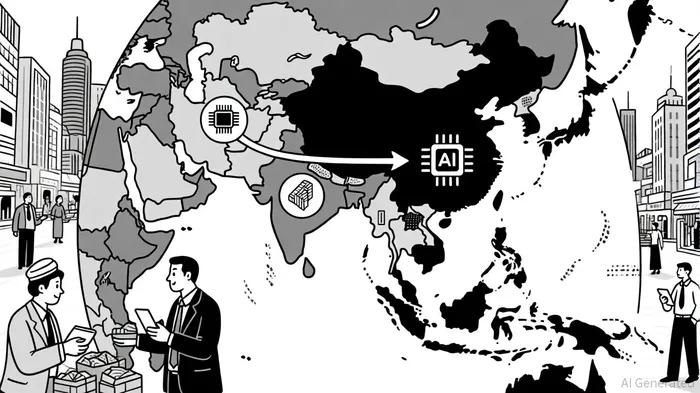
Trade Tensions and the Rare Earth Conundrum
China's imposition of stringent export controls on rare earth materials in October 2025 has intensified U.S.-China friction. These restrictions, requiring foreign firms to secure Chinese approval for products containing even trace amounts of rare earths sourced from China, threaten global supply chains in semiconductors, defense, and renewable energy. According to Politico, the U.S. has responded with a firm stance, threatening 100% tariffs on Chinese goods unless Beijing reverses its policy. Treasury Secretary Bessent has framed these controls as a "global supply chain power grab," emphasizing that the U.S. is prepared to impose countermeasures, including price floors and export controls on critical minerals, according to NBC News.
The semiconductor industry, in particular, faces acute risks. Rare earth elements like neodymium and dysprosium are indispensable for high-strength magnets used in EUV lithography machines and precision tools. A CSIS analysis notes that China's dominance in rare earth processing (90% of global capacity) grants it leverage to disrupt production for firms like ASMLASML-- and TSMCTSM--. This has spurred U.S. efforts to bolster domestic supply chains, including a $400 million investment in MP MaterialsMP-- and a 10-year price floor for neodymium-praseodymium products, according to VOA News.
Investor Sentiment and Asian Market Volatility
The uncertainty surrounding U.S.-China trade policy has triggered significant market turbulence. As CNBC reports, Asian indices, including the Hang Seng, CSI 300, and Kospi, have experienced sharp declines as investors grapple with the prospect of renewed tariffs and supply chain disruptions. Japan, a key U.S. ally, faces particular vulnerability, with its auto and electronics sectors exposed to potential U.S. tariffs. South Korea has adopted a cautious approach, engaging in trade delegations to mitigate risks, while India has pursued a diplomatic strategy to secure mutually beneficial agreements with the U.S.
Capwolf has warned that trade tensions are casting a long shadow over Asia's economic growth, with forecasts for China and India revised downward. However, India's resilience stands out. Its "China+1" strategy-diversifying manufacturing away from China-has attracted foreign direct investment (FDI) to sectors like semiconductors and green energy. For instance, India's National Green Hydrogen Mission and semiconductor PLI (Production-Linked Incentive) scheme have drawn partnerships with South Korean firms like Samsung and SK Hynix, according to The Economic Times.
Capital Reallocation and Supply Chain Diversification
The "China+1" strategy is accelerating capital reallocation across Asia. Companies are shifting production to Vietnam, Indonesia, and India to hedge against geopolitical risks. Vietnam's imports from China doubled between 2017 and 2023, while its exports to the U.S. surged by $60 billion, as noted by McKinsey. Similarly, India's PLI program for semiconductors, backed by state-level incentives (e.g., Uttar Pradesh's 75% land cost subsidy), aims to attract $10 billion in investments, according to Outlook Business.
Japan's ¥10 trillion ($65 billion) investment plan to boost semiconductor and AI sectors exemplifies the broader trend of strategic industrial policy. The government-backed chipmaker Rapidus, collaborating with IBM and Imec, aims to produce advanced chips by 2027, as The Japan Times reported. South Korea's 55 trillion won ($35.7 billion) supply chain stabilization initiative further underscores the region's focus on reducing dependency on single sources, according to ChosunBiz.
Policy Responses and Long-Term Implications
Governments across Asia are leveraging subsidies, R&D incentives, and regulatory frameworks to fortify their tech sectors. China's $138 billion Innovation Fund targets AI, quantum computing, and biomanufacturing, while the U.S. continues to tighten export controls on advanced technologies, IDC argues. India's Semicon India program, with state-level power subsidies and training initiatives, aims to train 85,000 engineers by 2030, according to LinkedIn.
For investors, the key takeaway is the need to navigate a landscape of fragmented supply chains and divergent policy regimes. The U.S.-China rivalry is not merely a trade issue but a structural shift in global economic governance. As The New York Times observes, "Both nations are weaponizing their control over critical resources, forcing markets to adapt to a new era of strategic competition."
Conclusion
The Bessent-He meetings and broader U.S.-China economic diplomacy will likely determine the trajectory of Asian markets in the coming months. While de-escalation remains possible, the underlying forces of decoupling and supply chain resilience are here to stay. Investors must prioritize diversification, monitor policy shifts in technology sectors, and capitalize on opportunities in regions like India and Southeast Asia, where strategic partnerships and industrial policies are reshaping the economic landscape.





Comentarios
Aún no hay comentarios