
Centene's Valuation Paradox and Retail-Driven Momentum: A Contrarian's Dilemma in a Post-Pandemic Healthcare Sector
A Tale of Two Metrics: Undervaluation and Operational Resilience
Centene's recent financial performance has been a mixed bag of promise and peril. The company's Q3 2025 earnings report, which exceeded expectations and prompted a raised full-year outlook to at least $2 in adjusted diluted EPS, has reignited retail investor optimism according to UBS strategic insights. This optimism is reflected in a 12.5% stock price surge following the earnings beat reported on Yahoo Finance. Yet, beneath the surface, Centene's valuation metrics tell a different story. Its P/E ratio has plummeted from 15.1 in 2023 to 7.07 as of September 2025 according to market data, while its P/B ratio stands at 0.79, indicating a market value significantly below book value as noted by Gurufocus. These figures suggest a stock trading at a steep discount relative to both historical norms and industry peers.
For context, Molina Healthcare (MOH), a direct peer, trades at a P/E of 9.39 according to FullRatio, and UnitedHealth Group (UNH), a larger, more diversified insurer, commands a P/E of 16.14 as reported by MacroTrends. Centene's EV/EBITDA multiple has also contracted sharply, from 12.4x in 2021 to 5.5x in 2024 according to FinBox analysis, reflecting a valuation contraction that outpaces even the broader sector's post-pandemic normalization.
The Shadow of Policy Risk
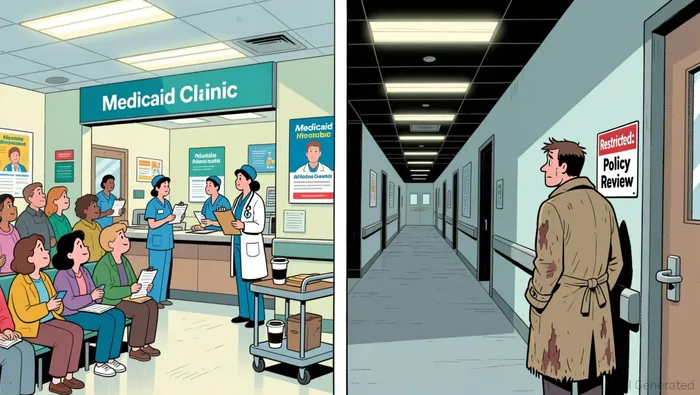
The paradox deepens when one considers Centene's business model. Approximately 60% of its members are enrolled in Medicaid as per investing.com analysis, making it acutely sensitive to shifts in federal healthcare policy. The recent proposal by President Donald Trump to redirect federal healthcare funding directly to individuals-bypassing insurers-has already triggered a 9.30% premarket drop in Centene's shares as reported by investing.com. This policy, if enacted, could fundamentally disrupt the company's revenue streams, particularly in states where it operates large Medicaid contracts.
The Florida Medicaid contract non-renewal, a $5 billion annual revenue stream, further illustrates the fragility of Centene's model. While the full financial impact is not expected until 2027 according to UBS insights, the loss of this contract underscores the sector's vulnerability to state-level policy decisions. For contrarian investors, the question is whether Centene's low valuation compensates for these risks-or if it merely reflects a market that has already priced in the worst-case scenario.
Retail Investor Sentiment: Momentum or Mirage?
Retail investor sentiment toward CenteneCNC-- has been anything but stable. The Q3 2025 earnings report sparked a 10% premarket jump in the stock price according to QuiverQuant, driven by social media discussions on platforms like X. This surge, however, follows a year-to-date decline of nearly 40% after Centene withdrew its 2025 guidance according to QuiverQuant analysis. The volatility highlights the role of retail-driven momentum in a stock that is otherwise dominated by institutional investors.
This dynamic raises a critical question: Is Centene's recent rally a sign of stabilization, or a temporary reprieve fueled by short-term optimism? The latter seems plausible given the broader political climate. For instance, the rejection of Democratic proposals to extend ACA subsidies as reported by Seeking Alpha and the ongoing debate over healthcare funding models have created a backdrop of uncertainty that could amplify retail-driven swings.
Contrarian Value Investing: A Calculated Bet
For value investors, Centene presents a classic dilemma. Its valuation metrics-particularly the P/E and P/B ratios-suggest a compelling entry point. A DCF analysis estimates its intrinsic value at $170.12, implying a 79.7% undervaluation according to Yahoo Finance. Moreover, its P/S ratio of 0.10x is far below the healthcare industry average of 1.27x as reported by Yahoo Finance, reinforcing the case for a re-rating.
Yet, the risks are formidable. Centene's trailing twelve-month net loss of $5.29 billion according to investing.com and its ongoing governance issues, including a proposed class-action lawsuit over its 401(k) plan as reported by Bloomberg Law, complicate the narrative. The company's reliance on Medicaid also exposes it to margin pressures, as evidenced by its renegotiation of terms with Express Scripts according to UBS insights.
Conclusion: Navigating the Paradox
Centene's valuation paradox-low multiples versus high policy risk-reflects the broader challenges of the post-pandemic healthcare sector. For contrarian investors, the key lies in balancing the company's attractive valuation with a rigorous assessment of its operational and political vulnerabilities. While the stock's recent momentum may attract short-term buyers, long-term success will depend on Centene's ability to adapt to a rapidly shifting regulatory landscape and demonstrate sustainable profitability.
In the end, the question is not whether Centene is undervalued, but whether the market's skepticism is justified. For those willing to navigate the paradox, the rewards could be substantial-but the risks, equally so.





Comentarios
Aún no hay comentarios