
The Case for Natural Gas Producers as AI and LNG Drive a Structural Bull Market
The global energy landscape is undergoing a profound transformation, driven by two converging forces: the exponential growth of artificial intelligence (AI) and the rapid expansion of liquefied natural gas (LNG) exports. These trends are reshaping demand dynamics, pricing structures, and the strategic positioning of natural gas producers. For investors, the implications are clear: natural gas is no longer a transitional fuel but a cornerstone of a structural bull market, underpinned by technological innovation and geopolitical realignments.
AI-Driven Electricity Demand: A New Energy Paradigm
The rise of AI has created an unprecedented surge in electricity demand, particularly in data centers. According to a report by Pew Research, U.S. data centers consumed 183 terawatt-hours (TWh) of electricity in 2024-equivalent to 4% of the nation's total consumption-and are projected to use 426 TWh by 2030 according to data. This growth is fueled by the energy-intensive nature of AI hardware, which requires significantly more power than traditional computing infrastructure.
Natural gas is uniquely positioned to meet this demand. The U.S. Energy Information Administration (EIA) forecasts that natural gas will account for 40% of U.S. electricity generation in 2025–2026, driven by its flexibility and reliability in balancing intermittent renewable sources as EIA reports. As a result, Henry Hub prices are expected to trend upward, averaging $3.90/MMBTU in Q4 2025 and rising to $4.30/MMBTU in 2026. This pricing trajectory reflects not only near-term demand but also the structural shift toward gas as a critical enabler of the AI economy.
LNG Export Growth: A Geopolitical and Economic Catalyst
The U.S. is emerging as the dominant force in the global LNG market, with export capacity projected to nearly double by 2028. New projects such as Corpus Christi LNG and Golden Pass LNG, coming online in 2025, are central to this expansion. By 2030, U.S. LNG capacity could exceed 30 billion cubic feet per day, supported by a $50 billion investment in infrastructure. This growth is not merely a function of domestic production but a strategic response to global demand, particularly in Europe and Asia, where the U.S. has become a critical alternative to Russian gas as noted by market analysis.
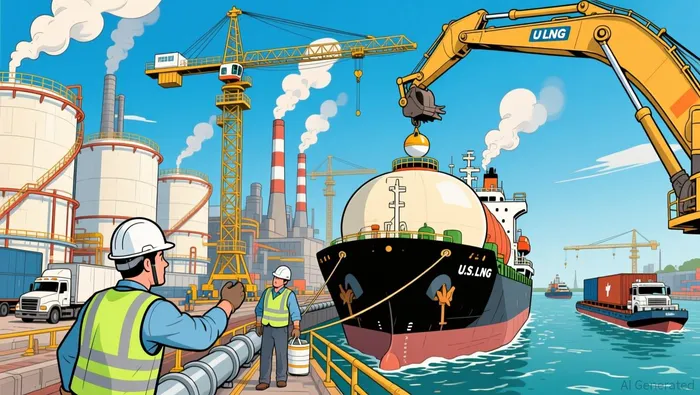 Super-producers like Expand EnergyEXE-- and EQTEQT-- are at the forefront of this transformation. Expand Energy, which overtook EQT as the largest U.S. gas producer in 2024 through a merger, is leveraging its scale to secure long-term supply agreements with AI data centers. Meanwhile, EQT is investing in pipeline infrastructure, including the Mountain Valley Pipeline, to unlock additional capacity and regain its leadership position according to industry analysis. These companies exemplify the disciplined production strategies required to thrive in a market where export-driven demand is increasingly price-anchored to global benchmarks.
Risks and Rebalancing: Industrial Sectors and Utilities in the Crosshairs
While natural gas producers benefit from rising prices, industrial sectors and utilities face significant headwinds. The EIA notes that electric power and industrial customers are projected to see natural gas price increases of 37% and 21%, respectively, in 2025 compared to 2024 levels. These costs are forcing utilities to reconsider their fuel mix, with some reverting to coal during periods of high LNG export volumes and cold weather. Such shifts risk undermining decarbonization efforts and highlight the tension between economic efficiency and environmental goals.
Pipeline capacity constraints further complicate the outlook. In the Appalachian Basin, takeaway limitations have already strained industrial access to natural gas, a challenge exacerbated by LNG export growth. However, ongoing expansions-such as those at Cameron, Rio Grande, and Port Arthur-are expected to alleviate bottlenecks by 2028. For now, the sector must navigate a delicate balance between meeting surging export demand and maintaining domestic supply reliability.
Strategic Positioning: The Long-Term Upside
The convergence of AI-driven demand, LNG export growth, and disciplined production creates a compelling case for natural gas super-producers. Expand Energy and EQT, with their focus on infrastructure development and long-term supply contracts, are well-positioned to capitalize on this structural bull market. Their ability to navigate regulatory and logistical challenges-while maintaining production discipline-will be critical in sustaining margins amid volatile global gas balances.
For investors, the key takeaway is that natural gas is no longer a cyclical commodity but a foundational asset in the energy transition. While risks such as coal re-emergence and pipeline constraints persist, the long-term trajectory is clear: AI and LNG are anchoring a new era of demand-driven growth, where strategic producers will reap outsized rewards.







Comentarios
Aún no hay comentarios