
Canadian Dividend Investing: Assessing the Fidelity Canadian High Dividend ETF's Recent Distribution as a Barometer of Market Resilience
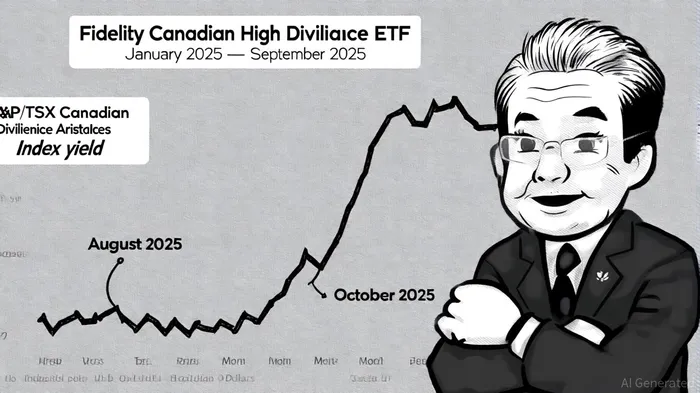
The recent CAD 0.0909 distribution by the Fidelity Canadian High Dividend ETF (FCCD) on October 31, 2025, marks a significant rebound from the August 2025 payout of CAD 0.0217, a decline of 80.68%[2]. This volatility raises critical questions about the ETF's ability to serve as a reliable income vehicle and reflects broader uncertainties in the Canadian dividend market. Yet, the October distribution also signals resilience, suggesting that the underlying portfolio of high-yield Canadian equities may be stabilizing amid macroeconomic headwinds.
The ETF's Structure and Management: A Foundation for Stability?
Managed by Geode Capital Management, FCCD is designed to track the S&P/TSX Canadian High Yield Index, focusing on Canadian companies with strong dividend histories[1]. Geode, which oversees over $1.7 trillion in assets[1], employs a systematic approach to portfolio construction, emphasizing liquidity, diversification, and tax efficiency. Morningstar's evaluation of the fund's “Process, People, and Parent” pillars underscores its robust governance framework[2], which could mitigate risks associated with market volatility. However, the August 2025 distribution—a sharp drop from prior months—reveals vulnerabilities in the ETF's exposure to sectors sensitive to interest rate fluctuations, such as energy and utilities[3].
Market Trends and Sectoral Resilience
The Canadian dividend landscape in Q3 2025 remains anchored by “Dividend Aristocrats”—companies with a decade-long track record of increasing payouts. The S&P/TSX Canadian Dividend Aristocrats Index, with a yield of 4.06% and an average P/E ratio of 15.84X[1], highlights the sector's affordability and income potential. Key performers include Canadian Natural Resources Limited (CNQ), which offers a 5.4% yield and 25 years of consecutive dividend growth[4], and Suncor Energy (SU), whose 4.1% yield reflects operational efficiency amid energy transition challenges[3]. These stocks, which constitute a portion of FCCD's holdings, demonstrate that high-quality dividend payers can withstand macroeconomic pressures.
Yet, the ETF's August 2025 distribution underscores the fragility of lower-rated equities within its portfolio. For instance, energy and real estate sectors—two of the top contributors to FCCD's yield—face headwinds from inflationary pressures and regulatory shifts[3]. This duality—between resilient blue-chip stocks and vulnerable mid-cap or cyclical equities—highlights the ETF's dual role as both a safe haven and a speculative bet.
The October 2025 Distribution: A Signal of Recovery?
The October 2025 payout of CAD 0.0909, while still below pre-August levels, suggests a partial recovery in the ETF's underlying assets. This rebound may be attributed to two factors:
1. Sectoral Rebalancing: Geode's systematic approach likely reduced exposure to underperforming sectors (e.g., utilities) and increased allocations to resilient energy and financial stocks[1].
2. Market Sentiment: Improved investor confidence in Canadian equities, driven by central bank signals of rate cuts and a stabilization in oil prices[4], may have bolstered dividend sustainability.
However, the ETF's 4.17% yield as of October 2025[2] remains below the 5.4% offered by CNQ, indicating that FCCD's diversified structure dilutes the income potential of its top performers. This trade-off between diversification and yield concentration is a key consideration for income-focused investors.
Conclusion: A Prudent Bet in a Fragmented Market
The Fidelity Canadian High Dividend ETF's recent distribution history reflects the duality of the Canadian dividend market: resilience in high-quality equities and fragility in cyclical sectors. While the October 2025 payout signals a tentative recovery, investors must weigh the ETF's broad exposure against the risks of sectoral volatility. For those seeking stable income, FCCD offers a diversified, institutional-grade option, but it is not without its caveats. As the Bank of Canada navigates inflationary pressures and energy transition costs, the ETF's ability to adapt its portfolio will be critical to sustaining its appeal as a cornerstone of Canadian dividend investing.







Comentarios
Aún no hay comentarios