
Bytedance's Strategic US Restructuring and Implications for TikTok's Long-Term Viability
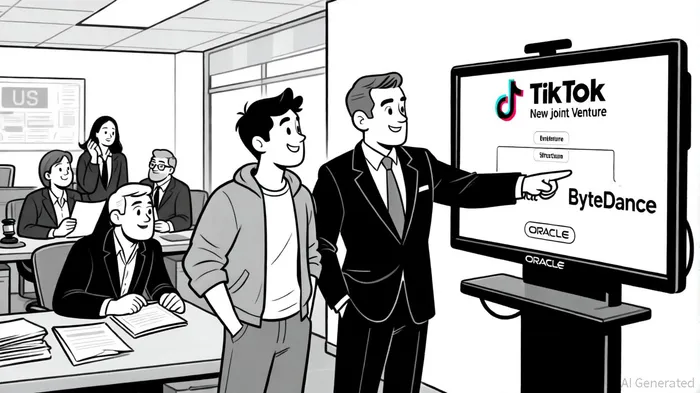
The saga of TikTok's survival in the United States has reached a critical juncture, shaped by the interplay of geopolitical pressures, regulatory demands, and corporate strategy. ByteDance's recent restructuring of its US operations, culminating in a proposed joint venture with American investors, represents a calculated effort to navigate the treacherous waters of national security concerns while preserving the platform's market access. This move, however, raises profound questions about the long-term viability of TikTok as a global social media giant and the broader implications for technology governance in an era of escalating Sino-American rivalry.
Geopolitical Risk Mitigation: A Delicate Balancing Act
ByteDance's restructuring is a direct response to the Protecting Americans from Foreign Adversary Controlled Applications Act (PAFACA), which mandates the divestiture of TikTok's US operations or faces a ban. The proposed joint venture, in which US investors hold 80% ownership and ByteDance retains less than 20%, aims to satisfy the law's requirement to remove “foreign adversary control”[1]. Crucially, OracleORCL--, a US-based firm, will manage TikTok's algorithm and user data in a “purpose-built cloud environment,” ensuring technical and operational independence from ByteDance[4]. This arrangement, while legally compliant, reflects a broader trend of nations asserting control over digital infrastructure to safeguard national security interests[2].
The restructuring also includes a seven-member board, with six seats held by Americans, granting majority governance and decision-making authority[3]. This structure is designed to address concerns about data privacy and potential manipulation of content recommendations, which have been central to the US government's scrutiny. However, the deal's success hinges on China's approval, as Beijing has insisted that the agreement must align with its own laws on technology transfer and national security[1]. The interdependence of regulatory frameworks in the US and China underscores the fragility of such cross-border compromises in an increasingly polarized global landscape.
Market Access Strategy: Preserving Relevance Amid Uncertainty
TikTok's market access in the US has been inextricably linked to its ability to adapt to regulatory pressures while maintaining its competitive edge. The platform's algorithm-driven content curation has been both its greatest asset and a source of geopolitical tension. By leasing the algorithm to Oracle and retraining it under US oversight, ByteDance seeks to preserve TikTok's user experience while mitigating risks of perceived foreign influence[4]. This approach, however, introduces operational complexities: the algorithm's performance may be compromised if the retraining process fails to replicate the nuanced micro-interactions that drive user engagement[1].
The extended deadlines granted by President Trump—most recently a 75-day reprieve—have provided TikTok with breathing room to finalize the deal[4]. Yet these extensions have drawn legal criticism for potentially undermining PAFACA's intent, creating regulatory ambiguity that could deter future foreign tech firms from operating in the US. For TikTok, the stakes are high: a ban would not only erase its presence in the world's largest digital market but also set a precedent for how nations manage foreign technology in the context of strategic rivalry[3].
Strategic Implications for the Global Tech Ecosystem
The TikTok case is emblematic of a broader shift toward digital sovereignty, where control over data and algorithms is treated as a strategic asset[2]. The US-China agreement to license the algorithm under defined terms suggests a model for managing cross-border technology dependencies, but it also highlights the limitations of such arrangements in a world of deepening mistrust. For investors, the key question is whether TikTok's new structure can sustain its dominance in the US market while avoiding the pitfalls of regulatory overreach or operational fragmentation.
A critical risk lies in the potential for retaliatory measures from China, which has already signaled its willingness to impose restrictions on foreign tech firms. If the deal is perceived as a capitulation to US demands, it could trigger a backlash against Western platforms in China, further fragmenting the global internet into competing digital ecosystems[3]. This fragmentation would not only complicate cross-border data flows but also increase costs for multinational tech firms, which must now navigate a patchwork of conflicting regulations.
Conclusion: A Precarious Path Forward
ByteDance's restructuring of TikTok's US operations is a pragmatic, if imperfect, solution to a politically charged problem. By ceding majority control to American stakeholders, the company has bought time to navigate the regulatory labyrinth while preserving its market access. However, the long-term viability of TikTok in the US will depend on its ability to maintain user trust and algorithmic effectiveness under the new governance model. For investors, the case underscores the growing importance of geopolitical risk in technology investments and the need for strategies that balance compliance with innovation.
As the US and China finalize their agreement, the world watches to see whether this deal will serve as a blueprint for future cross-border tech collaborations—or a harbinger of deeper digital divides.





Comentarios
Aún no hay comentarios