
Bitcoin's Path to $100,000: Institutional Adoption and Political Momentum as Catalysts
The ascent of BitcoinBTC-- toward $100,000 is no longer a speculative fantasy but a plausible outcome shaped by converging forces of institutional adoption and political momentum. These twin engines are not merely supporting the current bull cycle-they are redefining the architecture of global finance. To understand the strategic timing of this ascent, one must dissect the interplay between capital flows, regulatory clarity, and macroeconomic tailwinds.
Institutional Adoption: A Structural Shift
Institutional investment in Bitcoin has evolved from niche curiosity to mainstream inevitability. By Q1 2025, spot Bitcoin ETFs had amassed over $65 billion in assets under management (AUM), with BlackRock's iShares Bitcoin Trust (IBIT) alone securing $18 billion in assets, according to a Pinnacle Digest report. This surge reflects a broader trend: 335 institutional and fund entities now hold 3.75 million BTC, with major players like MicroStrategy and the U.S. Treasury leading the charge, as shown in BTCC data. The approval of regulated ETFs has provided a low-friction on-ramp for institutional capital, transforming Bitcoin from a speculative asset into a core portfolio component, as reported by Datos Insights.
Corporate treasuries are also embracing Bitcoin as a strategic reserve. Over 124 companies now allocate Bitcoin to hedge against inflation and facilitate international payments, per the Pinnacle Digest report. Sovereign Wealth Funds (SWFs), traditionally risk-averse, are exploring Bitcoin as a non-correlated store of value, as noted in BTCC coverage. This shift is underpinned by advancements in custody infrastructure, which have mitigated institutional concerns about security and compliance, a point Datos Insights highlights. Analysts project that Bitcoin's price could reach $200,000–$210,000 within 12–18 months, driven by sustained ETF inflows and macroeconomic demand, according to BTCC's market analysis.
Political Momentum: Regulatory Clarity as a Catalyst
The political landscape in 2025 has been equally transformative. A second Trump administration has reoriented U.S. policy toward embracing digital assets, framing Bitcoin as a national priority, in line with a Grant Thornton outlook. Executive orders have established a Strategic Bitcoin Reserve and a U.S. Digital Asset Stockpile, signaling institutional legitimacy, as Grant Thornton observes. The Securities and Exchange Commission (SEC) has adopted a lighter regulatory stance, rescinding SAB 121 and halting enforcement actions against crypto firms, which has reduced uncertainty and enabled institutions to allocate capital without fear of abrupt regulatory overhauls, a trend covered by Bitcoin Magazine in its reporting on advancing bills in Congress (Bitcoin Magazine article).
Legislative efforts, such as the GENIUS Act for stablecoin regulation and the Blockchain Regulatory Clarity Act, have further solidified this momentum, as Grant Thornton outlines. While the GENIUS Act focuses on stablecoins, its passage has indirectly bolstered Bitcoin's ecosystem by reinforcing a broader narrative of digital asset integration; this is detailed in a NatLawReview update. The CLARITY Act, meanwhile, has clarified jurisdictional boundaries-assigning the SEC oversight of "digital securities" and the CFTC to "digital commodities" like Bitcoin-an explanation provided in the same NatLawReview update. This framework reduces ambiguity, encouraging institutional participation.
Historical Parallels and Timing Signals
Bitcoin's bull cycles have historically followed a four-year rhythm, often anchored to halving events that tighten supply, as the Hyrotrader analysis explains. The 2024 halving, combined with ETF approvals, has reignited this pattern. However, the 2025 cycle diverges from prior ones in critical ways. Unlike the retail-driven 2017 bull run, this cycle is fueled by institutional inflows and macroeconomic factors, a distinction highlighted in CryptoSlate analysis. For instance, the Federal Reserve's rate cuts in Q3 2025 pushed investors toward higher-risk assets like Bitcoin, which also serves as a hedge against dollar debasement, according to BTCC reporting on market reactions.
Key timing signals reinforce this narrative. ETF inflow velocity has shown a direct correlation with price surges: each 1,000 BTC of monthly net inflows corresponds to a 0.4% price increase, a relationship Ecoinometrics documents in its analysis (Ecoinometrics finds). In July 2025, record inflows of $1 billion in a single day propelled IBITIBIT-- to $80 billion in AUM, also noted by Ecoinometrics. On-chain metrics, such as the RHODL ratio and HODL Waves, likewise indicate accumulation by long-term holders, per the same Ecoinometrics piece. Meanwhile, the MVRV Z-Score (a measure of realized versus market value) remains below 3, suggesting the market is in a bullish phase, as Forbes notes.
Strategic Investment Timing: Navigating the Bull Cycle
For investors, the current environment presents a rare alignment of catalysts. The interplay between institutional adoption and regulatory clarity has created a self-reinforcing cycle: ETF inflows boost liquidity, which attracts more institutions, further legitimizing Bitcoin as a strategic asset, a dynamic explored in an XT.com post. This dynamic is amplified by macroeconomic conditions, including inflationary pressures and the Fed's accommodative stance, which BTCC coverage has linked to surging crypto allocations.
However, timing remains critical. Historical data shows that bull cycles often peak 12–18 months after halving events, as Hyrotrader documents. Given the 2024 halving and the surge in ETF inflows, a peak in late 2025 or early 2026 is plausible. Investors should monitor ETF inflow velocity, regulatory developments (such as potential Bitcoin ETF extensions), and macroeconomic indicators like inflation and interest rates, guidance echoed in a TokenVitals post.
Conclusion: A New Paradigm
Bitcoin's journey to $100,000 is not a function of speculative fervor but a structural shift in how capital is allocated and regulated. Institutional adoption has transformed Bitcoin into a mainstream asset class, while political momentum has provided the regulatory scaffolding for its integration. As the 2025 bull cycle unfolds, investors who align their strategies with these forces-leveraging ETFs, monitoring on-chain metrics, and hedging against macroeconomic risks-will be best positioned to capitalize on the next phase of Bitcoin's ascent.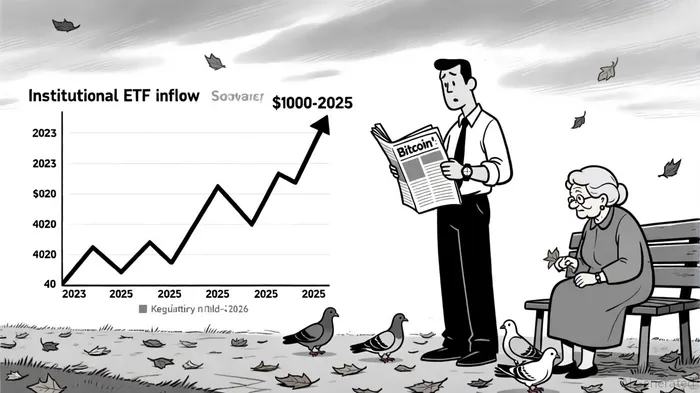





Comentarios
Aún no hay comentarios