
Bitcoin's Long-Term Adoption Potential: A Macroeconomic and Institutional Perspective
The global financial landscape in 2025 is witnessing a seismic shift in the perception and adoption of BitcoinBTC--. Once dismissed as a speculative asset, Bitcoin is increasingly being treated as a strategic reserve by corporations, governments, and institutional investors. This transformation is driven by a confluence of macroeconomic trends and institutional developments that are reshaping the cryptocurrency's role in the global economy. For new investors, understanding these forces is critical to assessing Bitcoin's long-term potential and optimal timing for entry.
Corporate Adoption: A New Paradigm of Reserve Management
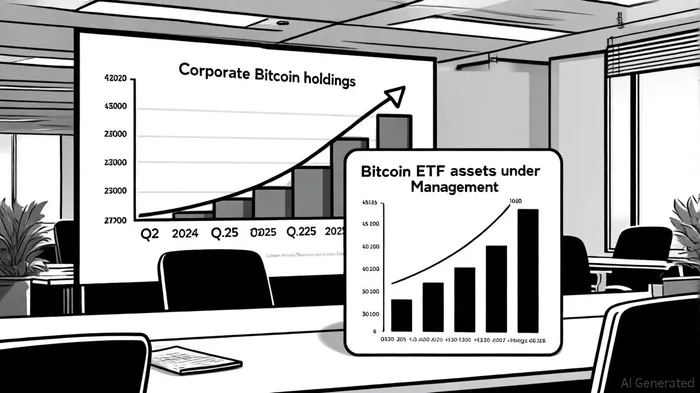
The most striking development in Bitcoin's adoption has been its integration into corporate treasuries. Public companies, led by entities like StrategyMSTR-- Inc. (formerly MicroStrategy), have redefined Bitcoin as a core component of their balance sheets. As of Q2 2025, 145 public companies collectively hold 855,000 BTCBTC--, effectively reducing the circulating supply and creating upward price pressure[1]. This trend is not merely speculative; it reflects a strategic response to inflationary pressures and the erosion of fiat value. By leveraging zero-interest bonds and covered call options, corporations are funding further Bitcoin purchases, transforming the asset into a hedge against macroeconomic instability[1].
Sovereign Reserves and Geopolitical Legitimacy
Bitcoin's journey from fringe asset to reserve currency has also gained momentum at the national level. The establishment of the U.S. Strategic Bitcoin Reserve in March 2025, holding 200,000 BTC, marks a pivotal moment in its institutional acceptance[1]. Countries like El Salvador and Bhutan have followed suit, adding to their Bitcoin reserves and signaling a broader recognition of its utility in diversifying sovereign wealth. These sovereign purchases lock up significant quantities of BTC, further tightening supply and amplifying price sensitivity to new demand[1].
Regulatory Clarity and Institutional Access
Regulatory developments have been instrumental in Bitcoin's mainstream ascent. The U.S. Securities and Exchange Commission's (SEC) 2024 approval of spot Bitcoin ETFs has democratized access to the asset, enabling both institutional and retail investors to participate with confidence[1]. These ETFs, managing over $50 billion in assets, have absorbed 51,500 BTC in December 2024 alone, stabilizing markets and reducing volatility by 75%[1]. Such regulatory clarity has been further bolstered by the Trump administration's pro-crypto policies, including relaxed custody rules and the creation of the U.S. Strategic Bitcoin Reserve, which have collectively enhanced investor trust[2].
Macroeconomic Tailwinds: Liquidity, Rates, and Dollar Dynamics
Bitcoin's growth in 2025 is also being propelled by favorable macroeconomic conditions. The Federal Reserve's anticipated rate cuts, beginning in September 2025, are expected to inject liquidity into markets and heighten demand for risk assets[2]. Simultaneously, a weakening U.S. dollar—driven by economic uncertainty and new import tariffs—has elevated Bitcoin's appeal as a store of value[2]. The potential cessation of quantitative tightening and a shift toward accommodative monetary policy could further accelerate capital flows into alternative assets like Bitcoin[3].
Scarcity and Cost Dynamics: Reinforcing Price Resilience
Bitcoin's intrinsic scarcity is being reinforced by rising production costs. Mining expenses have reached record highs in 2025, with the Cambridge Bitcoin Electricity Consumption Index estimating annual energy use at 1,174 TWh, 67% from fossil fuels[1]. As breakeven prices for new BTC increase, the asset's supply becomes more inelastic, amplifying its price response to demand shocks. This dynamic is compounded by shrinking exchange reserves and growing institutional demand, creating a virtuous cycle of scarcity-driven appreciation[1].
Legislative and Fiscal Catalysts for the Future
Looking ahead, Bitcoin's trajectory will depend on continued institutional adoption and regulatory progress. The proposed Bitcoin Act by U.S. Senator Cynthia Lummis could provide a legal framework that legitimizes the asset and drives long-term demand[3]. Meanwhile, expanded fiscal spending by major economies like the U.S. and China is likely to generate capital flows seeking alternative assets, with Bitcoin positioned to benefit[3].
Conclusion: Timing the Inevitable
For new investors, the alignment of macroeconomic and institutional catalysts presents a compelling case for Bitcoin's long-term adoption. The asset's integration into corporate and sovereign reserves, coupled with regulatory clarity and favorable monetary policy, suggests a structural shift rather than a cyclical boom. While volatility remains inherent to Bitcoin, the reduction in market instability—thanks to ETFs and institutional participation—has made it a more viable addition to diversified portfolios. Investors who recognize this inflection point and act with disciplined timing may find themselves positioned to benefit from one of the most transformative financial innovations of the 21st century.





Comentarios
Aún no hay comentarios