
Bitcoin's Critical $70K–$73K Support Zone: A Make-or-Break Threshold for 2026
Bitcoin stands at a pivotal juncture as it approaches the $70,000–$73,000 support zone, a level that could determine its trajectory for 2026. This threshold is not merely a technical marker but a confluence of macroeconomic forces and on-chain dynamics that will test the resilience of both bulls and bears. The interplay of these factors demands a nuanced analysis of how Bitcoin's price might evolve in the coming months.
Technical Analysis: A Fragile Foundation
The $70K–$73K range has emerged as a critical battleground for BitcoinBTC--. Historically, this zone has acted as a price magnet, with on-chain data revealing a "supply gap" between $70K and $80K. This gap, formed during the rapid surge to $80K in early 2024, reflects minimal accumulation of Bitcoin at these levels, leaving fewer holders with an incentive to defend the price if it breaks below $80K. If Bitcoin retests this zone convincingly, the lack of liquidity could accelerate a decline toward the $60K–$70K range, where deeper selling pressure is expected according to on-chain data.
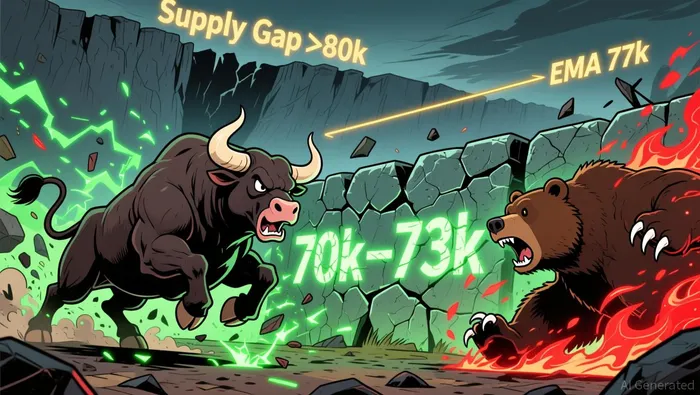 Technical indicators add further complexity. The RSI has entered oversold territory, suggesting a potential rebound, while a bullish cross in the stochastic RSI-historically associated with 56% average recoveries-has emerged. However, these signals are not guarantees. The 50-week exponential moving average (EMA) at $77,230 remains a dynamic support level, and Bitcoin must hold above $88,245 to trigger a bullish recovery toward $93,500–$94,000 according to technical analysis. A breakdown below $88,245, however, could expose liquidity at $83,869, where stronger buying interest is anticipated as per technical indicators.
Macroeconomic Positioning: Liquidity and Policy Divergence
Beyond technicals, macroeconomic forces loom large. The Bank of Japan's (BoJ) potential rate hike in December 2025 poses a significant risk. Historical data shows Bitcoin has corrected by over 20% following previous BoJ hikes, as the unwinding of yen carry trades forces institutions to sell assets like Bitcoin to repay borrowed yen. With core inflation in Japan at 3.0% as of November 2025, the BoJ's hawkish pivot could trigger a liquidity shock, potentially pushing Bitcoin below $70K.
Conversely, the U.S. Federal Reserve's dovish stance offers a counterbalance. A 25-basis-point rate cut in December 2025 is expected to drive liquidity into risk assets, historically boosting Bitcoin by 42% in the 30–60 days following a Fed easing pivot. However, this support may be offset if Japan's rate hike narrows global interest rate differentials, reducing inflows into high-risk assets.
Inflation also plays a role. Bitcoin's growing correlation with inflation expectations-evidenced by its performance during the pandemic-suggests it may act as a hedge against rising prices. Yet, this does not insulate it from broader financial stress, as seen in December 2025 when a 5% single-day drop coincided with BoJ rate hike expectations.
Interplay and Outlook: A Delicate Balance
The coming months will hinge on the interplay of these forces. If Bitcoin holds above $70K and the Fed's rate cuts offset BoJ's tightening, a bullish scenario could unfold, with the stochastic RSI's historical performance suggesting a potential rally toward $120K by mid-2025. However, a BoJ-driven liquidity crunch could override these gains, particularly if the $70K–$73K zone fails to hold.
For investors, the key lies in monitoring both technical confirmations and macroeconomic signals. A sustained break below $70K would likely trigger a bearish cascade, while a rebound supported by Fed easing could reignite optimism. The $70K–$73K zone is not just a price level-it is a litmus test for Bitcoin's resilience in an era of divergent monetary policies.
Conclusion
Bitcoin's $70K–$73K support zone represents a make-or-break threshold for 2026. Technically, it is a fragile yet historically significant level, while macroeconomically, it is a battleground for liquidity and policy divergence. Investors must weigh the risks of a BoJ-driven correction against the potential for Fed-driven recovery. The outcome will shape not only Bitcoin's short-term trajectory but also its long-term narrative as a store of value in a world of shifting monetary regimes.






Comentarios
Aún no hay comentarios