
Autodesk (ADSK): Valuation and Long-Term Growth Potential in the AEC and Manufacturing Sectors
The global economy's shift toward digital transformation has positioned software firms at the intersection of innovation and infrastructure. AutodeskADSK-- (ADSK), a leader in design and engineering software, stands at the nexus of two critical sectors: architecture, engineering, and construction (AEC), and manufacturing. To assess its valuation and long-term potential, one must dissect its market dynamics, financial health, and alignment with macroeconomic trends.
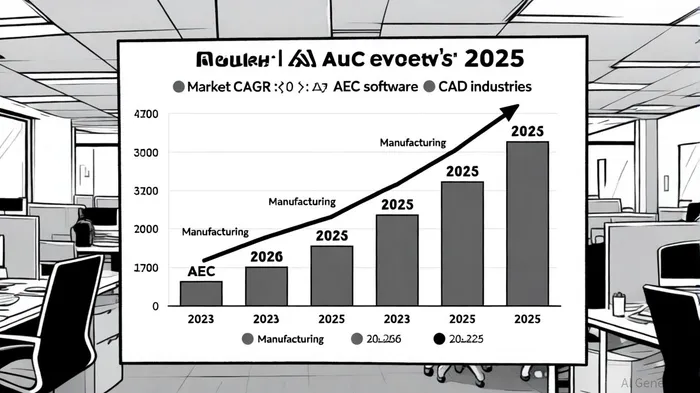
Market Dynamics: AEC and Manufacturing as Growth Engines
The AEC software market is poised for robust expansion, valued at $9.17 billion in 2023 and projected to reach $21.09 billion by 2032, growing at a compound annual rate of 9.7%, according to a Mordor Intelligence report. Autodesk's dominance in this space is underpinned by its BIM tools, such as Revit and AutoCAD Civil 3D, which have become industry standards. A strategic shift to a subscription model in 2024-reducing Revit's monthly cost to $290-has democratized access for small and medium enterprises (SMEs), accelerating adoption, according to a CSIMarket profile. For fiscal 2025, the AECO (Architecture, Engineering, Construction, and Operations) segment generated $2.94 billion in revenue, a 14% year-over-year increase, driven by infrastructure investments and cloud-based collaboration tools, per Autodesk's FY2025 earnings release.
In manufacturing, the 3D CAD software market is valued at $5.75 billion in 2025, with a 6.2% CAGR expected through 2033, according to Fortune Business Insights. Autodesk's Fusion 360 and other cloud-native tools are gaining traction, particularly as manufacturers prioritize AI-driven automation and sustainability. The manufacturing segment contributed $1.572 billion in revenue for fiscal 2025, reflecting an 8% growth rate, according to Tickergate. However, Autodesk's market share in this segment remains modest at 4.00% within the Software & Programming industry, trailing behind competitors like Dassault Systèmes and PTC, per CSIMarket data.
Financial Health: Profitability and Strategic Resilience
Autodesk's financials underscore its operational discipline. For fiscal 2025, the company reported revenue of $6.13 billion, an 11.53% increase from 2024, with a net margin of 15.79% and a non-GAAP operating margin of 37%, according to StockAnalysis. These figures highlight its ability to convert revenue into profit, even amid rising R&D and marketing expenses. The debt-to-equity ratio of 1.01 suggests a balanced capital structure, mitigating financial risk while allowing flexibility for strategic investments.
Segment-specific performance reveals nuanced strengths. The AECO segment's Q4 2025 revenue surged 15% year-over-year to $799 million, outpacing the manufacturing segment's 9% growth to $318 million, as shown in the Q4 2025 segment report. This disparity reflects the AEC sector's stronger tailwinds, including government-led infrastructure projects in Asia-Pacific and North America. Meanwhile, the manufacturing segment's growth is constrained by sector-specific challenges, such as supply chain bottlenecks and slower AI adoption, according to a BDO analysis.
Valuation and Long-Term Prospects
Autodesk's trailing P/E ratio of 63.12 appears elevated, but this must be contextualized against its 11.5% revenue growth and 37% non-GAAP operating margin. A forward P/E of 29.10 suggests the market anticipates decelerating growth, yet the company's strategic pivot to cloud and AI could justify a premium. For instance, the integration of AI into tools like AutoCAD and Fusion 360 is expected to enhance productivity, reducing project timelines by up to 30% in AEC workflows, according to an IMAGINiT report.
Long-term risks include fragmentation in data exchange standards and a talent gap in advanced modeling. However, Autodesk's focus on interoperability-such as its collaboration with Trimble and Bentley Systems-positions it to mitigate these challenges, according to Mordor Intelligence. Furthermore, the company's restructuring efforts, including a 9% workforce reduction and reallocation of resources to AI and cloud initiatives, signal a commitment to sustainable efficiency, per Autodesk's earnings release.
Conclusion
Autodesk's valuation, while seemingly rich, is anchored in its leadership within high-growth sectors and its ability to adapt to technological shifts. The AEC segment's expansion, fueled by BIM and cloud adoption, offers a durable growth engine, while the manufacturing sector's incremental progress reflects broader industry constraints. Investors must weigh the company's strong margins and strategic agility against sector-specific headwinds. For those with a long-term horizon, Autodesk's position as a digital infrastructure enabler in construction and manufacturing remains compelling.







Comentarios
Aún no hay comentarios