
The Attractiveness of Ellington Financial's Preferred Series C for Income-Seeking Investors
For income-seeking investors, the allure of high-yield preferred shares often hinges on a delicate balance between return potential and sustainability. Ellington Financial’s Preferred Series C (EFC.PR.C), offering an 8.625% dividend yield, appears to straddle this line. Yet, as with many high-yielding instruments, the critical question is whether this return can endure. This analysis evaluates the sustainability and yield potential of EFCEFC--.PR.C, drawing on recent financial performance, structural risks, and historical precedents.
The Yield: A Double-Edged Sword
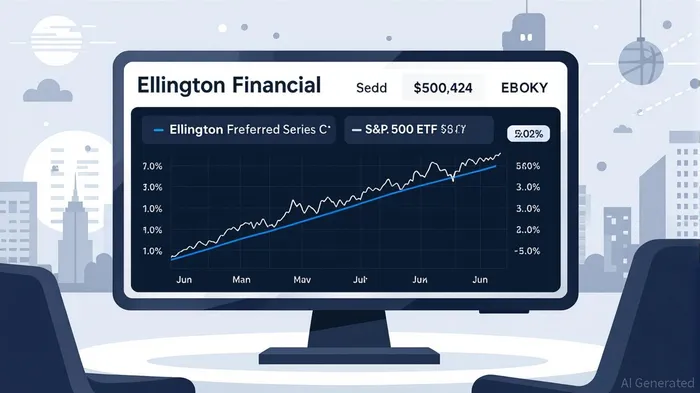
The 8.625% yield of EFC.PR.C, locked in until April 2028, is undeniably attractive in a low-interest-rate environment. At a current price of $25.27, the shares trade at a discount to their liquidation value, offering a margin of safety for investors [1]. However, this yield must be contextualized against the broader market. Over the past year, EFC.PR.C has delivered a modest 7.5% price return, lagging behind the S&P 500’s 19.4% gain [1]. This underperformance raises questions about the trade-off between yield and capital appreciation.
The high yield is partly a reflection of Ellington Financial’s (EFC) capital structure. As a real estate investment trust (REIT), EFC relies heavily on debt financing, with a debt-to-equity ratio of 8.93 [1]. While this leverage amplifies returns in favorable conditions, it also heightens vulnerability during downturns. The company’s recent financial results, however, offer some reassurance. In Q2 2025, EFC reported adjusted distributable earnings (ADE) of $0.47 per share, comfortably covering its $0.39 common dividend [2]. This suggests that, at least for now, the firm can sustain its payout.
Structural Risks and Dividend Sustainability
The sustainability of EFC.PR.C’s dividend hinges on EFC’s ability to maintain profitability amid shifting market conditions. Over the past five years, EFC’s payout ratio averaged 85%, but projections for 2025 suggest it could rise to 111% [2]. Such a trajectory is unsustainable in the long term, particularly given the company’s high leverage and exposure to interest rate fluctuations.
A closer look at EFC’s balance sheet reveals further concerns. Its net margin of 49.64% [1] is impressive, but this profitability is offset by a Piotroski F-Score of 3, indicating weak financial health. The firm’s reliance on securitization—a key driver of its revenue—also introduces volatility. While EFC executed six securitizations in Q2 2025 to optimize its balance sheet [2], a slowdown in this activity could strain earnings.
Historical precedents add nuance to the analysis. In 2017, EFC reduced its preferred dividend by 9% to free up capital for new investments [1]. Management has since emphasized that the common dividend would be the first to be cut in times of financial stress [2], a strategy that prioritizes preferred shareholders but risks eroding investor confidence in the common equity.
The Case for Caution
While EFC.PR.C’s yield is compelling, investors must weigh it against the risks. The company’s high debt load and elevated payout ratio create a precarious margin for error. A sharp rise in interest rates or a downturn in the housing market could force EFC to curtail dividends, as it did in 2017. Moreover, the preferred shares’ performance relative to the broader market underscores their sensitivity to macroeconomic shifts.
That said, EFC’s recent operational flexibility—such as pausing securitizations during April 2025 volatility [2]—demonstrates management’s ability to adapt. The firm’s diversified investment portfolio and strong book value growth (now $13.49 per share [2]) also provide a buffer. For investors with a medium-term horizon and a tolerance for risk, EFC.PR.C could offer a compelling income stream, provided they monitor the company’s leverage and earnings closely.
Conclusion
Ellington Financial’s Preferred Series C presents a tempting yield for income-focused investors, but its sustainability is far from guaranteed. The 8.625% dividend is supported by strong distributable earnings and a disciplined capital structure, yet the company’s high leverage and volatile revenue streams pose significant risks. Investors must balance the immediate appeal of the yield against the long-term viability of EFC’s business model. In a market where high yields often come with hidden costs, due diligence is paramount.
Source:
[1] EFC.PR.C Stock Quote | Price Chart | Volume Chart [https://marketchameleon.com/Overview/EFC-C/Summary/]
[2] Ellington Financial Inc.EFC-- (EFC) Q2 FY2025 earnings call transcript [https://finance.yahoo.com/quote/EFC/earnings/EFC-Q2-2025-earnings_call-344274.html/]





Comentarios
Aún no hay comentarios