
Asymmetric Opportunities in Tech and Energy: Riding Sector Rotations Amid AI and Infrastructure Shifts
The global economy is at a crossroads, with AI-driven tech growth clashing against the energy transition's infrastructural demands. Amid this divergence, investors face a critical choice: remain anchored to overbought tech titans or pivot to undervalued energy and infrastructure plays. This article dissects three key catalysts—NVIDIA's $4 trillion valuation, AES's sale speculation, and Merck's acquisition of VeronaVRNA-- Pharma—to reveal asymmetric risk-reward opportunities.
NVIDIA: The $4T "Golden Child" of AI—Justified or Overvalued?
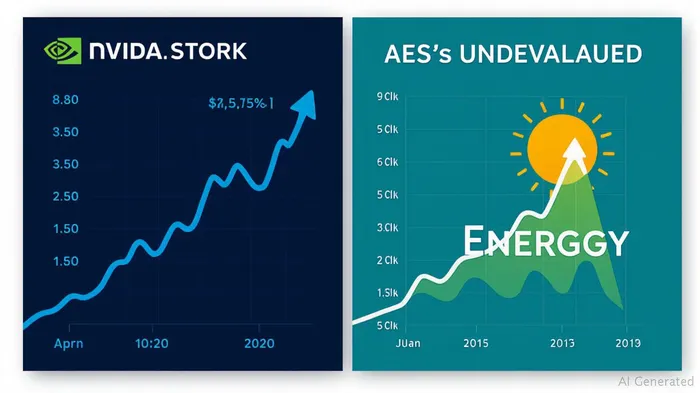
NVIDIA's surge to a $4 trillion market cap (as of July 2025) epitomizes the AI revolution's power. Driven by surging demand for its GPUs in data centers, the stock has risen 150% since early 2023, with revenue growth hitting 70% year-on-year. Yet, this valuation rests on precarious assumptions:
The Case for NVIDIA:
- Dominance in AI Infrastructure: NVIDIANVDA-- controls 90% of the data center GPU market, with cloud giants like MicrosoftMSFT-- and AmazonAMZN-- reliant on its chips.
- Valuation Metrics: While its forward P/E of 33x is high, it aligns with revenue growth (projected $200B by 2026).
- Risks: Geopolitical headwinds—U.S. export curbs on China alone cost $8B in lost sales—and potential AI hype cycles could curb growth.
Investment Thesis:
NVIDIA's valuation is a bet on AI's permanence. For aggressive investors, its upside remains, but the risk-reward skew is narrowing. Consider hedging via put options or rotating profits into undervalued sectors.
AES Corporation: The Undervalued Renewable Play with M&A Catalysts
AES, a global renewables operator, trades at 64% below its intrinsic value, despite owning 16GW of wind, solar, and storage assets. Recent speculation about a potential sale—driven by private equity interest—has sparked a 14% stock surge.
Why AES Stands Out:
- Strategic Assets: Its 11.7GW contracted project backlog (5.3GW under construction) aligns with tech firms' need for sustainable power to fuel AI data centers.
- DCF Potential: A $20/share fair value vs. $11/share current price implies 80% upside if bought out.
- Risks: High debt ($30.6B) and regulatory delays in projects like Colombia's thermal plants.
Investment Thesis:
AES is a classic asymmetric play. A takeover bid could unlock $18–20/share, while downside is limited by its asset-rich balance sheet. Pair long positions with put options to protect against execution risks.
Merck & Verona Pharma: The Pharma M&A Play with Synergies
Merck's acquisition of Verona Pharma—a small-cap player in respiratory therapies—highlights a broader trend: Big Pharma is consolidating to fund R&D and offset patent cliffs. While specifics on Verona's valuation are scarce, such deals often yield synergies:
Why It Matters:
- Strategic Value: MerckMRK-- gains access to Verona's inhaled therapies, expanding its respiratory portfolio.
- Sector Rotation: As tech cools, pharma's steady cash flows and M&A-driven growth offer stability.
Investment Thesis:
Pharma's undervalued mid-caps with strategic assets (like Verona) are ripe for acquisition. Look for companies with late-stage pipelines or niche therapies—these could be Merck's next targets.
Sector Rotation: The Playbook for 2025
- Rotate Out of Overbought Tech: While NVIDIA's AI tailwinds persist, its valuation demands flawless execution. Use profit-taking to rebalance portfolios.
- Overweight Renewable Infrastructure: AESAES-- and peers offer asymmetric upside in an energy transition boom.
- Diversify into Pharma M&A: Small-caps with unique assets will be acquisition targets in 2025–2026.
Actionable Strategies:
- Tech: Sell NVIDIA calls to lock in gains while retaining exposure.
- Energy: Buy AES paired with put options; add to renewable ETFs (e.g., ICLN).
- Pharma: Screen for mid-caps with R&D synergies and bid for them pre-M&A.
Conclusion: The New Asymmetry
The market's winners are no longer purely tech darlings but those bridging AI's future with infrastructure's present. NVIDIA's $4T tag is a testament to growth, but its risks are now overt. Meanwhile, AES and pharma M&A plays offer asymmetric upside—cheap assets in undervalued sectors, ready to soar on catalysts. The question is no longer whether to rotate but how quickly to do it.





Comentarios
Aún no hay comentarios