
Asterion (ASTER) Institutional Adoption and Market Implications
In the volatile world of cryptocurrency, whale activity often serves as a barometer for institutional sentiment and market direction. Recent developments in Asterion (ASTER) underscore this dynamic, with large-scale transactions by prominent wallets signaling robust institutional adoption and offering critical insights for retail investors.
Whale Accumulation and Institutional Signals
According to a Markets FinancialContent report, a significant on-chain event occurred on October 6, 2025, when the wallet address 0xfE5A executed a $3.16 million accumulation of 1.69 million ASTERASTER-- tokens. This transaction was part of a broader trend: over the preceding weeks, major wallets withdrew and redeposited ASTER in volumes exceeding $10 million, with 0xFB3B alone withdrawing 5 million ASTER ($9.9 million) from Gateio on September 26, according to a Blockchain.News alert. Notably, 0xFB3B is linked to blockchain pioneer Daniel Larimer and Galaxy DigitalGLXY--, which later deposited 10.18 million ASTER ($10.18 million) into a Binance address tied to Larimer, as noted in the Markets FinancialContent report. These movements suggest strategic positioning by institutional actors, who often use such transactions to secure liquidity or hedge against market volatility.
The implications for ASTER's price dynamics are profound. Large-scale purchases by whales absorb available liquidity, often triggering upward price momentum. On-chain metrics such as the On-Balance-Volume (OBV) and Accumulation/Distribution Line (A/D) likely reflected strong buying pressure during this period, as noted in the Markets FinancialContent report. For instance, between September 20 and 21, three whale wallets accumulated over $10 million in ASTER, with the largest single withdrawal totaling 7.04 million ASTER ($4.66 million), according to a Coinfomania report. Such activity tightens ASTER's liquidity, potentially supporting long-term price appreciation by reducing the circulating supply available for trading.
Market Implications and Retail Opportunities
Whale activity also acts as a leading indicator for retail investors. When institutional players accumulate assets, they often signal confidence in an asset's fundamentals or macroeconomic narrative. In ASTER's case, the fact that two major wallets now hold 123.25 million ASTER ($227 million)-representing 7.44% of the circulating supply-suggests a structural shift in market sentiment, as reported in the Blockchain.News alert. This concentration of holdings, while typically a red flag in speculative assets, appears justified here by the involvement of reputable entities like Galaxy Digital and the strategic redeposits into major exchanges such as Binance, per the Markets FinancialContent report.
Retail investors should, however, remain cautious. While whale accumulation can drive upward momentum, it also introduces short-term volatility. For example, the "Cooker" whale sold 575,045 ASTER ($1.18 million) in USDCUSDC-- and used the proceeds for leveraged positions in other tokens, as reported by Blockchain.News. Such behavior highlights the dual role of whales as both builders and destabilizers of market equilibrium. Retail participants must distinguish between accumulation (a sign of confidence) and distribution (a signal of profit-taking) to avoid being caught in abrupt reversals.
Strategic Positioning and Broader Trends
The September 28 accumulation of 118.25 million ASTER ($270.8 million)-equivalent to 7.13% of the circulating supply-further reinforces the narrative of institutional confidence, according to the Blockchain.News alert. This transaction, attributed to two high-profile addresses, aligns with broader trends of institutional capital seeking exposure to high-growth crypto assets. The timing of these moves, coinciding with ASTER's listing on major exchanges, suggests a coordinated effort to stabilize the token's price and attract retail demand.
For retail investors, the key takeaway is to monitor whale activity through on-chain analytics tools and interpret it within the context of broader market conditions. While large transactions by themselves are not guarantees of success, they provide actionable signals when combined with fundamental analysis of ASTER's ecosystem and use cases.
Conclusion
Whale activity in Asterion (ASTER) offers a compelling case study in how institutional adoption can shape market dynamics. The recent accumulation patterns, particularly those involving verified entities like Daniel Larimer and Galaxy Digital, suggest a maturing market where large players are laying the groundwork for sustained growth. For retail investors, these movements represent both an opportunity and a cautionary tale: the ability to decode whale behavior can unlock alpha, but it requires a disciplined approach to risk management and market timing.
As the crypto market continues to evolve, the interplay between institutional and retail capital will remain a defining feature. In ASTER's case, the current trajectory-marked by strategic accumulation and liquidity management-points to a potentially transformative phase for the asset.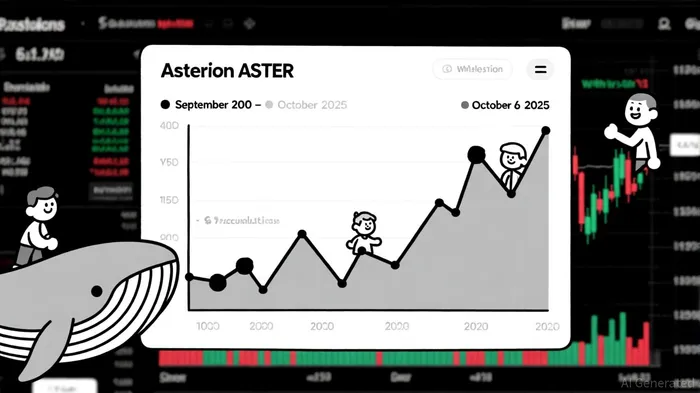





Comentarios
Aún no hay comentarios