
Assessing the Impact of Price Wars on High-Profile Sectors: Gold Mining, EVs, and Fast Food
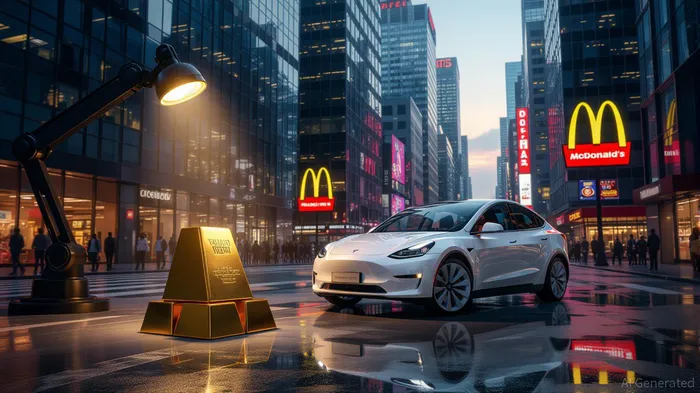
The global economy in 2025 is defined by relentless pricing pressures, forcing companies across high-profile sectors to adapt or risk obsolescence. Gold mining, electric vehicles (EVs), and fast food—industries with divergent operational models—face unique challenges yet share a common thread: the need to balance margin preservation with strategic innovation. This analysis evaluates how Kinross Gold CorporationKGC-- (KGC), TeslaRACE-- (TSLA), and McDonald’sMCD-- (MCD) are navigating these pressures, their valuation metrics, and whether their strategies create compelling investment opportunities or risks.
Gold Mining: KGC’s Resilience in a Volatile Commodity Market
Kinross Gold Corporation (KGC) has emerged as a standout performer in 2025, leveraging robust gold prices and operational efficiency to deliver record free cash flow of $646.6 million in Q2 [1]. With a trailing P/E ratio of 16.98 and a forward P/E of 13.01 [6], KGCKGC-- appears undervalued relative to its peers, supported by a strong liquidity position of $2.8 billion and a dividend yield of 0.57% [3]. The company’s strategy of returning $650 million to shareholders through buybacks and dividends underscores its confidence in sustaining margins, even as gold prices stabilize [1].
However, KGC’s success hinges on the sustainability of current gold prices and its ability to manage production costs. While the sector benefits from macroeconomic tailwinds (e.g., inflation hedging and geopolitical uncertainty), overreliance on a single commodity exposes KGC to cyclical risks. Investors must weigh its low valuation against potential volatility in gold markets.
EVs: Tesla’s Struggle to Stabilize Margins
Tesla’s Q2 2025 results highlight the existential challenges facing the EV sector. Revenue fell 12% year-over-year to $22.5 billion, driven by declining average selling prices (ASPs) and rising logistics costs [1]. With a P/E ratio of 176.65 and an EV/EBITDA of 90.74 [2], Tesla’s valuation appears stretched relative to its earnings performance, raising questions about its premium pricing in a saturated market.
To counteract these pressures, Tesla has introduced cost-cutting measures, including a redesigned Model Y with 20% lower production costs and automation via Optimus robots [1]. Supply chain localization and AI-driven efficiency are critical to its long-term viability, yet the company faces fierce competition from Chinese EVs like BYD and NIONIO--, which undercut Tesla’s prices [1]. Additionally, geopolitical risks tied to CEO Elon Musk’s political affiliations could erode brand trust, particularly in Europe [4].
Tesla’s $30.4 billion cash reserves provide a buffer, but its reliance on innovation (e.g., Full Self-Driving subscriptions) to drive growth remains unproven. For investors, the key question is whether Tesla can reassert its dominance in a market where margins are collapsing and rivals are scaling faster.
Fast Food: McDonald’s Value-Driven Resilience
McDonald’s (MCD) has mastered the art of navigating pricing pressures through value leadership. In 2025, the company reported a 3.8% global same-store sales increase, supported by initiatives like the $5 meal deal and region-specific promotions (e.g., McSmart in Australia) [1]. Its 47% adjusted operating margin and 2.25% dividend yield [2] reflect a franchise model that prioritizes operational efficiency and customer retention.
MCD’s valuation metrics—trailing P/E of 26.87 and EV/EBITDA of 19.63 [2]—suggest a balanced approach to growth and profitability. The company’s digital innovations, including AI-driven loyalty programs, further insulate it from commodity cost swings by encouraging frequent visits [5]. However, rising labor and supply chain costs could pressure margins in 2026, particularly as expansion plans (e.g., 10,000 new locations by 2027) strain resources [5].
Strategic Positioning and Investment Implications
The contrasting strategies of KGC, TSLATSLA--, and MCDMCD-- reveal sector-specific dynamics:
- KGC benefits from a defensive commodity and disciplined capital returns but faces cyclical risks.
- TSLA is overvalued relative to its earnings yet retains growth potential through innovation and market leadership.
- MCD combines a resilient franchise model with value-driven customer retention, offering a stable dividend and moderate growth.
Conclusion
Investors must assess these companies through the lens of risk tolerance and market outlook. KGC’s low valuation and gold market tailwinds make it a compelling defensive play, while TSLA’s high valuation demands a long-term bet on technological dominance. McDonald’s, with its balanced approach to value and innovation, offers a middle ground for those seeking stability amid sector-wide turbulence.
Source:
[1] KinrossKGC-- reports strong 2025 second-quarter results [https://www.kinross.com/English/news-and-investors/news-releases/press-release-details/2025/Kinross-reports-strong-2025-second-quarter-results/default.aspx]
[2] Tesla (TSLA) Statistics & Valuation [https://stockanalysis.com/stocks/tsla/statistics/]
[3] Earnings call transcript: Kinross GoldKGC-- Q2 2025 shows strong cash flow [https://www.investing.com/news/transcripts/earnings-call-transcript-kinross-gold-q2-2025-shows-strong-cash-flow-93CH-4163589]
[4] Musk warns of 'rough' quarters ahead amid Tesla revenue [https://www.cfodive.com/news/musk-warns-rough-quarters-ahead-tesla-revenue-auto-shareholders/753985/]
[5] McDonald’s Value-Based Strategy to Boost Growth by 2025 [https://visiblealpha.com/blog/mcdonalds-value-strategy-to-boost-growth-by-2025/]
[6] Kinross Gold (TSX:K) Statistics & Valuation Metrics [https://stockanalysis.com/quote/tsx/K/statistics/]





Comentarios
Aún no hay comentarios